46
83507013 Rev G
3.9.10 Multiple Load Connection with Distribution Terminals
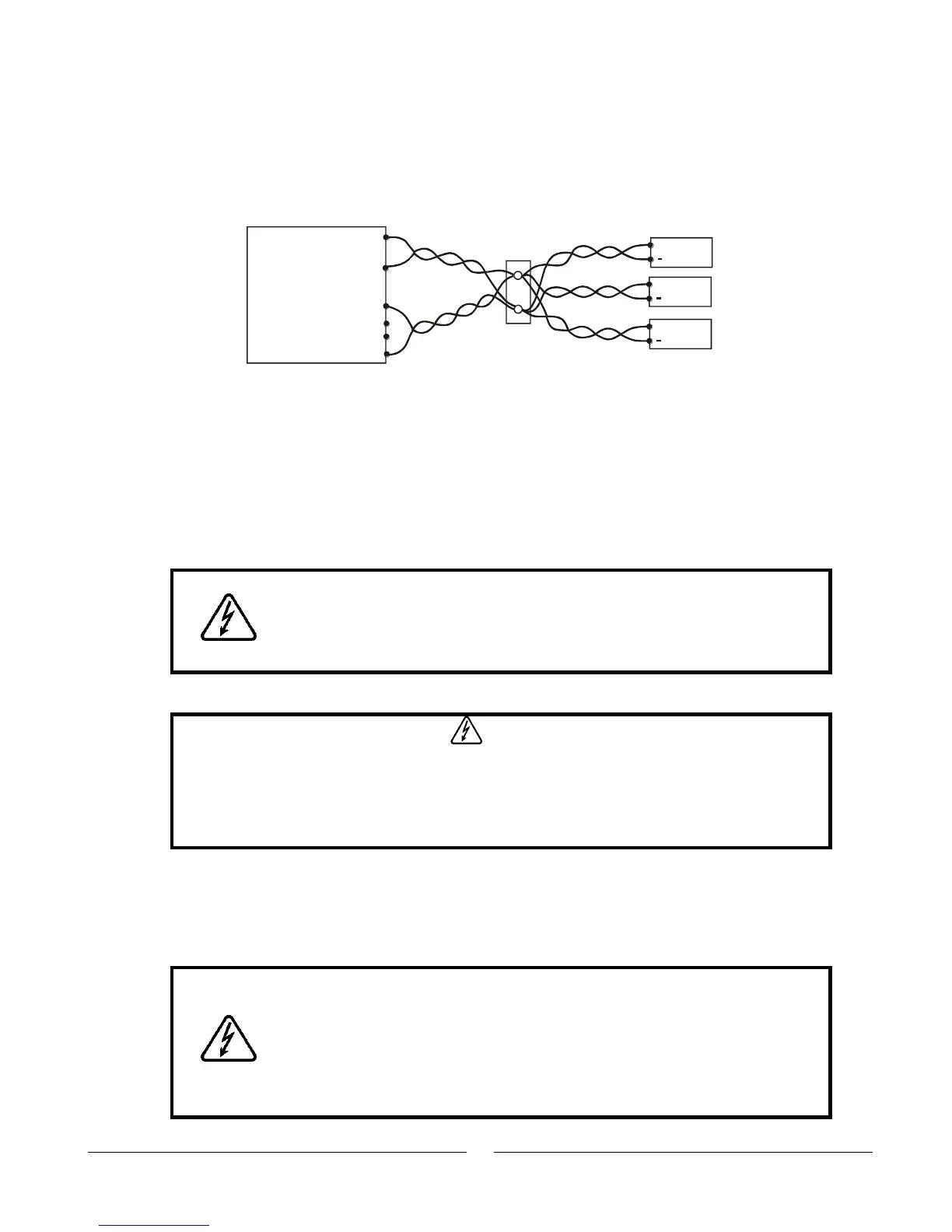
If remotely located output distribution terminals are used, the power supply output
terminals should be connected to the distribution terminals by pair of twisted and/or
shielded wires. Each load should be separately connected to the remote distribution
terminals (see Fig.3-13). If remote sensing is required, the sensing wires should be
connected to the distribution terminals or at the most critical load.
-
-
Rem.sense
Local sense
ocal sense
Rem.sense
+L
+
Distribution terminal
+V
+V
-V
-V
Load#1
+
Load#3
+
Load#2
+
Power
Supply
Fig.3-13: Multiple loads connection with distribution terminal
Fig. 3-13: Multiple loads connection with distribution terminal
3.9.11 Grounding Outputs
Either the positive or negative output terminals can be grounded. To avoid noise
probems caused by common-mode current flowing from the load to ground, it is
recommended to ground the output terminal as close as possible to the power supply
chassis ground. Always use two wires to connect the load to the power supply
regardless of how the system is grounded.
WARNING
Models up to 60VDC Rated Output shall not float outputs more than
+/-60VDC above/below chassis ground. Models > 60VDC Rated
Output shall not float outputs more than +/-600VDC above/below
chassis ground.
WARNING
OUTPUT TERMINAL GROUNDING
There is potential shock hazard at the RS232/485 and the IEEE ports when using
power supplies with rated or combined voltage greater than 400V with the Positive
Output of power supplies is grounded. Do not connect the Positive Output to
ground when using the RS232/485 or IEEE under the above conditions.
3.10 Local and Remote Sensing
The rear panel J2 sense connector is used to configure the power supply for local or remote
sensing of the Output Voltage. Refer to Fig.3-14 for sense connector location.
3.10.1 Sense wiring
WARNING
There is a potential shock hazard at the sense connector when using
a power supply with a rated Output Voltage greater than 40V. Local
sense and remote sense wires should have a minimum insulation
rating equivalent or greater than the maximum Output Voltage of the
power supply. Ensure that the connections at the load end are
shielded to prevent accidental contact with hazardous voltages.



 To Next Page