4-6
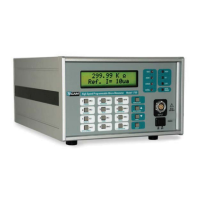
Model 3550 LCR Meter Instruction Manual Operating Instructions
Measurement Tips cont’d:
Measurement Signal Levels
Measurement signal levels are adjustable between 0.01V~5.00V. It is recommended that the
voltage level be kept at a high value (usually 1V or larger) to avoid potential stability problems
associated with test frequency, device impedance and noise.
Series or Parallel Circuit Modes
The "CIRCUIT MODE" should always be "AUTO" mode, unless there is a special circumstance that
requires otherwise. The 3550 is in the AUTO circuit mode when the pushbutton’s LED is
illuminated. Manually setting the circuit mode should only be done in special circumstances where
series or parallel measurement is necessary even if some discrepancy is known to occur.
Auto Range Switching Threshold
When using Auto Range for measurement, the relationship between the switching direction and
indicated switching values are as follows: (When Dissipation Factor: D=0)
Range UP When|Z|19999 counts
Range DOWN When|Z| 17999 counts
As the dissipation factor, D increases then these threshold values will change.
Display Resolution
The absolute impedance, |Z| of the DUT determines the range of the 3550. All subsequent
measurements will display with a resolution that is consistent with the instrument’s current range
setting.
AC Resistance of Coils with Cores
In most cases the AC resistance of a coil with no core at low frequencies is the same as the DC
resistance. This is not the case for coils with high permeability cores such as ferrite or iron. Higher
permeability will promote core losses from an AC signal causing the resistance measurement to
appear larger than it would be for a DC measured resistance value. Therefore, an inductance
measurement taken at 42Hz (the lowest frequency setting of the 3550) will not necessarily reflect
a DC equivalent resistance value.


 To Next Page