Aligna
®
4D User Manual
12 / 84
4 Principles of Laser Pointing Stabilization
4.1 Reasons of Pointing Instabilities
Laser beams, used in an experiment or in industrial applications, can move in space by many
reasons. Even small movements at the laser outlet may result in rather large movements of
the laser spot, depending on the distance to the target, and on the optical components in the
beam path. In the following, some of the most important reasons of pointing instabilities will be
named.
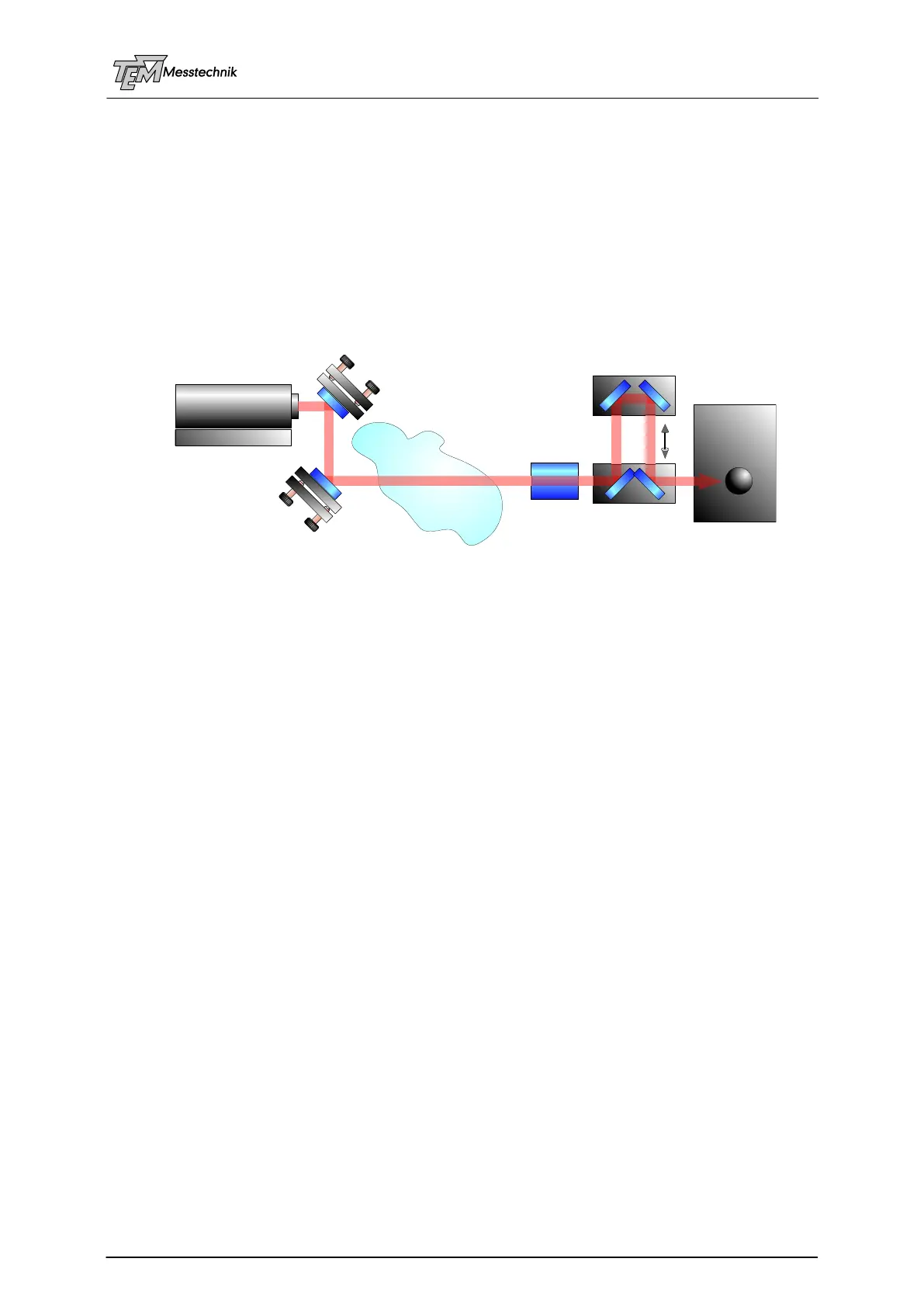
Reasons of Pointing Instabilities
4.1.1 Thermal properties of the laser itself
Often a high local power is dissipated in a small spatial region; even small thermal movements
can be transformed by collimating lenses of short focal lengths to relatively large angle move-
ments. Local heating may be caused by pump diodes, by gas discharges, flash lamps, or by
electrical excitation of the laser medium itself.
4.1.2 Thermal movement by the laser cooling system
If the laser medium is producing heat the laser is often cooled by Thermo-Electric Coolers
(TEC, Peltier elements), by fans or by a water cooling system. Those techniques produce
temperature gradients within the mechanical setup. If the development of the device is not
done in a perfectly temperature compensated manner, position and angle changes will result.
Even if the laser medium itself is stabilized and held at an exact constant temperature the
cooling system has to react on changing temperatures of the environment and it has to com-
pensate for the temperature change of the heat sinks. This will lead to pointing drifts.
4.1.3 Drifts of alignment and folding mirrors
Adjustment tools and element holders typically consist of different materials: Aluminum, stain-
less steel, brass and other materials, with different thermal expansion coefficients each.
Caused by a change of the environment temperature the different thermal expansions can
lead to position and –more critical- angle movements of the laser beam. The strength of these
effects strongly depends on the construction, the materials, and –of course- on the tempera-
ture variations of the environment.
4.1.4 Air turbulences and temperature gradients in the air
Air fluctuations may cause large pointing fluctuations, particularly at long distances. But even
one meter distance can produce pointing fluctuations in the order of some ten microns, which
may be too much for critical applications. Air fluctuations often play the main role in beam
pointing instabilities, especially at long distances between laser and target of several meters or
even several tens or even hundreds of meters. Using evacuated tubes for beam guiding over
Laser
Cooling System
1: thermal drifts
inside the laser,
movements by
frequency detuning,
by power variation
2: thermal drifts
of cooling system
and mechanical mounts
3: drifts of alignment
and folding mirror
holders
4: air fluctuations and
temperature gradients
6: moved optical elements
(delay lines, switching mirrors,
motorized telescopes,...)
7: Movement of the experimental
(optical) tables or vacuum chambers
5: thermal effects in
optical elements and
mirrors
Target



 To Next Page