Aligna
®
4D User Manual
14 / 84
4.2 2D or 4D Stabilization?
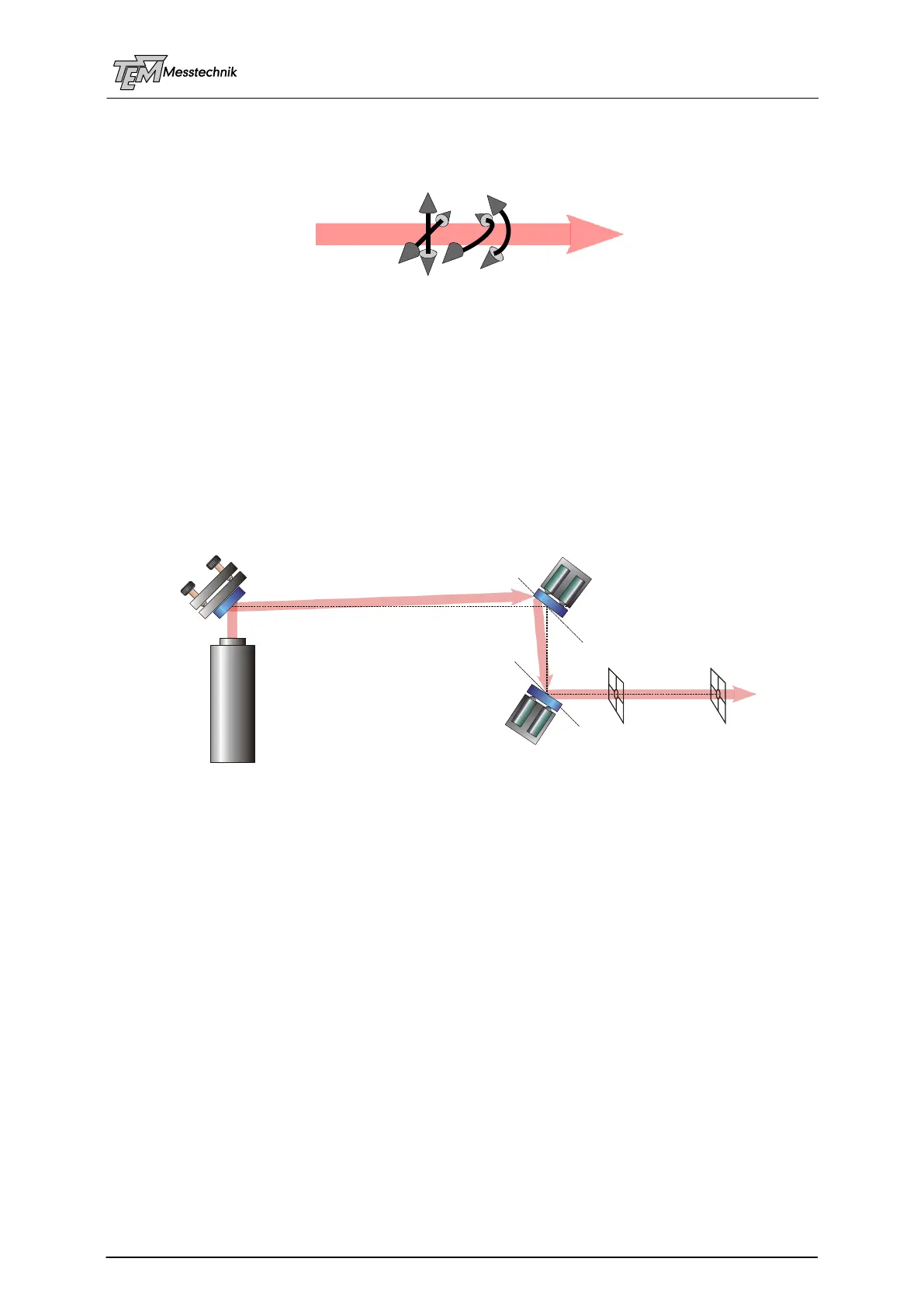
The movement of a collimated beam can be separated into four dimensions: two translational
("X", "Y") and two rotational ("", "")
These degrees of freedom are not really independent: If, for example, one mirror holder drifts
by 100 µrad due to the change of the room temperature the translation error of some µm will
be negligible compared to the beam diameter of let's say some mm close to the mirror. After
one meter free propagation, however, this leads to a movement of 0.1 mm, after 10 meters
this is 1 mm, which is really not negligible any more. (Note: the angle drift is not directly de-
pendent on the propagation length in this example. In reality, however, angle fluctuations due
to air fluctuations increase with the length with a factor of sqrt(L))
Even if the nature of the drift (in this example) is a pure angle drift (just 2D) it leads to a com-
bination of angle and position movement after a distance of propagation (near the experiment)
and cannot be compensated for by one single 2D moving mirror. It has to be compensated for
with a combination of position and angle correction, e.g. by two 2D moved mirrors.
In many applications it is not really necessary to keep the laser beam fixed both in position
AND direction at the place of the experimental target. In the case of laser material processing,
for example, it is very important to keep the focused laser spot at an exactly defined position at
the target surface. The angle, however, is not that critical. So one could think, a 2D correction
might be sufficient. A beam splitter (also called beam sampler) separates a small part of the
main beam. This part is handled exactly as the main beam (distances, focusing elements, etc.).
If the laser spot is actively held fixed by the actuator at the detector position, it will be fixed in
the plane of the target, too.
Laser
drifting mirror angle
compensation by a combination
of position and angle
reference direction
and position



 To Next Page