Aligna
®
4D User Manual
26 / 84
(If the mirror was located far away from the laser -or the main source of drift, resp.- the beam
might not hit the mirror due to even small miss-alignments or drifts.)
The laser itself may have pointing drifts.
Additional drifts and fluctuations will
appear along the long beam path.
The angle of the target beam is given
by the long distance and the position,
stabilized at the PSD. Thus, the angle is
not directly stabilized, but the beam
position at the target table.
5.3 4D System
In many experiments and applications the target is both sensitive to angle AND position of the
laser beam. In this case, a PSD4D can be used. (As discussed before the measurement of all
four degrees of freedom, Angle X/Y and Position X/Y, INDEPENDET from each other results
in a much better precision, than measurement of two positions along the beam path. Of course,
the Aligna system also can be used measuring two positions, using two PSD2D. However, this
normally is not recommended, only if other "far field" focusing is available and used for detec-
tion in the optical setup.)
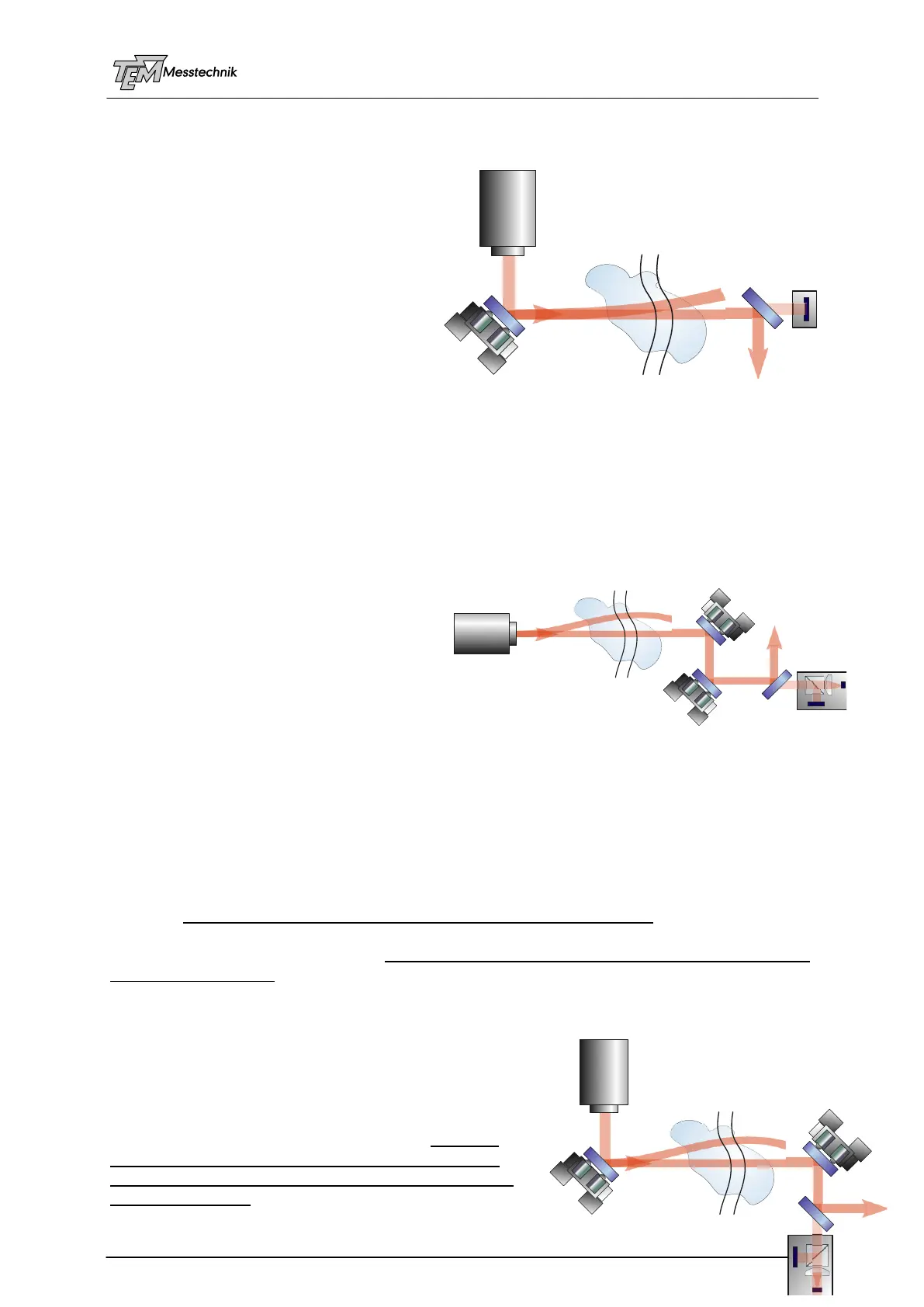
Sometimes it is necessary to place the two
active mirrors, used for correcting the 4D
pointing, close to the target. However, this
is not the best situation: In the case of a
long beam path, rather high position fluc-
tuations will occur.
(The position fluctuation and drifts are
calculated by the angle fluctuations, and
drifts at the laser position, multiplied with
the beam path length, while the angle fluctuations are not directly scaling with the beam path
length. Of course, additional angle fluctuations occur by air fluctuations along the beam path.
But even these additional fluctuations are multiplied by the beam path length, depending on
the position of their origin.
Therefore, in laser systems with long beam paths the ratio between position fluctuations
against angle fluctuations is rather high.
For compensation of position fluctuations, both mirrors have to perform the same angle, how-
ever with different sign. The amount of mirror movement is reverse proportional to the mirror
distance: the longer the distance, the smaller the necessary movements. However, the larger
the absolute angle movement, the larger the absolute residual angle error of the servo loop will
be (due to limited servo bandwidth). Because of that a large distance between the active mir-
rors is recommended,
5.4 4D System with Long Beam Path
As explained, a long distance between the mirrors
leads to small residual angle errors, which corre-
sponds to smallest possible target position errors.
As a result, for best dynamic performance in setups
with long laser beam paths one active mirror should
be located near the laser, the other should be located
close to the target.
M1
2D System
MoPiA
PSD 2D
Laser
(or PSD 4D)
BSM
M1
M2
4D System
MoPiA
MoPiA
Laser
BSM
PSD 4D
M1
M2
4D System
both active mirrors
close to target
MoPiA
MoPiA
Laser
BSM
PSD 4D



 To Next Page