Aligna
®
4D User Manual
15 / 84
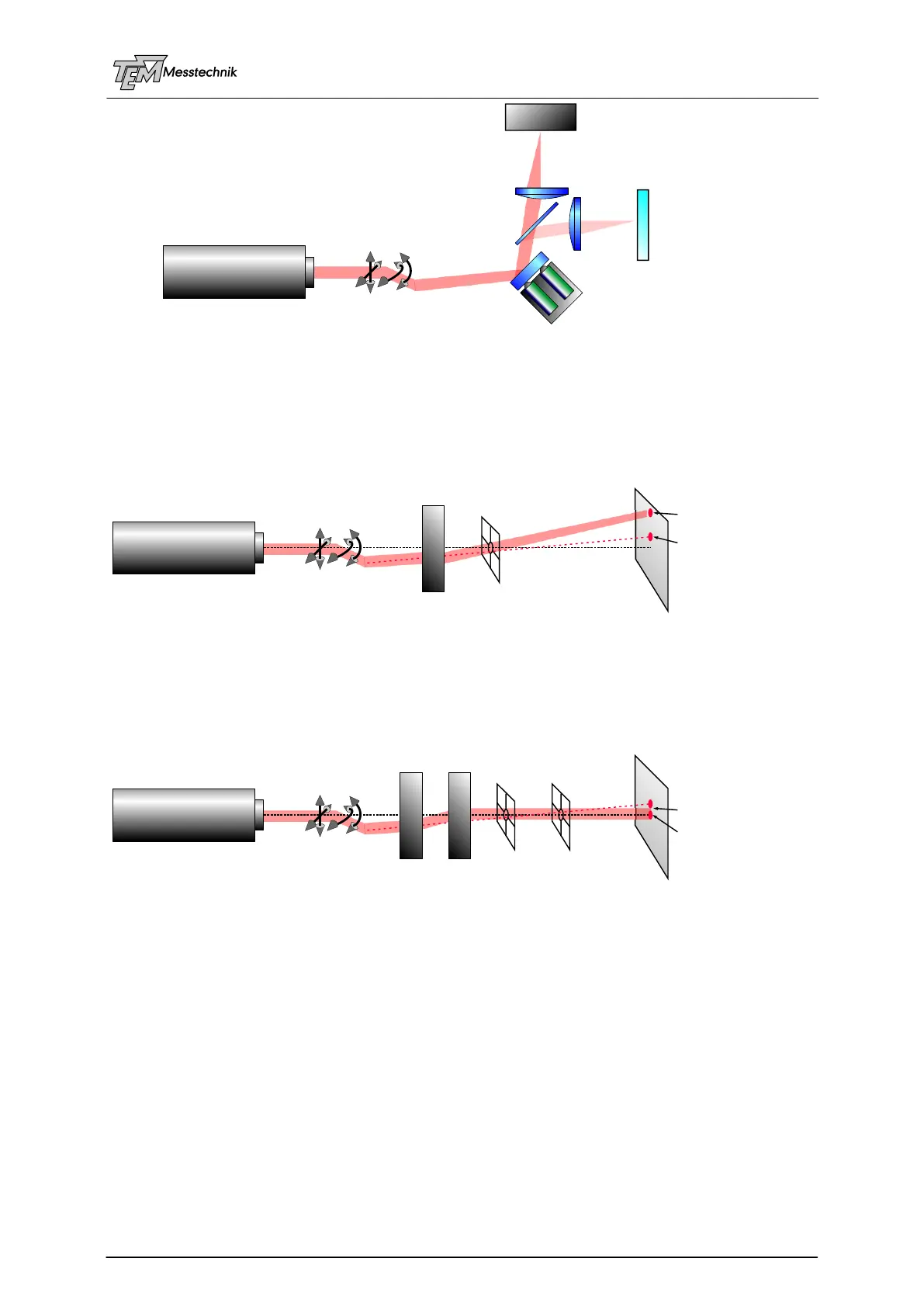
In principle this works. But: The detector has to be positioned in an exact (!) image of the
target. Therefore it has to be aligned mechanically very well. Often it is difficult to find the
correct Z-position for the detector. If this Z-position of the detector is wrong the stabilization
can even ENLARGE the pointing fluctuations, compared to the situation WITHOUT any stabili-
zation!
This shows: the fixed point of a laser beam has to be well matched with the target require-
ments. In normal cases this needs additional optics in the detection path, corresponding to the
main optics and distances in the main path, and it needs a precise and critical alignment of the
detector and the related optics.
With a 4D stabilization, in contrast, two points of the beam are fixed in space, instead of one
point in case of 2D. As a result, ALL points of the output beam are fixed. For this it is not im-
portant WHICH two points are fixed. They only have to have a certain distance from each
other to get enough resolution for the angle measurement. The Z-positions of the detectors are
not critical. They can be positioned within a coarse spatial range and need not to be aligned
precisely.
If PSDs are used (not quadrant detectors, see description on "detectors", “PSDs or QUAD
detectors”) it is not important to hit exactly the center of the detectors: PSDs create a linear
signal proportional to the spot position within the detector area, independent of the spot size
and of the spot shape. (In contrast, quad detectors can only be used exactly in the physical
center of the detectors; they show a strong dependence of the position error signal from the
spot size and shape.) Thus PSDs do not have to be aligned precisely in X and Y position,
because the servo loop (the user, respectively) can select the working point by applying an
electronical DC set point signal (X and Y, and ) to the regulator electronics. (Thus even the
stabilized beam can be scanned quickly and precisely.)
X
Y
Laser
Target
Beam Splitter
Pointing Drifr and Fluctuations
2D Position Detector
in the position
of an image of the target
X
Y
Laser
2D steering element
(tilting mirror, e.g.)
ONE fixed point
of the beam
without stabilization
with stabilization
X
Y
Laser
two 2D steering element
(tilting mirrors, e.g.)
two fixed points
of the beam
without stabilization
with 4D stabilization



 To Next Page