14
Hydraulic Brake Systems
CHECKING/BLEEDING
The hydraulic brake systems have been filled and bled at
the factory. To check and/or bleed a hydraulic brake sys-
tem, use the following procedure:
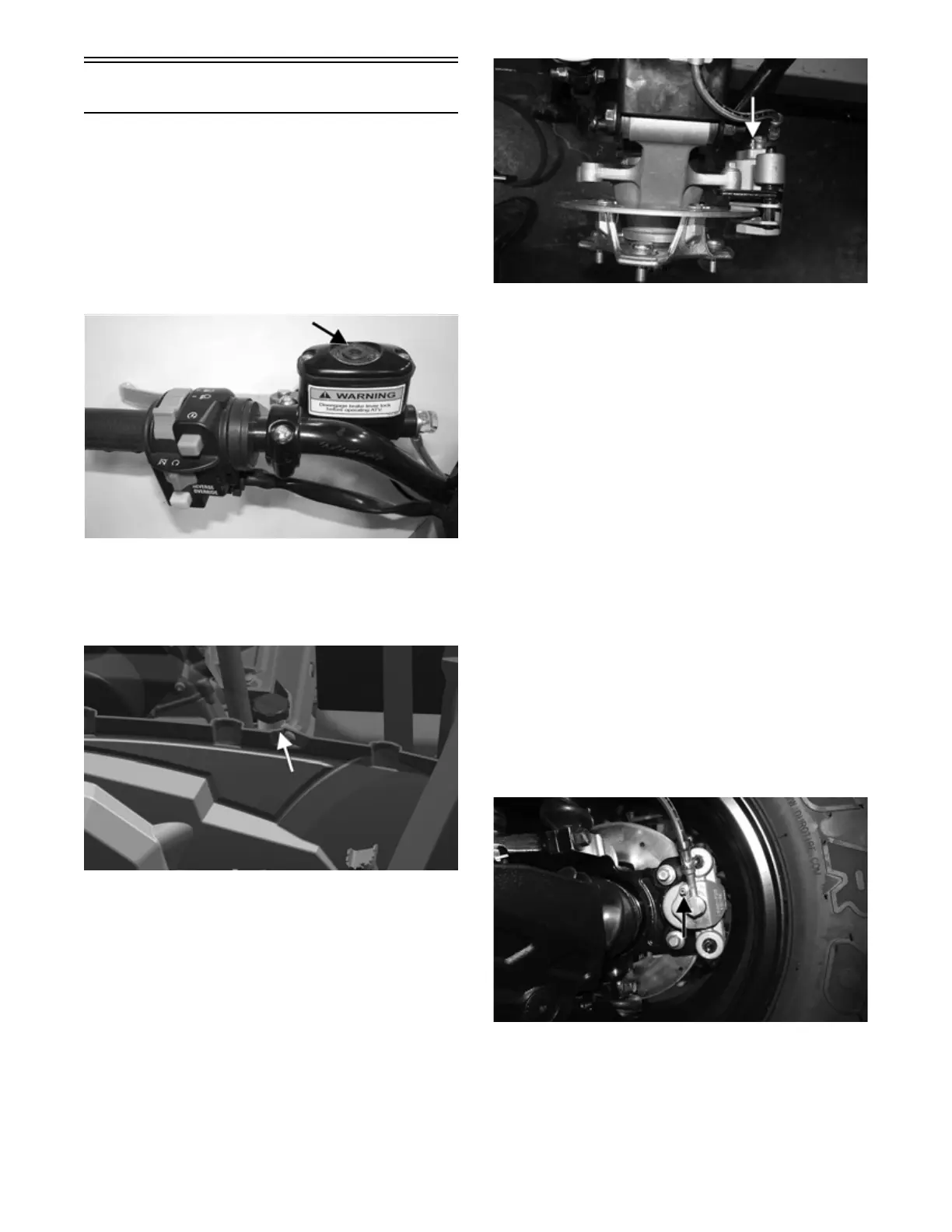
1. With the master cylinder in a level position, check
the fluid level in the reservoir. On the hand brake if
the level in the reservoir is adequate, the sight glass
will appear dark. If the level is low, the sight glass
will appear clear.
CF295A
2. On the auxiliary (rear) brake, the level must be
between the MIN and MAX lines on the reservoir.
NOTE: The brake fluid reservoir is located behind
the right-side panel.
OHA023A
3. Compress the brake lever/pedal several times to
check for a firm brake. If the brake is not firm, the
system must be bled.
4. To bleed the main brake system, use the following
procedure:
A. Remove the cover and fill the reservoir with DOT
4 Brake Fluid; then install and secure the cover.
B. Slowly compress the brake lever several times.
C. Remove the protective cap, install one end of a
clear hose onto the REAR bleeder screw, and direct
the other end into a container; then while holding
slight pressure on the brake lever, open the bleeder
screw and watch for air bubbles. Close the bleeder
screw before releasing the brake lever. Repeat this
procedure until no air bubbles are present.
XR167A
NOTE: During the bleeding procedure, watch the
sight glass very closely to make sure there is always a
sufficient amount of brake fluid. If low, refill the res-
ervoir before the bleeding procedure is continued.
Failure to maintain a sufficient amount of fluid in the
reservoir will result in air in the system.
D. At this point, perform step B and C on the
FRONT LEFT bleeder screw; then move to the
FRONT RIGHT bleeder screw and follow the
same procedure.
E. Repeat step D until the brake lever is firm.
5. To bleed the auxiliary brake system, use the follow-
ing procedure:
A. Remove the cover and fill the reservoir with
DOT 4 Brake Fluid; then install and secure the
cover.
B. Slowly compress the brake pedal several times.
C. Remove the protective cap, install one end of a
clear hose onto the rear bleeder screw, and direct
the other end into a container; then while hold-
ing slight pressure on the brake pedal, open the
bleeder screw and watch for air bubbles. Close
the bleeder screw before releasing the brake
pedal. Repeat this procedure until no air bubbles
are present.
XR023A
NOTE: During the bleeding procedure, watch the
reservoir very closely to make sure there is always a
sufficient amount of brake fluid. If low, refill the res-
ervoir before the bleeding procedure is continued.
Failure to maintain a sufficient amount of fluid in the
reservoir will result in air in the system.


 To Next Page