---19---
C. General description
The differential of the front axle has an automatic
differential brake. The differential brake engages
automatically when wheel---spin occurs. Front wheel drive
is engaged and disengaged by means of a control on the
left side of the driver’s seat.
Front wheel drive can be used in all gears, but when
running on the road it should remain disengaged.
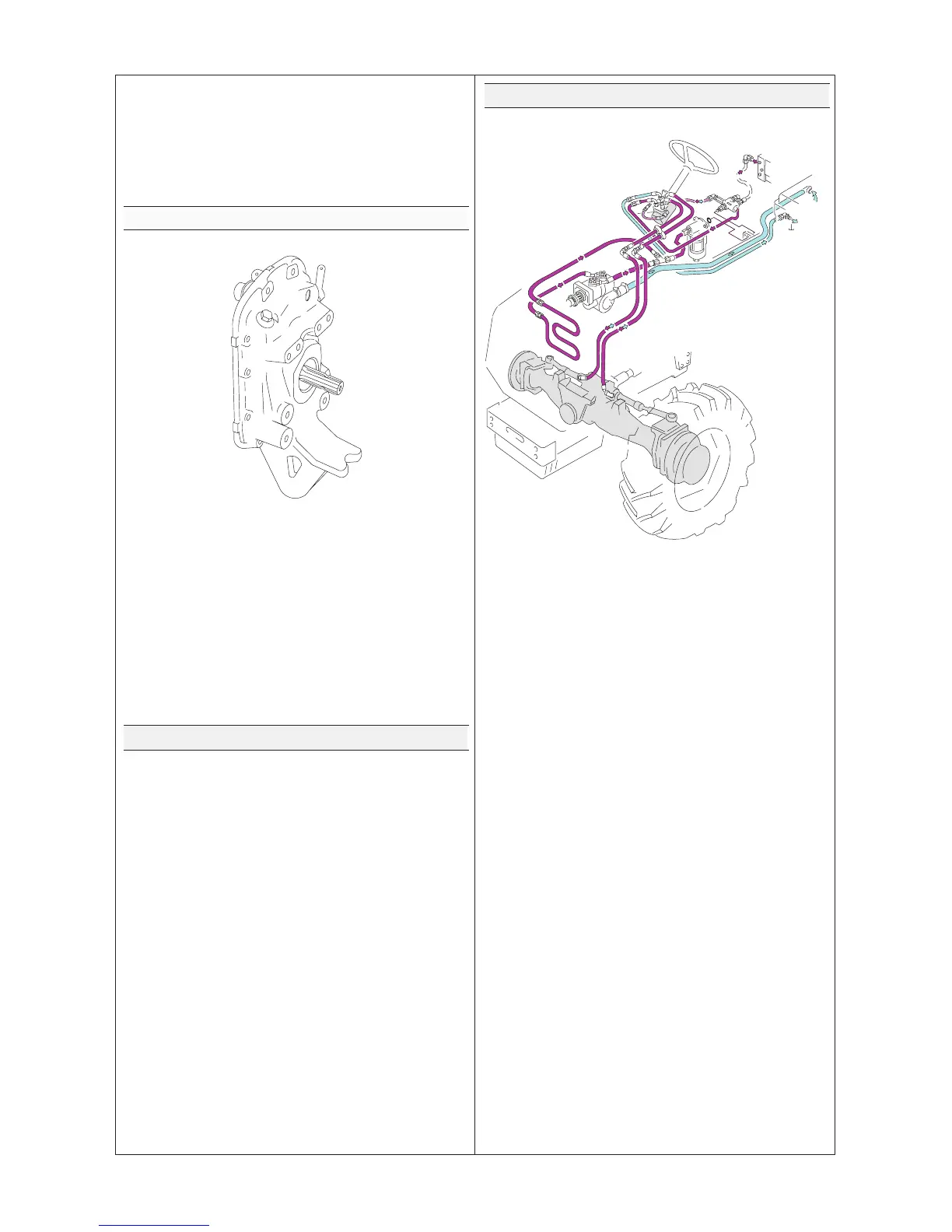
C 4.7. Power take---off
A3565---21
The power take---off works fully independently of the
gearbox. It has its own clutch disc in the twin clutch which
is attached to the flywheel. Engagement and
disengagement of the power take---off is via the PTO
clutch control lever of the clutch disc. Power is transmitted
from the flywheel to the power take---off through a power
take---off shaft which runs through the gearbox.
With the PTO selector control lever, located on the right
side of the driving seat, you can select either 540 RPM or
1000 RPM, alternative equipment 540E (750 RPM) PTO.
Front PTO (extra equipment) shaft‘s nominal speed is
1000 RPM (at an engine rotating speed 2120 PRM).
C 5. Brake system
The oil bath multi---disc brakes are located between the
differential and final drive gears in the final drive housing.
The brakes operate hydraulically from the brake pedals.
The pedals can be connected together and used as
running brakes or separated and used individually as
steering brakes.
The parking brake is mechanically operated and operates
on the main brakes.
The brakes can be adjusted by means of adjusting nuts
which are fitted on the rear axle.
A trailer brake valve and the air pressure brakes are
available as extra equipment.
C 6. Steering system
65---7
The tractor has a hydrostatic steering system meaning
that the steering movement from steering wheel to the
front axle is transmitted by means of oil under pressure.
This makes the hydrostatic steering particularly easy to
use. If the oil pressure in the steering system should
collapse for any reason, steering is still possible by hand.
The steering valve then acts as a pump, although steering
will be considerably heavier.
On the hydraulic steering system there are two
alternatives. On one system there is a different hydraulic
pump for the steering system. On the other system there
is a priority valve (standard on models 800 and 900) which
ensures that there is always sufficient oil for the steering
system.



 To Next Page