---52---
F. Operating instructions
F. Operating instructions
Operating instructions for the extra equipment are in
section K, of this book, after each extra equipment.
F 1. Use of power take---off
Before attaching implements to the tractor PTO unit, make
sure the implement is designed for 540 R.P.M PTO or
1000 R.P.M PTO.
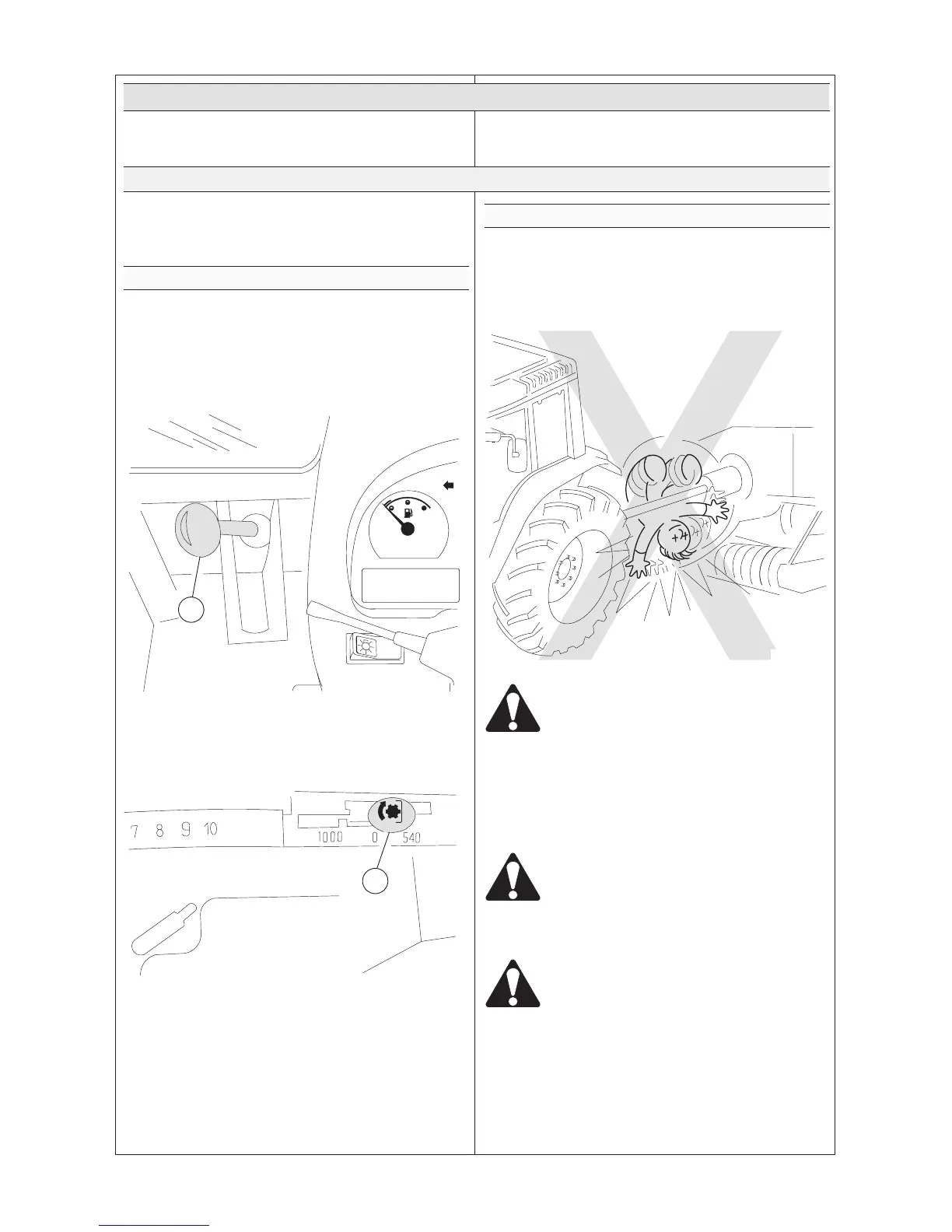
F 1.1. To engage PTO
The power take---off should not be engaged, if it is not in
use. Disengagement for a short time can be done with
the PTO clutchlever (1) (max 5 min). When the PTO is
disengaged using lever (1) which is situated on left side of
the instrument panel, the light on the instrument panel is
lit.
1
69---38
--- Pull the PTO clutch lever (1) back (at the same time
turning the knob clockwise).
--- Set engine revs to low idling.
65---39
2
--- Move the PTO selector lever (2) to desired PTO range
position
lever in left position = 1000 or 540E
lever in right position =540
--- Release the PTO clutch lever (1) steadily and allow it to
move forward to the front position. Adjust engine revs.
NOTE! When using the 540 E position, be aware that,
when increasing the engine revs, the PTO shaft can
rotate up to 800 r/min.
F 1.2. Disengagement
In reverse order.
The power take---off is equipped with a brake, which
prevents the PTO shaft from rotating when the PTO is
disengaged.
69---56,2
WARNING: Stop the engine and disengage
the PTO before attaching an implement to
the tractor. Check that the implement’s
working area is clear before engaging the
PTO.
CAUTION: The PTO should only be engaged when the
engine is running.
CAUTION: The disengagement of the PTO must only
be done using the lever (2) on the right---hand side of
the seat, e.g. when leaving the cap.
WARNING: When a PTO driven implement is
used no personnel are allowed near the PTO
shaft. Service work on the PTO shaft should
only be carried out with the PTO
disengaged, the engine stopped and the key
removed from the ignition switch.
WARNING: After the PTO is disengaged the
implement continues to rotate for some time.
Do not approach the implement until it has
fully stopped.
When coupling or decoupling an implement it should
be supported if necessary to prevent it from falling.



 To Next Page