890557_d•en•01.07.2014
We reserve the right to carry out improvements
56
Wisotronic 1-channel
Operating instructions
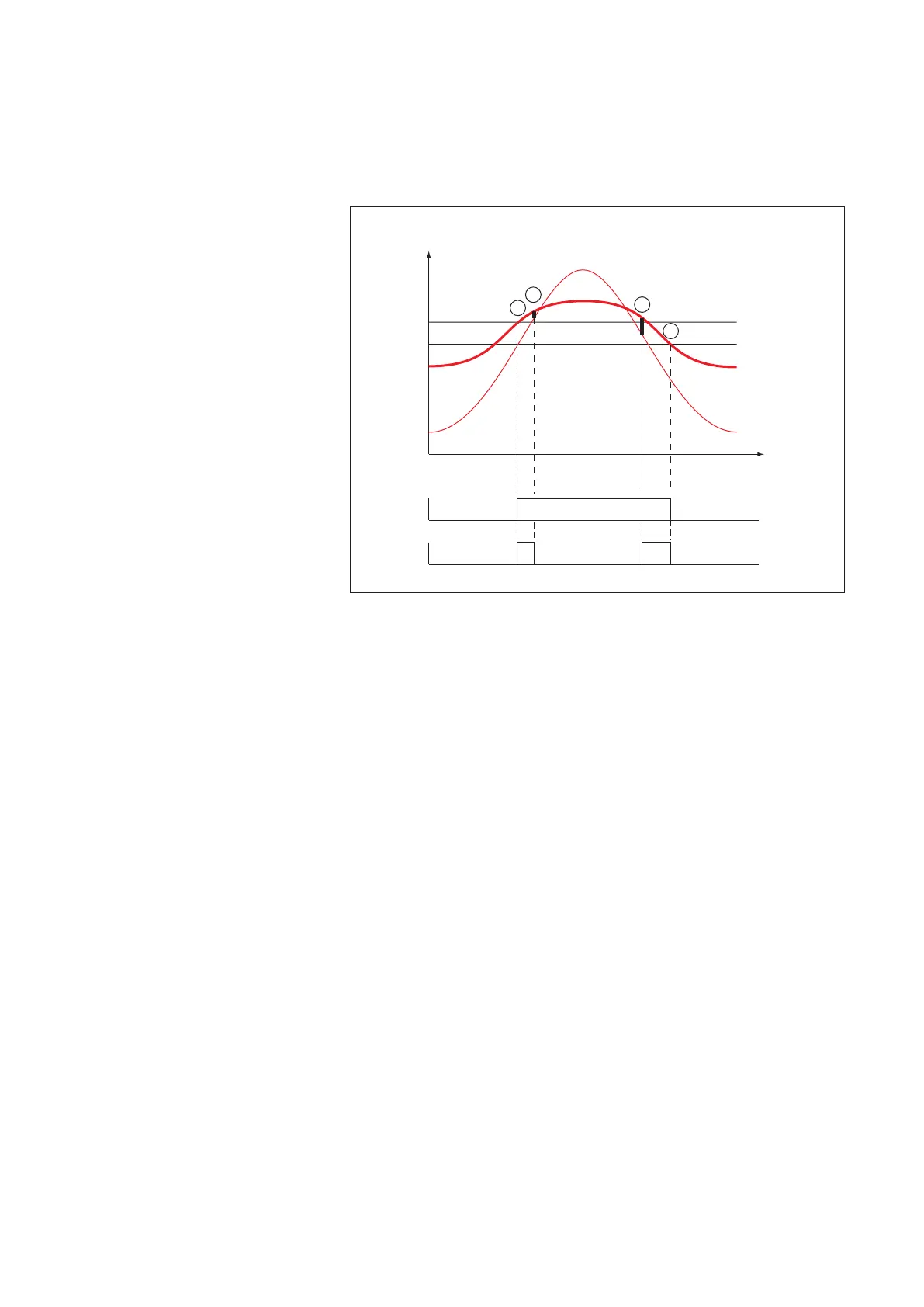
Example The following example shall illustrate this function:
26 °C
22 °C
Temperature
Daily course
Limit value WARM
Limit value COLD
Diff. temp.
control
Window
OFF OFFON
Close Close CloseOpen Open
1
2
3
4
Temp. inside
Temp. outside
Fig. 15 Difference temperature control
Set values: Limit value WARM: +26°C
Limit value COLD: +22°C
D-temp COOLER: 5°C
D-temp WARMER: 2°C
In the morning, it is initially too cool in the room. The sun shines through
windows into the room and warms it. When the inside temperature exceeds
the max. comfort temperature of 26 °C, the difference temperature control is
automatically activated
a
. The windows are opened because it is still cooler
outside than inside.
The room is cooled by venting it. In the course of the day, the outside tem-
perature continues to rise because of the solar radiation. If it becomes too
hot outside to cool the room by venting (the current outside temperature lies
less than 2°C under the currently measured inside temperature
b
), the win-
dows are closed again.
In the evening, the outside temperature drops again and at some point it
is cooler again outside than inside. When the currently measured outside
temperature lies at least 5°C below the inside temperature, the windows are
opened again for venting and cooling
c
).
When the min. comfort temperature of 22 °C has been reached in the
room, the windows are closed again to protect the room from becoming too
cool
d
).
NOTE The correct setting of the limit values “D-temp COOLER” and “D-temp
WARMER” (limit value “D-temp COOLER” is clearly higher than limit value
“D-temp WARMER”) quiets the motion behaviour of the window drive and
as a consequence, the windows are not immediately opened and closed at
each temperature change.
Temperature control


 To Next Page