55
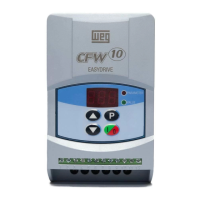
This chapter describes in detail all CFW-10 parameters and functions.
6.1 SYMBOLS
Please find below some symbols used in this chapter:
AIx = Analog input number x.
AO = Analog output.
DIx = Digital input number x.
F* = Frequency reference. This is thefrequency value(or alternatively,
of speed) that indicates the desired motor speed at the inverter output.
F
e
= Input frequency of the acceleration and deceleration ramp.
F
max
= Maximum output frequency, defined at P134.
F
min
= Minimum output frequency, defined at P133.
F
s
= Output frequency - frequency applied to the motor.
I
nom
= Rated inverter output current (rms), in Ampères (A). This value
is defined in P295.
I
s
= Inverter output current.
I
a
= Active current at inverter output, i.e., it is the component of the
total motor current proportional to active electric power absorbed by
the motor.
RLx = Relay output number x.
U
d
= DC link voltage in the DC link circuit.
This section describes the main concepts related to the CFW-10
frequency inverter.
This control mode is based on the constant V/F curve (P202 = 0 -
linear V/F curve). Its performance is limited at low frequencies as
function of the voltage drop in the stator resistance, that causes a
significant magnetic flow reduction in the motor air gap and
consequently reducing the motor torque. This deficiency should be
compensated by using manual and automatic boost torque (I x R
compensations), that are set manually and depend on the user
experience.
In most applications (for instance: centrifugal pumps and fans) the
setting of these functions is enough to obtain the required
performance.
In V/F control, the speed regulation, that can be obtained by setting
properly slip compensation can be maintained within 1 % to 2 % of
the rated speed. For instance, for a IV pole motor/60 Hz, the minimum
speed variation at no load condition and at rated load can be
maintained between 18 to 36 rpm.
There is still a variation of the linear V/F control previously described:
The quadratic V/F control.
6.2 INTRODUCTION
6.2.1 V/F (Scalar)
Control
DETAILED PARAMETER DESCRIPTION
CHAPTER 6


 To Next Page