EasyManua.ls Logo

Westerbeke 65A-FOUR - Assembly Procedures; Surface Preparation; Gasket Information

Westerbeke 65A-FOUR
110 pages
Print Icon
To Next Page IconTo Next Page
To Previous Page IconTo Previous Page
Loading...
ASSEMBLY
PROCEDURES
GENERAl
INFORMATION
Surface
Preparation
Thoroughly remove
all
substances deposited
on
the
gasket
application
surfaces
using
a gasket scraper
or
wire
brush.
Check
to
ensure
that
the
surfaces
to
which
the
silicone
gasket
is
to
be
applied
is
flat.
Make sure that there
are
no
oils,
greases and
foreign
substances deposited
on
the
application
surfaces.
Do
not
forget
to
remove
the
old
sealant
that
remains
in
the
bolt
holes.
ASSEMBLY
Wash
all
parts,
except
for
oil
seals,
O-rings, rubber sheets,
etc.
with cleaning solvent
and
dry
them
with
air
pressure.
Always
use
tools
that
are
in
good
condition
and
be
sure
you
understand
how
to
use
them
before performing
any
job.
Use
only
good
quality lubricants. Be
sure
to
apply
a
coat
of
oil, grease or sealant
to
parts
as
specified.
Be sure
to
use
a torque
wrench
to
tighten
parts
for
which
torques
are
specified.
When
the
engine
is
assembled,
new
gaskets
and
O-rings
must be installed.
Be
aware
of
these
common
problems
that
can
occur during
assembly.
Insufticlent Lubrication.
Heavily
oil
sliding
and
reciprocating parts, lightly
oil
head
bolts
and
other
fasteners,
except those
that
penetrate into
the
water jacket.
These
fasteners should
be
sealed
with
Pennatex
No.
Z
or
the
high-tech equivalent.
Reversed
orientation. Most
gaskets,
many
bolt
washers,
and
all
thermostats
are
asymmetrical.
Mechanical damage.
Run
fasteners
down
in
approved
torque sequences and
in
three steps-I/Z,
2/3,
and
111
torque.
Exceptions
are
torque-to-yield bolts
and
rocker
arm
shaft
fasteners.
The former
are
torqued
as
indicated.
The
latter-mcker shaft fasteners should
be
brought
down
in
very
small increments,
working
from
the center
bolts
out.
Gaskets,
especially head
gaskets,
might
also
be
damaged during
assembly,
they
should
be
positioned
with
great
care.
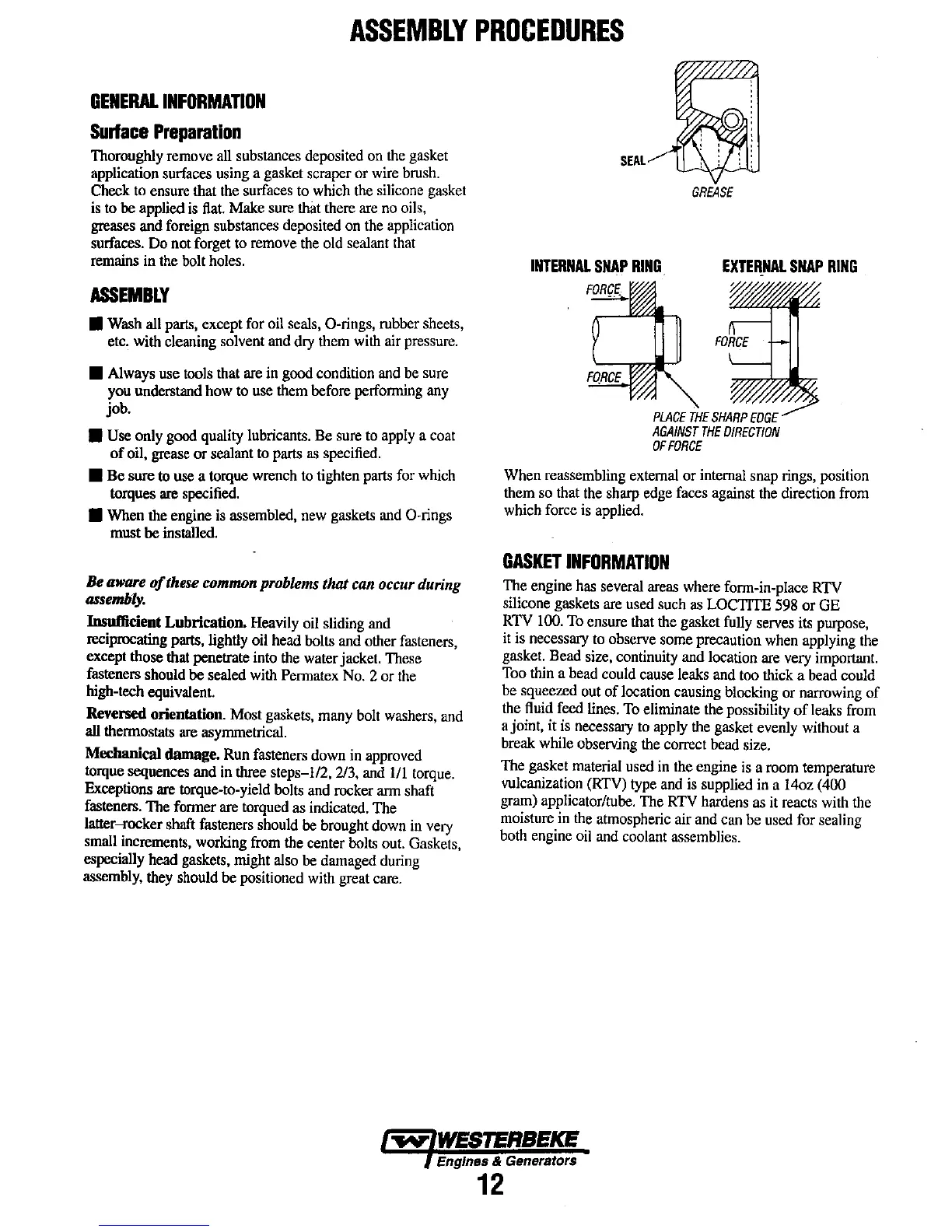
GREASE
INTERNAL
SNAP
RING.
EXTERNAL
SNAP
RING
PLACE
THE
SHARP
EDGE
AGAINST
THE
DIRECTION
aFFORCE
When
reassembling external or internal
snap
rings,
position
them
so
that
the
sharp
edge
faces
against
the
direction
from
which
force
is
applied.
GASKET
INFORMATION
The
engine
has
several
areas
where
form-in-place
RTV
silicone gaskets
are
used
such
as
LOCTITE
598
or
GE
RTV
100.
To
ensure that
the
gasket
fully
serves
its
purpose,
it
is
necessary
to
observe
some
precaution
when
applying
the
gasket.
Bead
size,
continuity and location
are
very
important.
Too
thin
a
bead
could
cause
leaks
and
too
thick
a
bead
could
be
squeezed out of location causing blocking
or
narrowing of
the
fluid
feed
lines.
To
eliminate
the
possibility
of
leaks
from
a joint,
it
is
necessary
to
apply
the
gasket
evenly
without a
break while observing
the
correct
bead
size.
The
gasket
material
used
in
the
engine
is
a
room
temperature
vulcanization
(RTV)
type
and
is
supplied
in
a
140z
(400
gram)
applicator/tube.
The
RTV
hardens
as
it
reacts
with
the
moisture
in
the
atmospheric
air
and
can
be
used
for
sealing
both
engine
oil
and
coolant assemblies.
Engines & Generators
12

Related product manuals