TESTING
FOR
OVERHAUL
HOW
TO
DETERMINE
ENGINE
OVERHAUL
PERIOD
.
Cause
of
Low
Compression
Generally, the time at which
an
engine should be overhauled
is determined
by
various conditions such
as
lowered engine
power output, decreased compression pressure,
and
increased
fuel
and
oil
consumption. The lowered engine power output
is not necessarily due
to
trouble with the engine itself, but
is
sometimes caused
by
injector nozzle wear or injection pump
wear.
The decrease in compression pressure
is
caused
by
many
factors. It is, therefore, necessary
to
determine a cause
or causes
on
the
basis
of
data produced
by
periodic
inspection and maintenance.
Oil analysis on a seasonal basis
is a good means of monitoring engine internal
wear.
When
caused
by
worn
cylinders or piston rings,
the
following
symptoms will occur:
1 Low engine power output
2 Increased fuel consumption
3 Increased oil consumption
4
Hard
engine starting
5 Noisy engine operation
These symptoms often appear together. Symptoms 2
and
4
can result also from excessive fuel injection, improper
injection timing,
and
wear
of
the injectors. They are caused
also by defective electrical devices such
as
the battery,
alternator, starter
and
glow plugs. Therefore it is desirable
to
judge the optimum engine overhaul time
by
the
lowered
compression pressure caused
by
worn cylinders and pistons
plus increased oil consumption. Satisfactory combustion is
obtained only under sufficient compression pressure. If
an
engine lacks compression pressure, incomplete combustion
of fuel will take place even
if
other parts of the engine are
operating properly.
To
determine
the
period of engine
overhaul,
it
is
important
to
measure the engine compression
pressure regularly. At the same time,
the
engine speed
at
which the measurement
of
compression pressure
is
made
should be checked because the compression pressure varies
with engine rpm. The engine rpm
can
be measured at the
front end of the crankshaft.
OVERHAUL
CONDITIONS
Compression pressure tends
to
increase a little
in
a
new
engine until piston rings and valve seats have been broken
in.
Thereafter, it decreases gradually with the progress of wear
of these parts.
When decrease
of
compression pressure reaches the repair
limit, the engine must
be
overhauled.
The engine requires overhaul when oil consumption
is
high,
blowby evident, and compression valves are
at
minimum or
below.
ENGINE
COMPRESSION
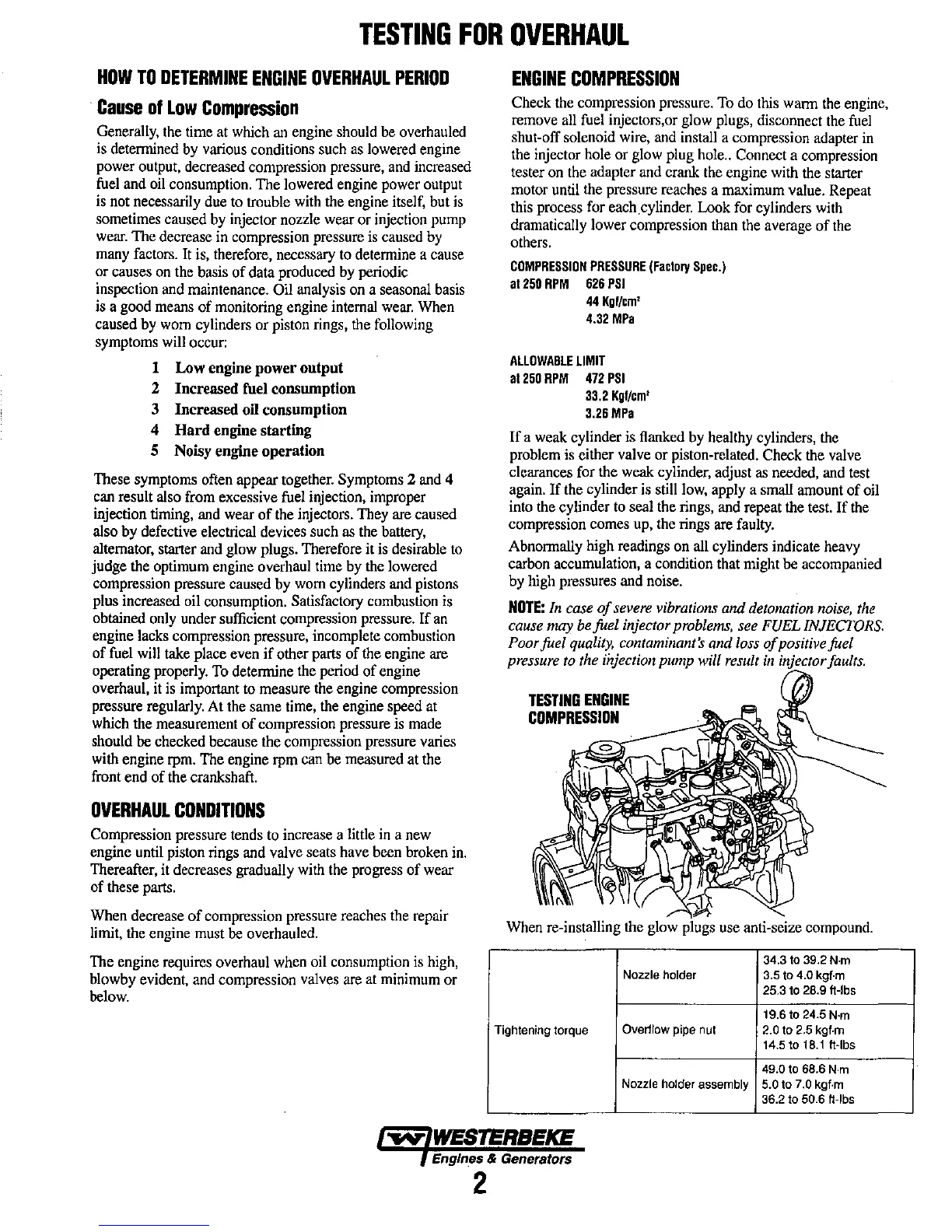
Check the compression pressure.
To
do
this warm
the
engine,
remove all fuel injectors,or glow plugs, disconnect the
fuel
shut-off solenoid wire,
and
install a compression adapter
in
the injector hole or glow plug hole
..
Connect a compression
tester on the adapter
and
crank the engine with
the
starter
motor until the pressure reaches a maximum value. Repeat
this process for
each
cylinder. Look for cylinders
with
dramatically lower compression than the average of
the
others.
COMPRESSION
PRESSURE
(Faclary
Spec.)
at
250
RPM
626
PSI
44
Kgl/cm'
4.32
MPa
ALLOWABLE
LIMIT
al250
RPM
472
PSI
33.2
Kgl/cm'
3.26
MPa
If
a weak cylinder is flanked
by
healthy cylinders, the
problem
is
either valve or piston-related. Check the valve
elearances for the weak cylinder, adjust
as
needed, and test
again.
If
the cylinder
is
still
low,
apply a small amount of
oil
into the cylinder
to
seal the rings, and repeat the test. If
the
compression comes up, the rings are
faulty.
Abnormally high readings on all cylinders indicate heavy
carbon accumulation, a condition that might be accompanied
by high pressures and noise.
NOTE:
In case
of
severe vibrations and detonation noise, the
cause may be fuel injector problems, see
FUEL INJECTORS.
Poor
fuel quality, contaminants and loss
of
po
sitive fuel
pressure to the injection pump will result
in
faults.
TESTING
ENGINE
COMPRESSION
When re-installing the glow use anti-seize compound.
34.3
to
39.2
N·m
Nozzle holder
3.5
to
4.0
kgf·m
25.3
to
2B.9
ft-Ibs
t9.6
to
24.5
N·m
Tightening torque
Over1low pipe nut
2.0
to
2.5
kgf·m
14.5
to
tB.t
ft·lbs
49.0
to
6B.6
N·m
Nozzle holder assembly
5.0
to
7.0
kgl·m
36.2
to
50.6
ft·lbs
Engines & Generators
2



 To Next Page