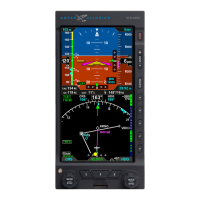
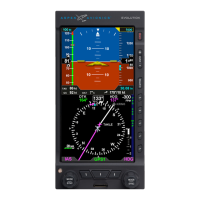
EFD1000 Installation Manual
DOCUMENT # A-01-126-00 PAGE 162-225 Revision H
© Copyright 2009 Aspen Avionics Inc.
11 Post Installation Flight Check
CAUTION: Only perform flight test in day VFR conditions with an appropriately rated
pilot for the aircraft type to be flown.
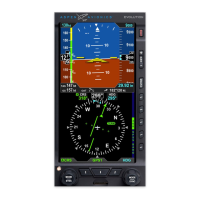
11.1 Basic ADI Flight Checks
Fly the aircraft in straight and level flight and verify that the ADI roll indication is level
with reference to the horizon. Observe the Slip Indicator is centered under the Roll
pointer and adjust rudder trim if available to center.
a) Make a coordinated 30 degree banked turn to the right and verify that the ADI roll
indication is correct with reference to the horizon.
b) Make a coordinated 30 degree banked turn to the left and verify the ADI roll
indication is correct with reference to the horizon.
c) Pitch the aircraft up 10 degrees and verify the ADI pitch indication is correct with
reference to the horizon.
d) Pitch the aircraft down 10 degrees and verify the ADI pitch indication is correct
with reference to the horizon.
11.2 Basic HSI/DG Flight Checks
a) Make a 180 degree coordinated turn to the right and verify that the compass scale
and numerical heading indication correctly track the aircraft heading during the
turn.
b) Make a 180 degree coordinated turn to the left and verify that the compass scale
and numerical heading indication correctly track the aircraft heading during the
turn.
c) Then turn from West to North (30° Angle of Bank) and, using an outside reference,
roll out to a northerly heading. (In the Southern Hemisphere, also turn West to
South)
d) Immediately after the aircraft rolls out, record the heading indication.
e) Maintain the same heading by outside visual reference. There may be some
movement of the heading indicator as the heading system stabilizes.
f) When the heading stabilizes, record the heading again. Then perform the test
from East to North (In the southern Hemisphere, also turn east to South).
g) If the difference between the heading on rollout and the heading after stabilizing
is more than 7°, refer to the Troubleshooting Guide, Appendix A.



 To Next Page