EFD1000 Installation Manual
DOCUMENT # A-01-126-00 PAGE 175-225 Revision H
© Copyright 2009 Aspen Avionics Inc.
12.7 Map Range Control
The EFD1000 basemap range may be set to ranges of 2.5, 5, 10, 15, 20, 30, 40, 60, 80, 100,
and 200 nautical miles. Map range is measured from the own ship position to the outside of
the compass arc.
To increase the range push the ‘+’ side of the range key located on the upper right side of the
bezel. To decrease the range push the ‘–‘ side of the key. The currently selected map range is
displayed in the lower left corner of the display.
12.8 Display Reversion Control and Abnormal Shutdown
Single PFD installations do not have any display reversion capability that can be activated by
the REV button. As such, the reversion function is inoperative in single display installations.
In addition to display reversion control, the REV button may be used to force the unit to power
off should, for example, the display stop responding to pilot inputs. When external power has
been removed, pressing and holding the REV button for 5 Seconds will produce in an
immediate system shut down. When external power is available, pressing and holding the REV
button for 5 seconds will result in a system restart.
While the button is pressed, the following annunciation is provided adjacent to the button
Figure 12.6 – REV Button
12.9 Primary Flight Instruments
12.9.1 Attitude Indicator
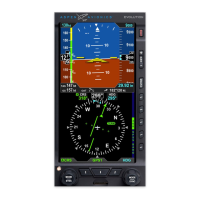
The Attitude Indicator consists of a conventional blue over brown attitude ‘ball’ rendered
behind a fixed aircraft symbol to display pitch, roll and slip/skid information. The
horizon line is represented by a fixed white line extending to each edge of the display
area separating the blue sky and brown ground of the artificial horizon. A fixed roll
pointer reads degrees of bank against a moveable roll scale.
The AHRS attitude solution continually self-monitors and will present a “CROSS CHECK
ATTITUDE” annunciation whenever it determines that the AHRS solution may be
degraded. Should this alert be presented, the pilot should immediately cross compare
the attitude against backup sources of attitude information.



 To Next Page