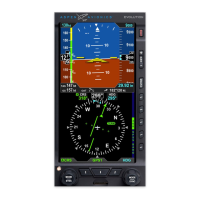
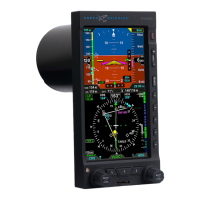
EFD1000 Installation Manual
DOCUMENT # A-01-126-00 PAGE 2-225 Revision H
© Copyright 2009 Aspen Avionics Inc.
Special Notes to the Installer
It is important to review the entire Installation Manual before installing the EFD1000. The following
items are of special note and should be considered for planning and installation.
1. The integral EFD1000 ADAHRS uses air data and magnetic inputs as cross checks for the
aircraft attitude solution. Airspeed and altimeter maintenance checks will normally generate
warnings on the EFD1000 display and produce changes in the displayed attitude.
2. Pre Modification Planning, section 5, contains planning information for the EFD1000
installation. Correct replacement and proper placement of the aircraft instruments is critical
to maintain the aircraft certification. Certain instruments can be removed. More importantly,
certain instruments must not be removed. Generally, redundant attitude and air data
instruments are required, resulting in a safer and more capable aircraft after the installation.
3. The EFD1000 does not provide a synchro bootstrap output. If equipment on the aircraft
using the bootstrap output does not accept a low speed ARINC 429 signal provided by the
EFD1000, then the bootstrap-enabled slaved compass system should be retained.
4. The Primary Flight Display must be powered from the Battery Bus, not the avionics master
bus. This permits the pilot to shed the avionics load in flight and retain attitude, heading and
air data information. Installing the equipment on the avionics master bus violates the
provisions of the Aircraft Flight Manual supplement
and is not approved under the STC. An
EFIS master switch on the Battery Bus is recommended.
5. The RSM contains magnetic elements used for heading and to cross check the attitude
solution. The RSM is sensitive to magnetic fields on the aircraft. Section 6.9 describes how
to locate the RSM. Note that mounting over the cabin can be problematic due to the
possibility of passengers using headsets with magnetic speakers. Be sure to exercise the
control cables while validating a location to consider all the magnetic field variations. A
satisfactory RSM location is an item to be checked on the Final Check Sheet.
6. Proper RSM orientation
and placement is critical to the performance of the AHRS attitude and
heading solution. The OAT vent hole faces aft. See Figure 6.15. Use caution when installing
the RSM connector to avoid damaging the connector or wiring.
7. Structural mounting and lightning direct effects approval for Composite or fabric aircraft is
not
included under the AML STC. For aircraft of composite or tube/fabric construction,
regulatory approval for the RSM
structural mounting and lightning direct effects must be
obtained separately. See Section 6.9.3. Mounting the RSM on a pressure vessel also requires
separate structural approval.
8. Avionics integrations are shown in Section 9. The manufacturer’s documentation for the
integrated equipment must be used to validate the operation of the integrated equipment.
9. The installer must determine whether the design changes described in this document are
compatible with previously approved modifications.
10. Troubleshooting information is in Appendix A of this document.
11. To avoid damage to the equipment, do not place the EFD face down resting on the knobs.
12. The internal battery is normally disconnected for shipping the EFD1000. The battery must be
connected after completing post-installation testing and prior to maintenance release.



 To Next Page