Ch. 20. Safety Precautions Sec. 20.2. Light Source Safety
• If the power is cut and you must move the objective, you can reach inside the enclosure and feel
for a wheel at the lower left hand side near the rear of the Cypher chassis. This wheel turns the
motor manually. Ten turns are required for every millimeter of objective motion. Turn clockwise
to move the objective DOWN and counter-clockwise to move the objective UP.
20.2. Light Source Safety
Caution
Use of controls or adjustments or performance procedures other than those
specified herein may result in harzardous invisible laser energy exposure.
20.2.1. Non-visible Laser Diode or Super Luminescent Diode Light
The Cypher SPM contains a laser diode (LD) or super luminescent diode (SLD) light source. Superlu-
minescent diodes are like lasers, but have a shorter coherence length. As of the writing of this manual all
Cypher light sources have an output of several mW around 850 nm, which is non-visible. From a safety
perspective LDs and SLDs can be regarded as identical and the terms will be used interchangeably.
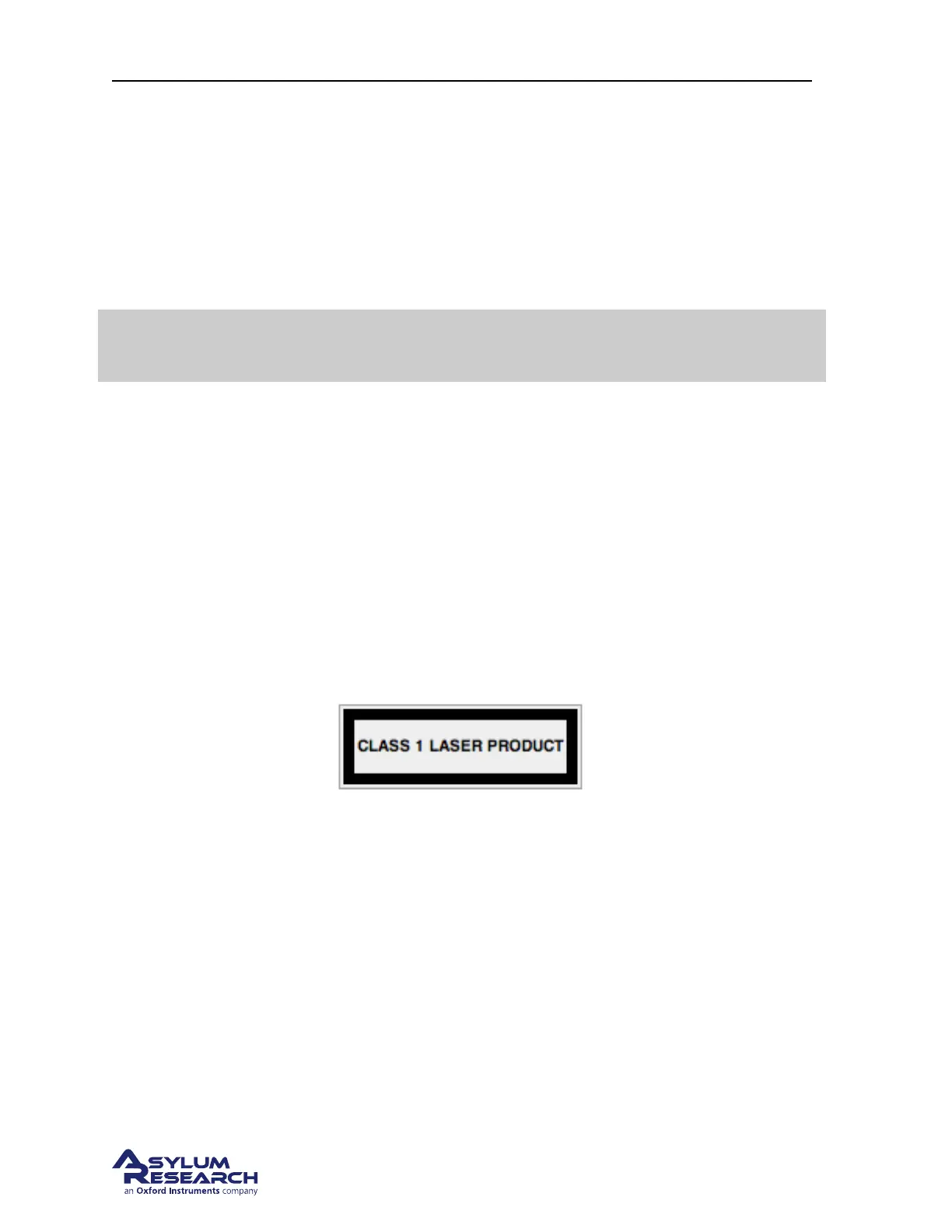
The Cypher laser is sufficiently well shielded that the Cypher SPM qualifies as IEC Class 1 laser product
that complies with 21 CFR 1040.10 and 1040.11, except for deviations pursuant to Laser Notice No.
50, dated 24 June 2007. Complies with IEC/EN 60825-1, Ed.2:2007. In layman’s terms this means the
Cypher SPM is in the same class as a home DVD player, and in a safer class than a laser pointer. When
used as prescribed there is no danger of exposure. Nonetheless, it is still good to have an understanding
of the laser in the instrument and the safety features.
Figure 20.2.: A class 1 laser product (IEC 60825-1:2007 and EN60825-1:2007) is safe under all conditions
of normal use.
20.2.2. The Laser Optical Path
Understanding the laser optical path is the best way to reduce the possibility of harmful exposure to
non-visible light, which may cause eye damage.
Figure 20.3 on page 232 shows a simplified picture
of the laser optical path. The light originates inside the removable laser module, then reflects via a
mirror (called the “hot mirror” because it reflects infrared light while transmitting visible light) into the
objective. The only place a person can be exposed to the light during normal operation is where the
light exits the objective. As you will see in the next section, there are numerous interlocks to make the
possibility of exposure very low. Still, here are a few things you should avoid:
BETA
Page 231


 To Next Page