AeroNav 900/880 Series Pilot’s Guide
89000039-010
Rev 1 May 2019 System Overview 1-25
COM-NAV †
The VHF radio consists of a Com radio that covers the frequency
band from 118.0 MHz to 136.990 MHz and a Nav radio that
covers the frequency band from 108.0 MHz to 117.95 MHz. Both
25 kHz and 8.33 kHz spacing is supported. The AeroNav comes
standard with a 10 watt transmitter, but can be configured as a 16
watt transmitter at the factory or in the field as a paid option.
Display
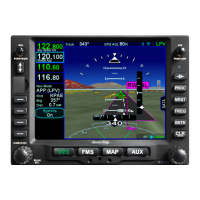
The active com frequency is the frequency that the radio will
transmit on when the Push-To-Talk button is pressed. A standby
frequency is a frequency that will become the active com
frequency when the bezel Frequency Swap button is pressed.
The active frequency is displayed in green and a standby is
displayed in white. The number of available standby frequencies
is configurable.
Display of the frequencies can be formatted in several ways via
the “User Options” and “Datablock Setup” LSKs of the SETUP tab
on the AUX page (see the Datablock Setup description on page
5-20 for more details). The default display format is two com
frequencies (active and #1 standby) above two nav frequencies
(active and #1 standby). A custom display format can be set up
to display the active com and up to four standby com frequencies.
The frequency that will be swapped into the active frequency
when the bezel Frequency Swap button is pressed is called the
“# 1 Standby”. For example, in the case where the user has set
up 4 com slots to be displayed, any one of slots 2, 3 or 4 can be
selected to be the “#1 Standby” simply by touching the slot. In
every case, the “#1 Standby” slot is visually indicated by a cyan
outline.


 To Next Page