Section 2 System Description
21
These flashes of light are detected by the light-sensitive layer of a
photomultiplier. Electrons released from this layer are then moved
to several dynodes by means of high voltage cascade to release
further electrons there. During this process virtually every electron
triggers an electron avalanche. The pulses created in this manner
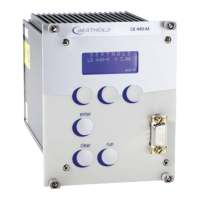
are counted in the detector and the results transmitted to the
evaluation unit LB 442. A photomultiplier which is optically coupled
to the detector converts the flashes of light into electrical signals.
To achieve a very high accuracy and high long-term stability, the
integrated processor automatically adjusts the optimum operation
point of the photomultiplier, monitors the limit values, and stores
all detector-specific data. Power is supplied via 2-wire technique;
all measured data and information can be transmitted between de-
tector and evaluation at the same time.
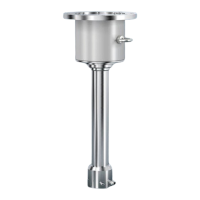
The detector is assembled in a sturdy stainless steel housing which
protects the instrument against normal environmental stress.
To ensure reliable function and a long service life, the detec-
tor must not be subject to heavy mechanical stress and vi-
brations.
The ambient temperatures must not exceed 50°C; other-
wise, adequate cooling has to be provided either by:
installing a cooling jacket (see section Installation of Water
Cooling) installing a shielding plate if the detector is ex-
posed to sunlight.
The detector for the Cobalt/Cesium version
is mounted on the
measuring frame parallel to the conveyor, since the sidewalls and
the centerpiece of the measuring frame absorb a major share of
the radiation.
The opening of the detector must be exactly vertical above the
source.
The detector for the Am version
is mounted vertically to the
conveyor.




 To Next Page