8.1 General Information
76
Section 8 Checking the Calibration
8.1 General Information
If deviations of the measured result occur, a new tare measure-
ment has to be performed first. To carry out a performance check
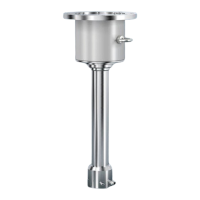
of the bulk flow measurement, you can push a calibration cap (op-
tion) over the scintillator. The load measured at empty belt with
the calibration cap must not change compared to previous tests,
provided the calibration coefficients did not change in the mean-
time.
8.1.1 Correction of Calibration
First, you should run a tare measurement and a check as described
in Section 8.
If you detect any deviations, you may correct the slope of the
curve by a multiplicative factor (see Correction of Display Value on
page 77).
8.1.2 Operating Instructions for Calibration
Start and Stop of Calibration Measurement
Push the <run> button to start and stop a calibration measure-
ment. With <+> and <-> you can switch to the live display. In the
live display, a push of the <run> button is ignored. With the <+>
and <-> buttons you can scroll in this window; the current, not yet
calibrated measured values are displayed. With <more> you get
back to the calibration window.
Store
When the calibration measurement has been stopped, confirm the
respective measured value with <enter>; otherwise it will be re-
jected when exiting the respective ‘calibration point’.
Stop Measurement
If the system is in the operating mode, the ongoing measurement
can be stopped by pushing the <run> button, provided the meas-
urement product is the same as the calibration product. If the se-
lected product is not the same as the measurement product, the
<run> button is locked. The calibration parameters for the se-
lected product can only be entered manually.
Current Output
The current output supplies a current proportional to the load and
the selected measuring range, provided the correct absorption co-
efficient has been entered.




 To Next Page