7.1 Background
68
Section 7 Calibration
7.1 Background
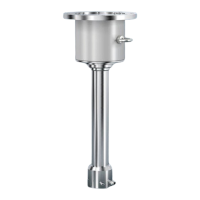
If you are working with rod detectors, the background, i.e. the
natural environmental radiation, has to be determined. The count
rate of the background has to be regarded as constant and may
therefore not be compensated for automatically. The background
should be measured by placing the detector in a certain distance
from the measuring frame (with Cs137 3 m, with Co60 at least
5 m). If the detector cable is not long enough, a two-wire exten-
sion cable may be connected. Before measuring the zero count
rate, the detector has to be in operation or operating voltage has
to be applied for at least 30 minutes.
See also Background for rod detector on page 59.
Note: If the background is not measured correctly, a display devia-
tion may occur in the course of time.
7.2 Tare Measurement
7.2.1 General Information
Before taking the measuring system into operation, the zero or
tare weight has to be determined.
The tare weight changes constantly as a result of conveyor irregu-
larities, such as variation of the thickness of belt or, as in the case
of chain conveyors, differences between chains links and scrapers.
During tare determination, therefore, the conveyor must run and
the average value must be determined over several complete con-
veyor belt cycles. The rule is: the more cycles, the more precise
the result.
The tare measurement can be checked by running a test meas-
urement with empty belt. During the test measurement (approx. 5
minutes) no or only a negligible mass (t) should be integrated.
There are two ways of performing a tare measurement:
a) Tare measurement via time
b) Tare measurement via belt length
a) Tare Measurement via Time
First, the time for one cycle has to be determined by marking the
belt and taking the time until the mark reappears. With most con-
veyors, averaging over one belt length is insufficient. For this rea-
son, depending on the available time, enter a multiple of this
value.
Example: 1 cycle measured = 56 s
15 cycles = 840 s




 To Next Page