51
AEC Input
AEC Inputs provide acoustic echo cancellation and background noise reduction, and are available in pairs
only as part of AudiaFLEX hardware. NOTE: Newer AEC2w inputs cards have a wider bandwidth (20kHz)
than earlier AEC2 input cards (7kHz). For proper performance, AEC Inputs must be used in conjunction
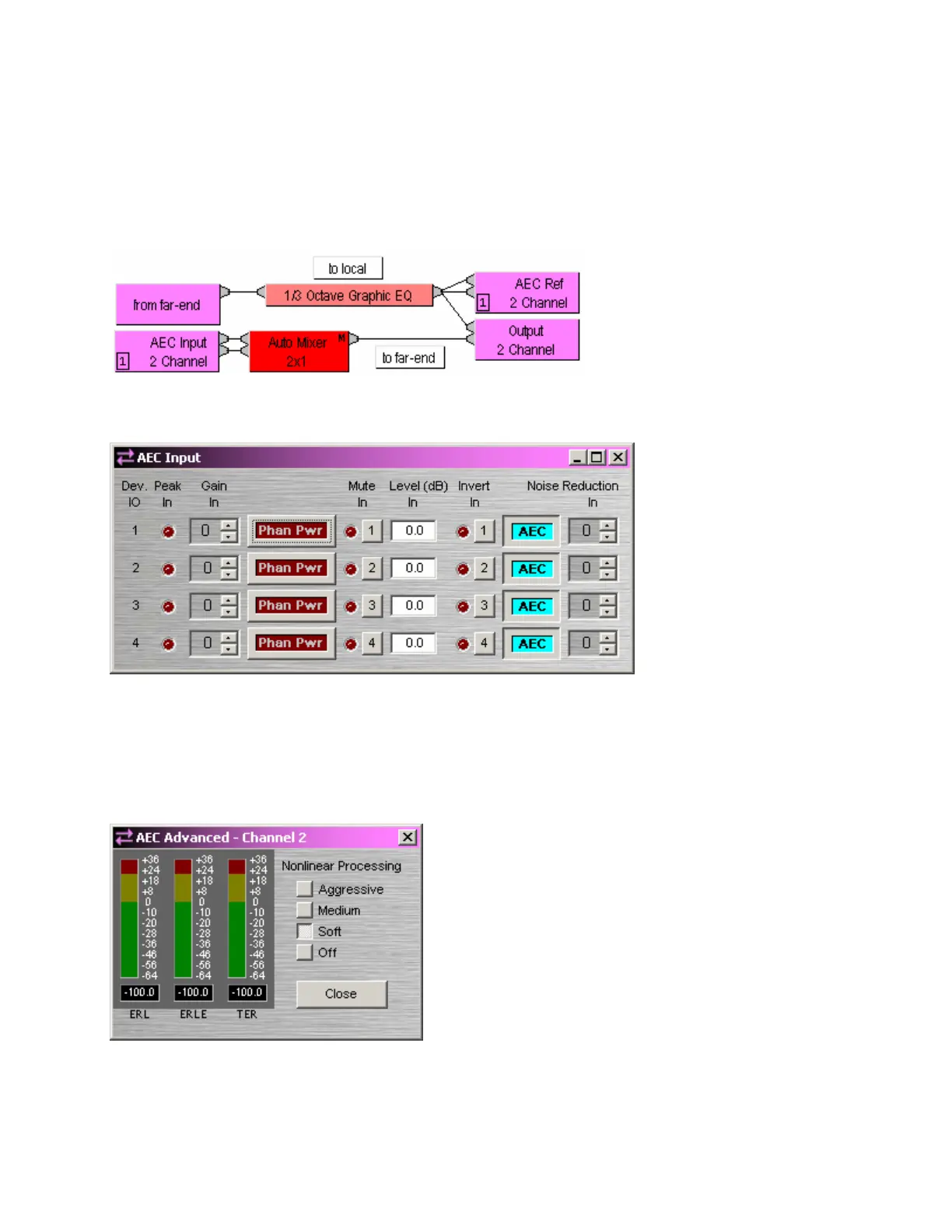
with Auto Mixer blocks. When placed into the Layout, AEC Inputs consist of two separate blocks. An AEC
Input block represents the actual audio inputs, and an AEC Ref block provides the associated signal
reference points. In conferencing applications, AEC Ref blocks should be connected as close as possible
to outputs that contain 'far-end' signal only, and which include any signal processing applied for local sound
reinforcement of that signal. This approach provides the most accurate reference. AEC Ref blocks should
never be connected to paths containing signal from corresponding AEC Inputs.
In applications where only background noise reduction is desired, AEC can be turned off and no AEC Ref
connection is required. Noise Reduction is intended for 'stationary' or steady-state background noises,
such as from HVAC systems, fans, motors, or other mechanical devices.
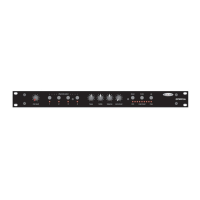
Device IO indicates which hardware input is associated with that software channel. Gain In compensates
for different input levels (mic or line), and should be set so Peak In flashes only occasionally (6dB
headroom). Phan Pwr assigns +48 Volt phantom power to the input for condenser microphones. Mute In
turns the input signal on/off. Level In adjusts the relative input volume. Invert In reverses the polarity of
the input signal. AEC turns on/off acoustic echo cancellation. Noise Reduction In selects the amount of
background noise reduction to be applied (6~15dB).
Right-clicking over certain settings will provide a menu of additional options.
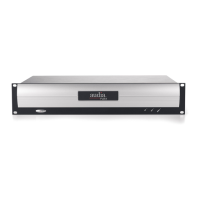
With earlier AEC2 input cards, each channel has an
AEC Advanced dialog box (when 'on-line'). NOTE:
Newer AEC2w input cards have no such Advanced
dialog box. ERL (Echo Return Loss) shows the level
difference between a signal at the speaker output
(AEC Ref) and that same signal as picked up at the
mic (AEC Input). ERLE (Echo Return Loss
Enhancement) indicates the amount of processing
being applied on that channel. TER (Total Echo
Reduction) shows the combined echo reduction
achieved by acoustic damping (ERL) and signal
processing (ERLE). Nonlinear Processing provides
additional echo cancellation, for more challenging
applications. However, increased Nonlinear
Processing can also adversely affect full-duplex
operation.


 To Next Page