VDL (E3) 09/2019 Page 41/234
The interior is hermetically sealed from the heating device. Even in the event of a fault, the explosive
atmosphere cannot come into contact with the hot surface of the heating elements. And the heating
elements are always below the auto-ignition temperature.
Normal operation when used correctly: Even without taking into account the pressure control, which is
also effective in practice, there is no ignition source during the drying process. This also applies in the
event that the system is ventilated before the drying process finishes.
Fault: Incorrect loading with inadmissible solvent with a too low ignition temperature: Due to the vacu-
um, there is no ignition source during the drying process. The drying process could safely be ended. In
order to cancel the drying process, it is the chamber must first have cooled to room temperature befo-
re ventilation and opening (chap. 9.9.4).
• Taking into account the volume dependence of the auto-ignition temperature
The surface temperature is not to exceed 80% of the auto-ignition temperature of the gas or fluid,
measured in °C.
Action: The safety margin of 20% of the auto-ignition temperature. is sufficiently large.
• Safety pressure monitoring with heater release by pressure switch
There is no explosive atmosphere in a vacuum. The heater is only released starting with a pressure
threshold of 100 mbar.
There is thus always a vacuum ≤ 100mbar during drying.
The protective measure of ignition source monitoring provides redundant safety during the drying pro-
cess: There are no hot surfaces at a pressure > 100 mbar, and, when used correctly, after the heater
is released the hot surfaces are always below the auto-ignition temperature of permitted materials.
• Sweeping the area for electrical equipment and the instrument box with compressed air
The area for electrical equipment and the instrument box are protected against penetration of explosi-
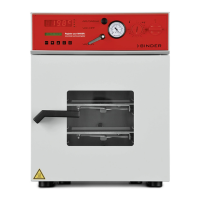
ve atmosphere by a technical ventilation system (minimum overpressure: 25 Pa). The user must moni-
tor the pressure on the manometer on the chamber front, especially when loading and removing the
loading material This reliably prevents explosive atmosphere to reach electrical or electronic parts of
the VDL safety vacuum drying oven (protection against solvent-containing ambient air).
• Heater shutdown in the event of component failure
In case of failure of the controller Pt100 temperature sensor or the heater Pt100 temperature sensor.
The heater is turned off. On the controller an alarm message is displayed.
• Measures for lacking / incorrect maintenance / adjustment / sensor drift
Proper maintenance requires that all Pt100 sensors are correctly adjusted.
Regular adjustment intervals for the temperature sensors (annual) are specified (Chap. 27.3).
• Prevention of electrostatic charges / grounding plan
All chamber components are at a common potential. The interior parts of the chamber are grounded.
The outer painted housing plates have a layer thickness of <2mm and are connected with the earth
potential via the protective conductor connection.
A detailed grounding plan for the VDL, the pump module, the pump and the installation and loading
area is provided, all components are prepared accordingly for grounding: Connections are available to
ground the device and accessories. Achieving equipotential bonding according to the grounding plan
of the manufacturer is mandatory, see operating manual chap. 6.6.
To create the connection between the vacuum drying oven and the pump, an antistatic PTFE hose is
used. All conductive parts have the same electrical potential.


 To Next Page