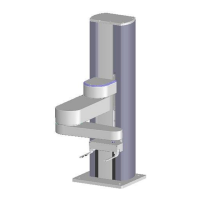
2. Introduction to the Hardware PreciseFlex 100 Robot
Machine Safety Part Number: 603988 Rev. A
For increased generality, uncertified zones can be arbitrarily positioned and rotated in all three
dimensions. Due to implementation limitations, certified zones must be non-rotated rectangular
volumes, which can be arbitrarily positioned. Up to 10 zones can be defined for each robot and any
mix of certified and uncertified can be specified. Due to safety requirements, any new or modified
zone specifications only go into effect after the controller is rebooted.
Safety Zone Violation Detection and Clearing
Uncertified safety zones are active in the following circumstances:
l
Continuously during program-controlled motions of all types (straight line or arc Cartesian and joint
interpolated).
l
Continuously during manual (jog) control modes: World, Tool and Joint, but not free.
l
Motion planning (final destinations only).
l
Location object.KineSol method during conversions to either Cartesian or joint Locations.
Certified safety zones are only active during program-controlled motions (of all types) since this is
the only circumstance where higher TCP speeds are possible.
When motor power is enabled and the robot’s TCP is in violation of an uncertified safety zone, a
program-controlled motion cannot be initiated. This condition can be cleared by disabling motor
power and manually repositioning the robot or by manually jogging the TCP in World, Tool or Joint
modes, so long as the jog motion reduces the safety zone violation distance. That is, jogging
motions that increase the violation of a safety zone are not permitted.
NOTE: Safety zone testing is based on the TCP of the robot. Therefore, it is very
important that the position of the tool center point relative to the robot’s tool mounting
flange is set correctly. Please see the Robot.Tool property for information on defining
the TCP.
Certified Speed Restrict Safety Zones
While the uncertified safety zones perform conventional tests on just the position of the TCP, there
are two certified safety zones and these perform special tests to detect if the speed of the TCP
exceeds a limit while the TCP is within the zone. The first certified safety zone tests if the Z
downward speed of the TCP exceeds a specified limit. This safety zone was implemented for the
PreciseFlex 400 and PreciseFlex 3400 robots since their only intrinsically non-safe motion is a high-
speed downward Z motion that could trap a person's hand between the tooltip and a fixed object or
horizontal surface. The second certified safety zone tests if the horizontal, XY planar, speed of the
TCP exceeds a specified limit. This test was developed for the PreciseFlex™ DD robots since
robots can generate excessive speeds when moving horizontally.
For both of these tests, in order to satisfy the computational redundancy requirement of the
Category 3 safety regulations, the shapes of these safety zones are limited to non-rotated
rectangular volumes.
30
Copyright © 2023 Brooks Automation, Inc.



 To Next Page