Group 22, Wheels and Tires
22-2-2 • Pneumatic Wheels and Tires SM 765, Nov ’06
13. Do not use undersized rims. Use the right rims for
the job.
14. Do not overload rims. Ask your rim manufacturer if
special operating conditions are required.
15. Do not seat rings by hitting with a hammer while the
tire is filled with air pressure. Do not hit a filled or
partially-filled tire/rim assembly with a hammer.
16. Double check to make sure all the components are
properly seated prior to filling tire with air.
17. Have the tire in a safety cage when filling with air.
18. When removing wheels, regardless or how hard or
firm the ground appears, put hardwood blocks under
the jack.
19. Block the tire and wheel on the other side of the vehi-
cle, before you place the jack in position. Place
blocks under the truck frame as near as possible to
the jack to prevent the truck from falling if the jack
should fail.
20. Remove the bead seat band slowly to prevent it from
dropping off and crushing your toes. Support the
band on your thigh and roll it slowly to the ground.
This will protect your back and feet.
21. Bead breakers and rams apply pressure to bead
flanges. Keep your fingers away from the bead
flanges. Slant bead breaker about 10° to keep it
firmly in place. If it slips off, it can fly with enough
force to kill. Always stand to one side when you
apply hydraulic pressure.
General Tire Maintenance, Inspec-
tion, and Repair
1. Park the truck as described in “Safe Parking” and
check for correct tire inflation air pressure.
• Drive GEX20/25/30: 800 kPa (116psi)
• Steer GEX20/25/30: 1000 kPa (145 psi)
CAUTION
!
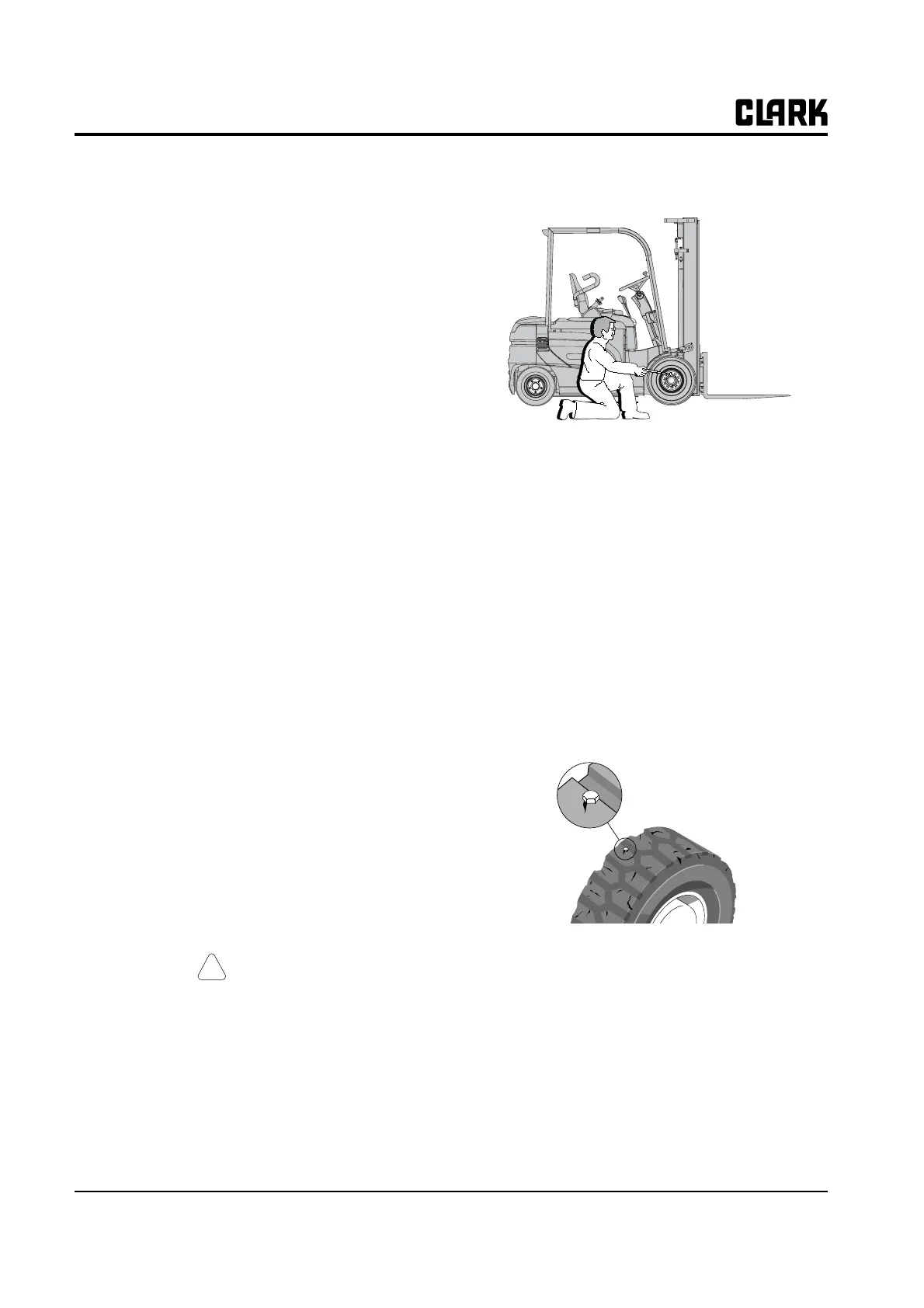
Check tire pressure from a position facing
the tread of the tire, not the side. Use a long-
handled gauge to keep your body away from
the side.
• If tires are low, do not add air. Have the tire and
wheel inspected by a person trained and autho-
rized to do tire and wheel maintenance. The tire
may require removal and repair.
• Incorrect (low) tire pressure can reduce the sta-
bility of a lift truck and cause it to tip over.
IMP
RTANT
Check wheels and tires for damage every
time you check tire pressure. Make repairs
when needed. Dirt can get into cuts and cause
damage to the tire cord and tread. Remove
debris from all cuts.
2. Check the condition of the drive and steer wheels and
tires. Remove objects that are imbedded in the tread.
Inspect the tires for excessive wear, cuts and breaks.
3. Check all wheel lug nuts or bolts to be sure none are
loose or missing. Have missing bolts replaced and
loose bolts tightened to the correct torque before
operating the truck.
• Torque pneumatic steer tires to 225-250 N⋅m (165-
185 ft⋅lb).
• Torque 1 piece black lug nuts for pneumatic drive
tires to 155-180 N⋅m (114-133 ft⋅lb).



 To Next Page