Group PS, Periodic Service
PS-2-12 • Planned Maintenance SM 765, Nov ’06
Air-Cleaning
Always maintain a lift truck in a clean condition. Do not
allow dirt, dust, lint, or other contaminants to accumulate
on the truck. Keep the truck free from leaking oil and
grease. Wipe up all oil spills. Keep the controls and floor-
board clean and dry. A clean truck makes it easier to see
leaks and loose, missing or damaged parts, and will help
prevent fires. A clean truck will run cooler.
The environment in which a lift truck operates will deter-
mine how often and to what extent cleaning is necessary.
For example, trucks operating in manufacturing plants
which have a high level of dirt or lint (e.g., cotton fibers,
paper dust, etc.) in the air or on the floor, will require
more frequent cleaning. If air pressure does not remove
heavy deposits of grease, oil, etc., it may be necessary to
use steam or liquid spray cleaner. DO NOT clean electri-
cal components with steam.
N
TE
See special provision for blowing dust from
pump and drive motors on page 14 of this
section.
CAUTION
!
Battery must be disconnected and capacitors
discharged before inserting air wand through
access holes.
CAUTION
!
Wear suitable eye protection and protective
clothing.
Lift trucks should be air-cleaned at every PM interval, and
as often as required.
Air-cleaning should be done using an air hose with special
adapter or extension having a control valve and nozzle to
direct the air properly. Use clean, dry, low-pressure com-
pressed air. Restrict air pressure to 207 kPa (30 psi).
Air-clean the following: upright assembly; drive axle; bat-
tery, cables, switches and wiring harness; transistor con-
trols and wiring; drive and hydraulic pump motors;
steering axle and steering cylinder.
Critical Fastener Torque Checks
Fasteners in highly loaded (critical) components can
quickly fail if they loosen. Loose fasteners can cause dam-
age or component failure. For safety, it is important that
the correct torque be maintained on all fasteners of com-
ponents which directly support, handle or control the load,
or protect the operator.
Check torque of critical items, including: overhead guard,
drive axle mounting, drive and steering wheel mounting,
counterweight mounting, load backrest extension, tilt cyl-
inder mounting and yokes, upright mounting and compo-
nents. Refer to Group 40 for torque specifications.
Lubrication, Fluids, and Filters
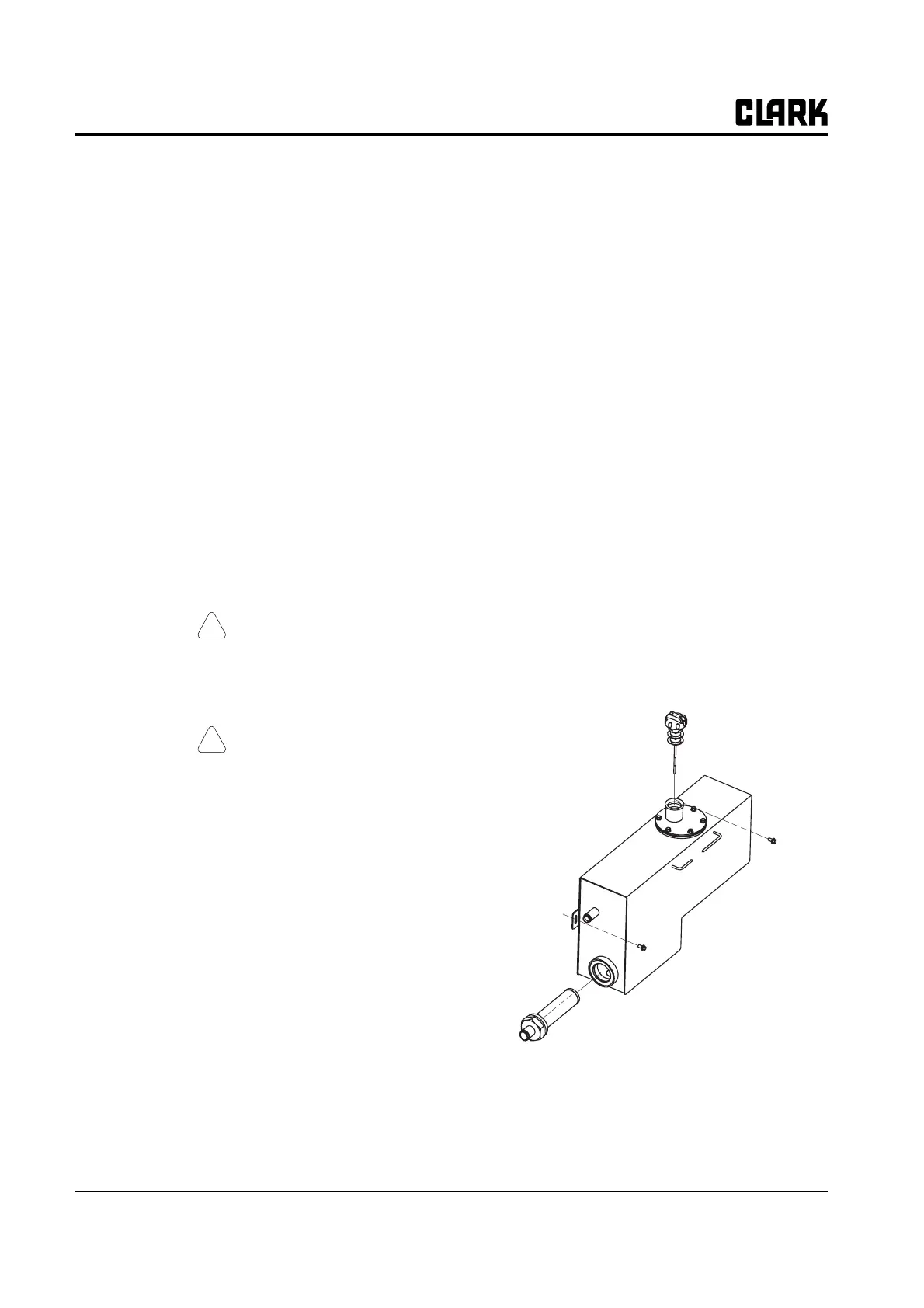
Hydraulic Sump
Check the hydraulic sump tank fluid level. Correct fluid
level is important for proper hydraulic system operation.
Low fluid level can cause pump damage. Overfilling can
cause loss of fluid or lift system malfunction.
Hydraulic fluid expands as its temperature rises. Check
the fluid level at operating temperature, after approxi-
mately 30 minutes of truck operation. To check the fluid
level, park the truck on a level surface. Put the upright in a
vertical position and lower the fork carriage fully down.
Remove the floorplate and observe the fluid level marking
on the sump tank. Refer to Group 29, Section 1 for more
information on the sump tank. DO NOT overfill.
Check the condition of the hydraulic fluid for color, clar-
ity, and contamination. Change (replace) the hydraulic
fluid as necessary.
Hydraulic Fluid and Filter Change
Drain and replace the hydraulic sump fluid every 2000
operating hours, or sooner, as required. Replace the



 To Next Page