Group 34, Uprights
SM 765, Nov ’06 Upright Inspection • 34-3-9
If the upright does not increase lifting speed, but you still
suspect an internal leak, repeat the procedure with a
capacity load. If the upright does not extend to full MFH,
the problem is likely an internal leak and the cylinder
should be overhauled.
Lift Cylinder Shimming
The lift cylinders on both standard uprights, Hi-Lo and
TSUs bottom out at the end of the stroke to limit upright
extension. The upright has dual lift cylinders and the cyl-
inders’ extension length must be equal. If not, “racking,”
or side-to-side shifting, results. Rod extension length is
made equal by using shims under the rod end of the cylin-
der. To determine if shimming of the cylinders is required
to prevent racking, perform the following operational
check:
CAUTION
!
CAUTION
!
Make sure truck is parked on level surface
with parking brake applied and wheels
chocked; make sure overhead clearance is
adequate to extend upright to its full height.
1. Center the forks or attachments on the upright.
2. Check for equal chain tension.
3. Raise the upright from the retracted position to full
lift height. Note the point when the lift cylinders
reach the end of their stroke.
• If the upright shifts right or left noticeably, shim-
ming is required.
• Repeat the check three times before adding shims.
N
TE
Offset or unbalanced loads and off-center
attachments can cause the upright to shift
even with proper lift cylinder shimming.
See Section 5 for lift cylinder shimming procedure. Rack-
ing adjustments for tilt cylinders appear in Group 32, Sec-
tion 2, “Tilt Cylinder Checks and Adjustments.”
Hydraulic Plumbing
Use the Lift Cylinder Shimming Check, the Load Test,
and the following Drift Test to check the performance of
the hydraulic system.
1. Check all fittings for leakage. Disassemble fittings
and inspect the seals. Replace seals as required. See
Group 40 for hydraulic fitting tightening procedures.
2. Check all hoses and tubes for wear and damage.
a. Hoses or tubes with scrapes or kinks should be
replaced.
b. Hoses with outer cover wear exposing the rein-
forcement braiding should be replaced.
Upright Drift
Drift tests check cylinder, main valve, and hydraulic cir-
cuit integrity under load pressures. A load is held elevated
for an extended period to determine how much the upright
“drifts” (moves) over a specified time period. A tilt cylin-
der drift test appears in Group 32, Section 2, “Tilt Cylin-
der Checks and Adjustments.”
WARNING
!
An upright or carriage can move unexpect-
edly during service procedures causing
severe injury:
Do not walk or stand under raised forks.
Keep clear of load and carriage when making
any check or adjustment.
Keep your arms and fingers away from mov-
ing parts of the upright.
Do not reach through open areas of the
upright.
Failure to follow these warnings can result in
serious injury.
1. Raise upright with the rated capacity and carriage to
its full extension and lower to a point halfway down
from full extension with the upright substantially ver-
tical.
2. Shut off the truck. Apply the parking brake and
chock the wheels.
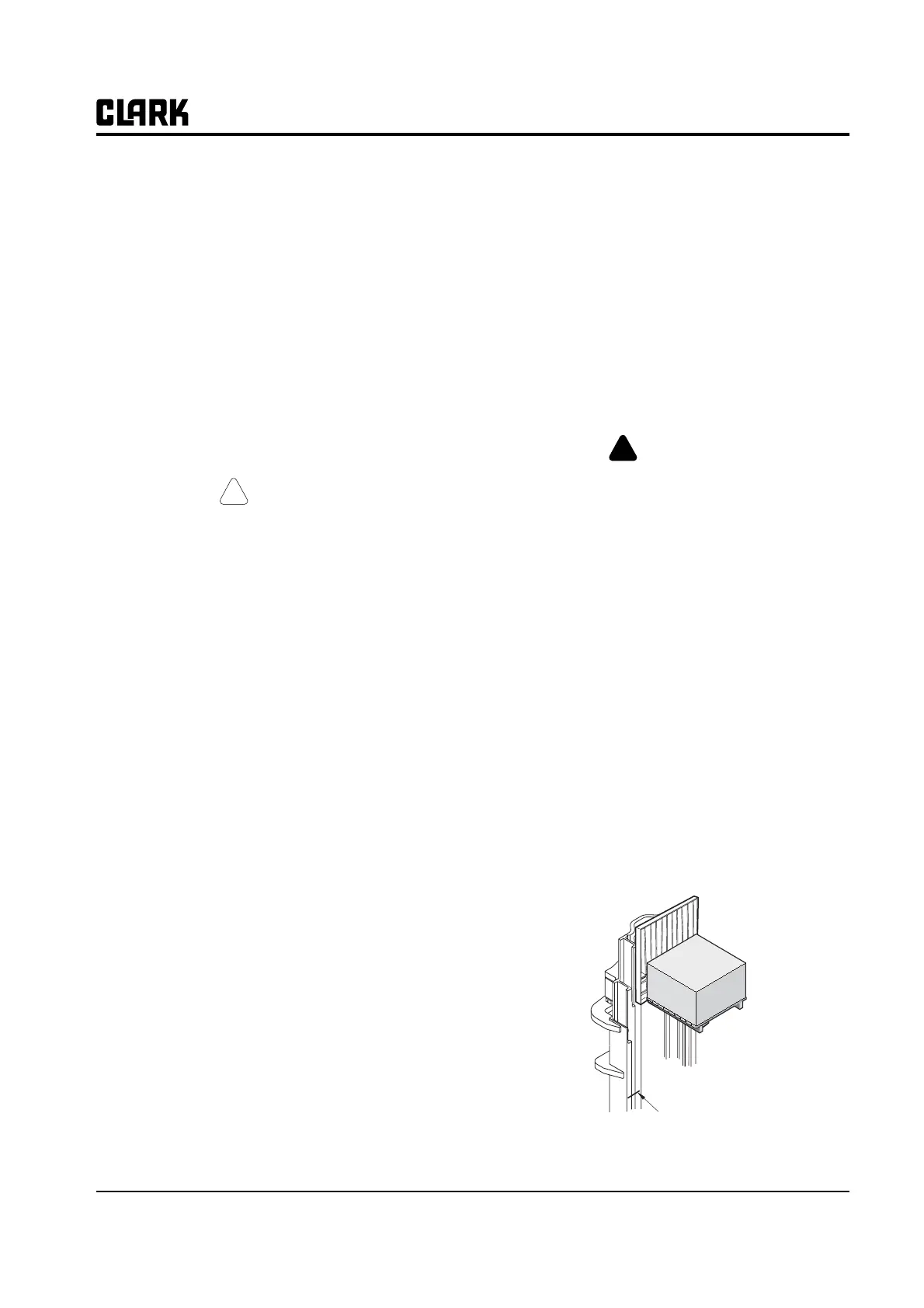
3. With a pencil or chalk, make a mark across the rails
on one side of the upright.
Mark upright
rails here



 To Next Page