Group 34, Uprights
SM 765, Nov ’06 Upright Chain Inspection, Adjustment, and Replacement • 34-6-3
Periodic Inspections
Each 50-250 hours of operation (more frequently in severe
or extreme environments), chains should be inspected and
lubricated. Inspection should focus on the following:
Elongation
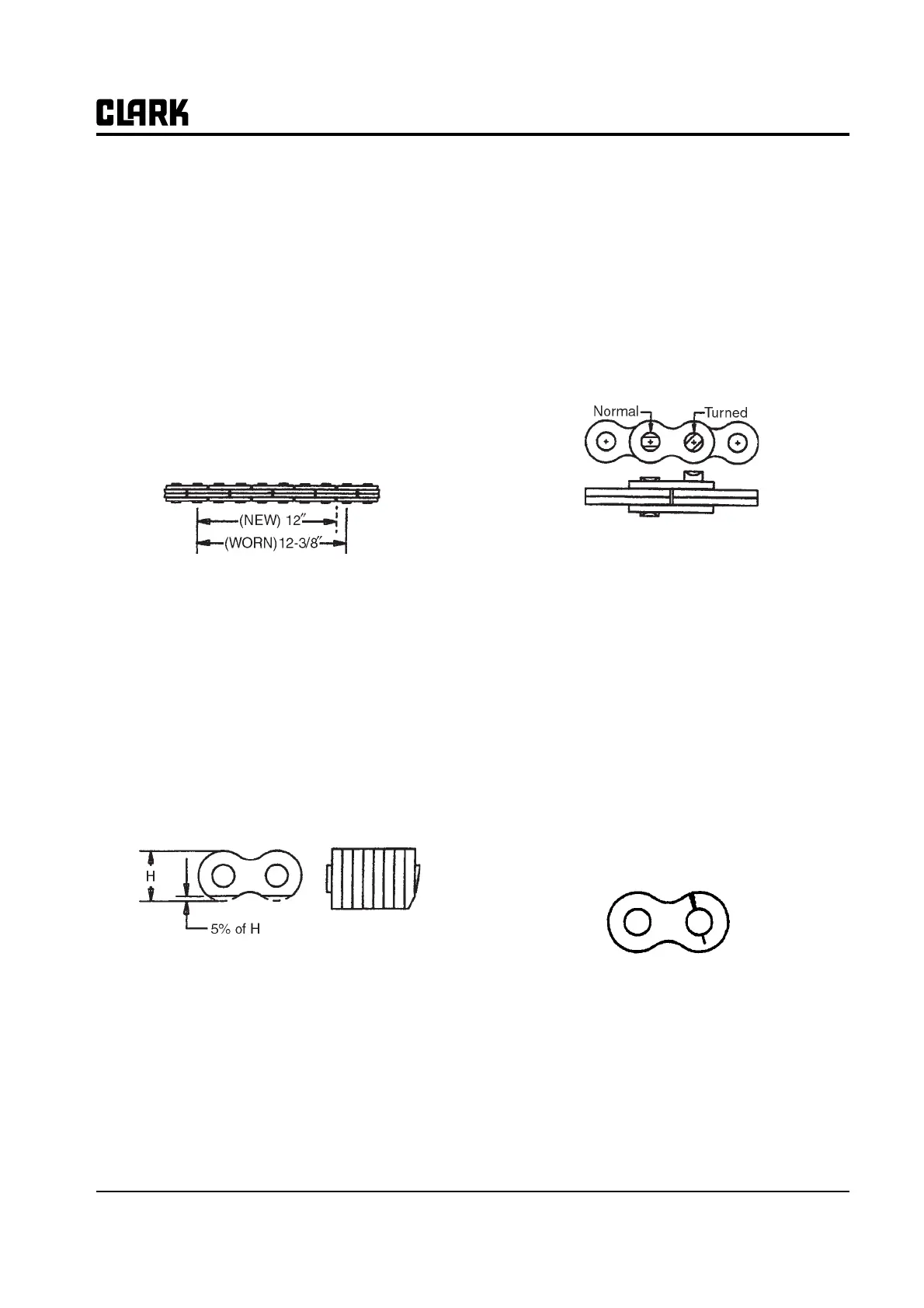
When a length of 12.00 inches (305 mm) of new chain has
elongated to a length of 12.360 inches (315 mm), it should
be discarded and replaced. It is important to measure the
chain in the section that moves over the sheaves because it
receives the most frequent articulation. Measuring the
chain near its clevis terminals could give an erroneous
reading as it would not have flexed as frequently, if indeed
at all, as nearer the middle of the assembly.
Chains should be replaced when wear exceeds 3% or
when 12 inches (305 mm) of chain is stretched 3/8 inch
(10 mm).
Edge Wear
Check the chain for wear on the link plate edges caused by
running back and forth over the sheave. The maximum
reduction of material should not exceed 5%. This can be
compared to a normal link plate height by measuring a
portion of chain that does not run over the sheave. Dis-
torted or battered plates on leaf chain can cause tight
joints and prevent flexing.
Worn contours and worn surfaces on the outside links or
pin heads should not exceed 5% of new link height.
Turning or Protruding Pins
Highly loaded chain operating with inadequate lubrication
can generate abnormal frictional forces between pin and
link plates. In extreme instances, the torque could surpass
the press fit force between the pins and the outside plates,
resulting in pin rotation. When chain is allowed to operate
in this condition, a pin, or series of pins, can begin to twist
out of a chain resulting in failure. The pin head rivets
should be examined to determine if the "VEE" flats are
still in correct alignment. Chain with rotated/displaced
heads or abnormal pin protrusion should be replaced
immediately. Do not attempt to repair the chain by weld-
ing or driving the pin(s) back into the chain. Once the
press fit integrity between outside plates and pins has been
altered, it cannot be restored. Any wear pattern on the pin
heads or the sides of the link plates indicates misalign-
ment in the system. This condition damages the chain and
increases frictional loading, and should be corrected.
Turned pins and abnormal pin protrusion.
Cracked Plates
The chains should periodically be inspected very care-
fully, front and back as well as side to side, for any evi-
dence of cracked plates. If any one crack is discovered, the
chain(s) should be replaced. It is important, however, to
determine the causes of the crack before installing new
chain so the condition does not repeat itself.
• Fatigue Cracking - Fatigue cracks are a result of
repeated cyclic loading beyond the chain's endur-
ance limit. The magnitude of the load and fre-
quency of its occurrence are factors which
determine when fatigue failure will occur. The
loading can be continuous or intermittent (impulse
load).
Fatigue cracks generally run from the pin hole toward the
edge of the link plate approximately 90o from the line of
pull.
Fatigue cracks almost always start at the link plate
pin hole (point of highest stress) and are perpendic-
ular to the chain pitch line. They are often micro-
scopic in their early stage. Unlike a pure tensile
failure, there is no noticeable yielding (stretch) of
the material.



 To Next Page