Group 34, Uprights
34-3-8 • Upright Inspection SM 765, Nov ’06
Carriage rollers, including side-thrust rollers, and all
upright rollers can be checked by examining roll patterns.
If irregular impressions result from the checks, perform
the “Lift Cylinder Shimming Check” and the “Load Test”
to further diagnose problems.
See Section 4 for procedures to measure clearances and
adjust carriage or upright rollers.
Cylinders
Use the Drift Test, presented under “Hydraulic Checks”
below, for additional diagnosis of cylinder condition. See
Section 5 for cylinder repair.
External Leakage (All Cylinders)
To check for external leakage on the primary cylinder:
1. Clean the top of the gland and rod to remove any
buildup of debris.
2. Check rod surface for defects or unusual wear.
• Nicks, burrs, or other sharp defects can cause dam-
age to the seal and will lead to leaks. The rod
should be repaired or replaced.
• For piston-type cylinders, small blunt defects in the
top and midsection of the rod can be tolerated in
this cylinder design. The high pressure sealing is
over the last several inches of stroke. This type of
defect is acceptable if leakage is not evident.
3. Check for external leakage from the cylinder barrel,
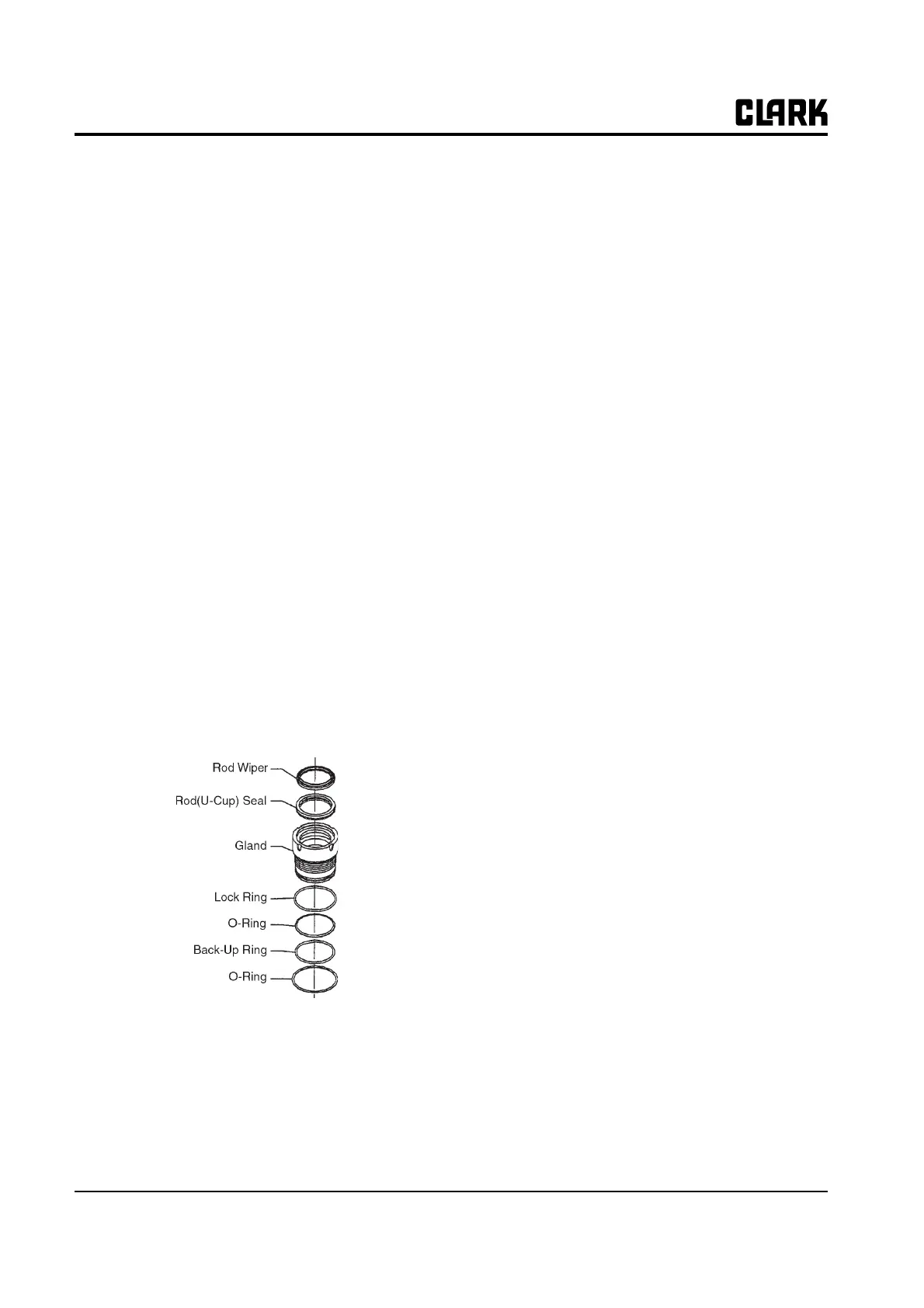
gland O-rings and backup ring, and the rod seal.
• The gland O-rings and backup ring are near-zero
leakage seals. If, after cleaning the gland and tube,
oil accumulates to form a run, the O-rings and
backup ring should be replaced (see Section 5).
• External leakage from the barrel requires replace-
ment of the barrel.
N
TE
The seals are installed with lubricant and a
trace amount will be in the gland/tube inter-
face area.
4. After cleaning the top of the gland and the barrel,
cycle the upright 5-10 times. If a ring of oil forms to
run 3 mm (0.125 in) down the rod, the cylinder must
be overhauled or replaced.
Internal Leakage on Primary Cylinder
To check for internal leakage on the primary cylinder:
1. Lift the upright to maximum height then lower forks
completely.
2. Cycle the upright 5-10 times through the first 2/3
length of the primary stroke and lower forks com-
pletely.
3. Slowly lift the carriage 305-610 mm (1-2 ft) into the
secondary lift stage then lift to full extension.
4. If the carriage does not lift to full height, the problem
is likely an internal leak and the cylinder should be
overhauled.
5. If the carriage does lift to full height, but you still
suspect an internal leak, repeat the procedure with a
40-70% capacity load.
N
TE
The primary cylinder normally has approxi-
mately 100 ml (3.4 oz) of hydraulic fluid on
the rod side of the piston as a pre-charge.
Use the Drift Test, presented under “Hydraulic Checks”
below, for additional diagnosis of cylinder condition. See
Section 5 for cylinder repair.
Internal Leakage on Piston-Type Lift and Secondary
Cylinders
To check for internal leakage in Standard lift and TSU
secondary cylinders:
1. Lift the upright to MFH then lower forks completely.
2. Cycle the upright 5-10 times through the first 2/3
length of the lift cylinder stroke and lower forks com-
pletely.
3. Lift the upright to full MFH.
Watch for the lift cylinder to increase lift speed. If you see
an increase in lift speed, one or both of the lift cylinders
have an internal leak and requires overhaul.



 To Next Page