Group 34, Uprights
SM 765, Nov ’06 Upright Inspection • 34-3-7
WARNING
!
An upright or carriage can move unexpect-
edly during service procedures causing
severe injury:
Do not walk or stand under raised forks.
Keep clear of load and carriage when making
any check or adjustment.
Keep your arms and fingers away from mov-
ing parts of the upright.
Do not reach through open areas of the
upright.
Failure to follow these warnings can result in
serious injury.
1. Place a capacity load on the forks and secure it to the
carriage.
CAUTION
!
CAUTION
!
Test load must be stacked stably, not extend
beyond the pallet, and be secured on the pal-
let. Operate the truck only from within the
operator’s compartment.
2. Tilt the upright back slightly and raise the upright to
its maximum extension several times. Note the
smoothness of operation, the carriage play, and play
between the rails.
3. Move the load 102 mm (4 in) off center on the forks
and resecure it to the carriage.
4. Raise the upright to its maximum extension and
lower the load to the floor several times.
5. Repeat the step, moving the load 102 mm (4 in) off
center to the other side.
6. Raise the upright to its maximum extension and
lower the load to the floor several times.
Carefully observe the smoothness of operation, particu-
larly in carriage play, and play between the rails. If any
unusual movement, staging, or noise occurs during the
test, correct the problem before returning the truck to ser-
vice. Continue with the following roller shimming checks
if too much play is evident in the carriage and rails in the
load test. The troubleshooting guide may also help to
identify specific problems with upright operation.
Roller Side-Clearance
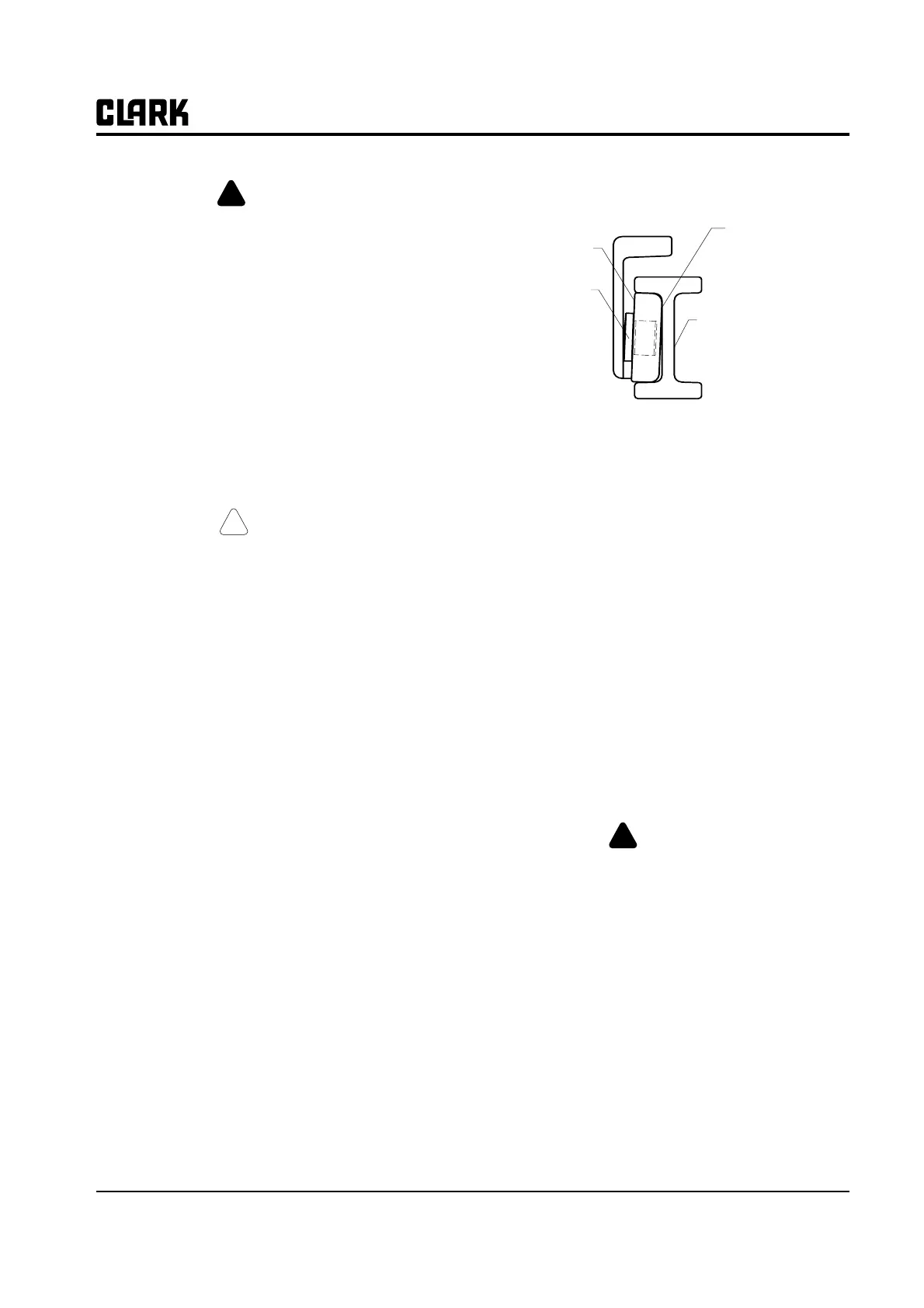
The carriage and upright rollers are shimmed between the
inner race and the roller shaft shoulder to maintain mini-
mal clearance between the side of the roller and the web
of the adjacent rail. Shim adjustments help accommodate
manufacturing tolerances and wear in the upright rail sec-
tions.
Signs of loose shimming include:
1. Excessive lateral (side-to-side) movement in the
upright rail sections
2. Excessive lateral shift in the upright at, or near, full
maximum fork height (MFH)
3. Irregular roller patterns on the rail.
Signs of over shimming include:
1. Mis-staging or hanging up of the upright
2. Excessive wear in the rail web
3. Premature bearing failure.
Perform the following roll pattern check and the load test
if the need for roller shimming is suspected. See Section 4
for detailed clearance measurement procedures.
Roll Patterns
Impressions made by rollers on upright rails are called roll
patterns. Roll patterns can provide indication of the need
for upright or carriage adjustment.
WARNING
!
Keep clear of load and carriage when making
any checks or adjustments.
1. Elevate the carriage about 4 feet (1.3 m).
2. Apply a light, thin layer of grease to the roller con-
tact area.
3. Lower the forks and pick up a capacity load. Raise
and lower the upright several times.
4. Back out from the load and raise the carriage.
Compare the impressions of the rollers on each side of the
upright rails. The impressions should look the same on
both sides. Look for signs of metal scoring or gouging
which can indicate excessive pressure caused by damaged
or misadjusted rollers.
Rail Web
Side Clearance
Roller
Roller Shaft
and shoulder



 To Next Page