Group 34, Uprights
34-3-6 • Upright Inspection SM 765, Nov ’06
• Tie bar areas should be free of foreign objects and
debris. The roller area of the rail should be cleaned
every 500-1000 hours in a normal application.
− In applications where excessive amounts of
contaminants settle in the rail channels, clean-
ing may be required on 50-250 hour intervals.
− If excessive contamination exists, the rollers
should be exposed and the bearing seal areas
cleaned thoroughly.
See Section 4 for carriage roller and upright
roller removal and installation.
Carriage and Upright Rollers
Carriage Thrust Rollers
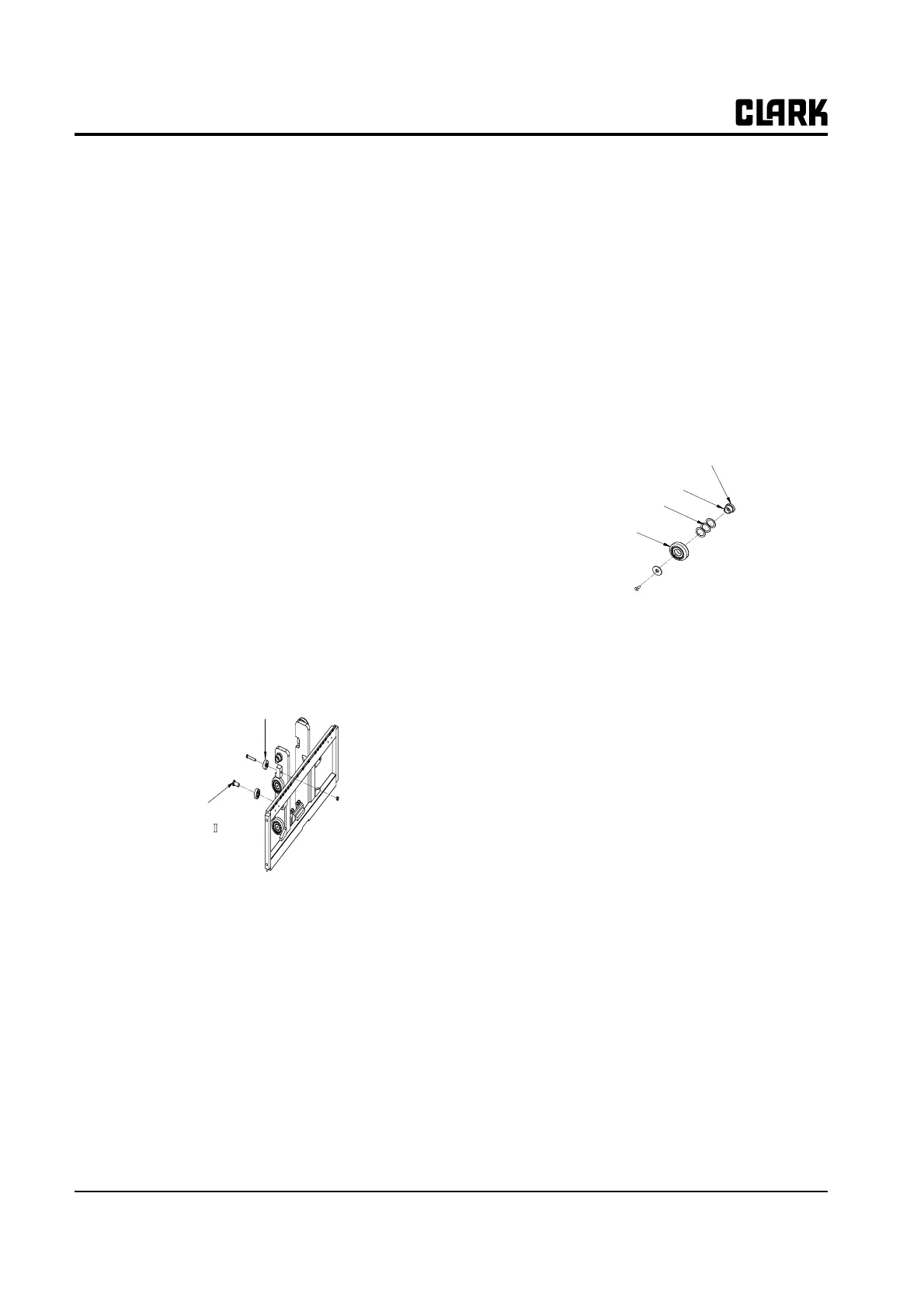
The carriage uses two types of thrust rollers.
• The internal thrust roller is found on both standard
and TSUs. The carriage internal thrust rollers are
located on the lift bracket and run on the inside
web of the inner rail. The internal thrust roller is
intended to carry a portion of the carriage lateral
load.
• The second type of carriage thrust roller is an
external thrust roller. The external thrust roller runs
along the outside flange of the inner rail to control
lateral load on the carriage. External thrust rollers
are found on STD, Hi-Lo CL III and TSUs.
Both types of thrust rollers should be checked for smooth
rotation, seal integrity, radial bearing tightness, and a tight
cap screw. A roller should turn smoothly without sticking
and be grit free. Replace the roller if any defect is found.
External thrust roller cap screws have a locking patch to
prevent the cap screw from backing out. Repeated
removal will deteriorate the ability of the patch to hold the
cap screw. If the cap screw is backing out without holding,
a new cap screw is recommended. The cap screw can also
be cleaned and set using thread locking compound Loctite
271 (Clark Part 1802302). The internal thrust rollers use a
jam nut to ensure that the bearing remains secure.
N
TE
Some grease will purge from the bearings in
the first 100-200 hours of operation. This is
not necessarily a sign of a failed roller bear-
ing seal.
The external thrust rollers are not adjustable. The internal
thrust roller adjusts using a locking cam on the mounting
cap screw. See Section 4 for roller replacement and inter-
nal thrust roller adjustment procedures.
Carriage and Upright Main Load Rollers
Inspect the carriage and upright main load rollers for bro-
ken, loose, or rough bearings. Defective rollers should be
replaced.
Indications of broken or damaged rollers include:
• Part of all of roller bearing missing
• Bearing outer race loose
• Scraping noise from the upright
• Scraping of carriage fork bar on inner rail (carriage
rollers)
• Upright rail sections scraping together (upright
rollers)
• Upright misstaging
• Excessive looseness of the rail section or carriage
demonstrated by the following load test.
N
TE
Some grease will purge from the bearings in
the first 100-200 hours of operation. This is
not necessarily a sign of a failed roller bear-
ing seal.
Load Test
A load test helps you to determine the amount of clear-
ance between the moving upright parts. The upright
requires some lateral movement between the interlocking
rails and the carriage. But, too much or too little clearance
can be the cause of binding and uneven operation.
Internal thrust roller
External thrust roller
(not in 2.0/2.5 ton STD
and Hi-Lo CL )
shims
Bearing outer race
Roller shaft
Shoulder



 To Next Page