Group 34, Uprights
SM 765, Nov ’06 Cylinder Removal, Shimming, Overhaul, and Replacement • 34-5-5
IMP
RTANT
Use extreme care that you do not make nicks
and burrs on the interior surface area of the
cap or cylinder or the piston.
Parts Inspection and Service
1. Clean all parts completely in a suitable solvent. Dry
all parts with a soft clean cloth.
2. Inspect cylinder barrel and bore for cracks, pining,
scoring, or other irregularities that may require
replacement of the barrel.
3. Inspect the piston and rod for nicks, scratches, scor-
ing, or other defects that may demand new parts.
4. Check all gland and piston seal grooves for nicks,
burrs, and scratches that can damage seals during
reinstallation.
5. Inspect and clean the check valves.
6. Inspect all seals, including the check valve O-ring.
N
TE
Minute imperfections inside the cylinder bar-
rel or on the piston or rod may be improved
for acceptable use by careful honing. How-
ever, removal of material that produces a
notch, groove, or out-of-roundness may cause
excessive leakage during operation and a
shortened life.
7. Use new parts as necessary. Always use the Packing
Kit listed in the parts manual. New kits include all
the seals, wiper rings, wear rings and O-rings neces-
sary for the particular cylinder.
Cylinder Reassembly
Take care when installing these parts to make sure that no
parts are damaged.
1. Coat all packing, seals and rings in clean, hydraulic
oil (Clark part number 1800236 qt., 1802155 gal.)
prior to reassembly. Coat the inside of the gland nut
bore with hydraulic oil.
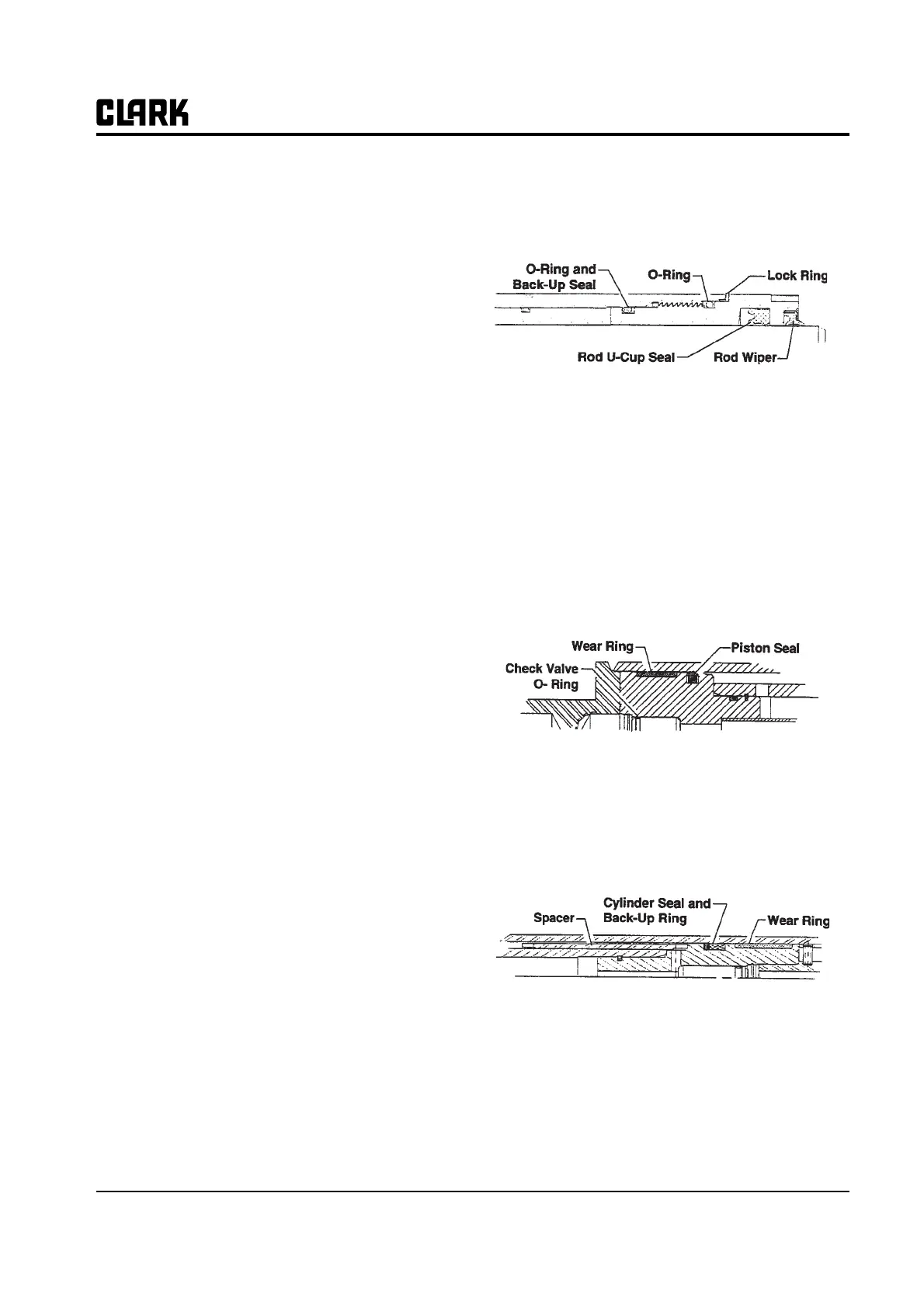
2. Replace the U-cup seal (groove toward bottom of
cylinder), rod wiper, and O-ring and back-up seals on
the gland.
N
TE
O-rings should be carefully installed to elimi-
nate cuts or twisting.
3. Replace the piston seals:
a. Primary cylinder pistons require a piston seal and
wear ring. Install the piston seal from the top of
the rod. Use a ring compressor to compress the
piston seal. This prevents damage to the seal dur-
ing reassembly.
b. Piston-type lift and secondary cylinder require a
cylinder seal, a back-up ring, and a wear ring on
the piston. Install the cylinder seal from the top of
the rod.
4. For protection against corrosion, lubricate spacers
(where used) with petroleum-based hydraulic fluid.
Slide the spacer onto the rod.



 To Next Page