Group 34, Uprights
34-6-8 • Upright Chain Inspection, Adjustment, and Replacement SM 765, Nov ’06
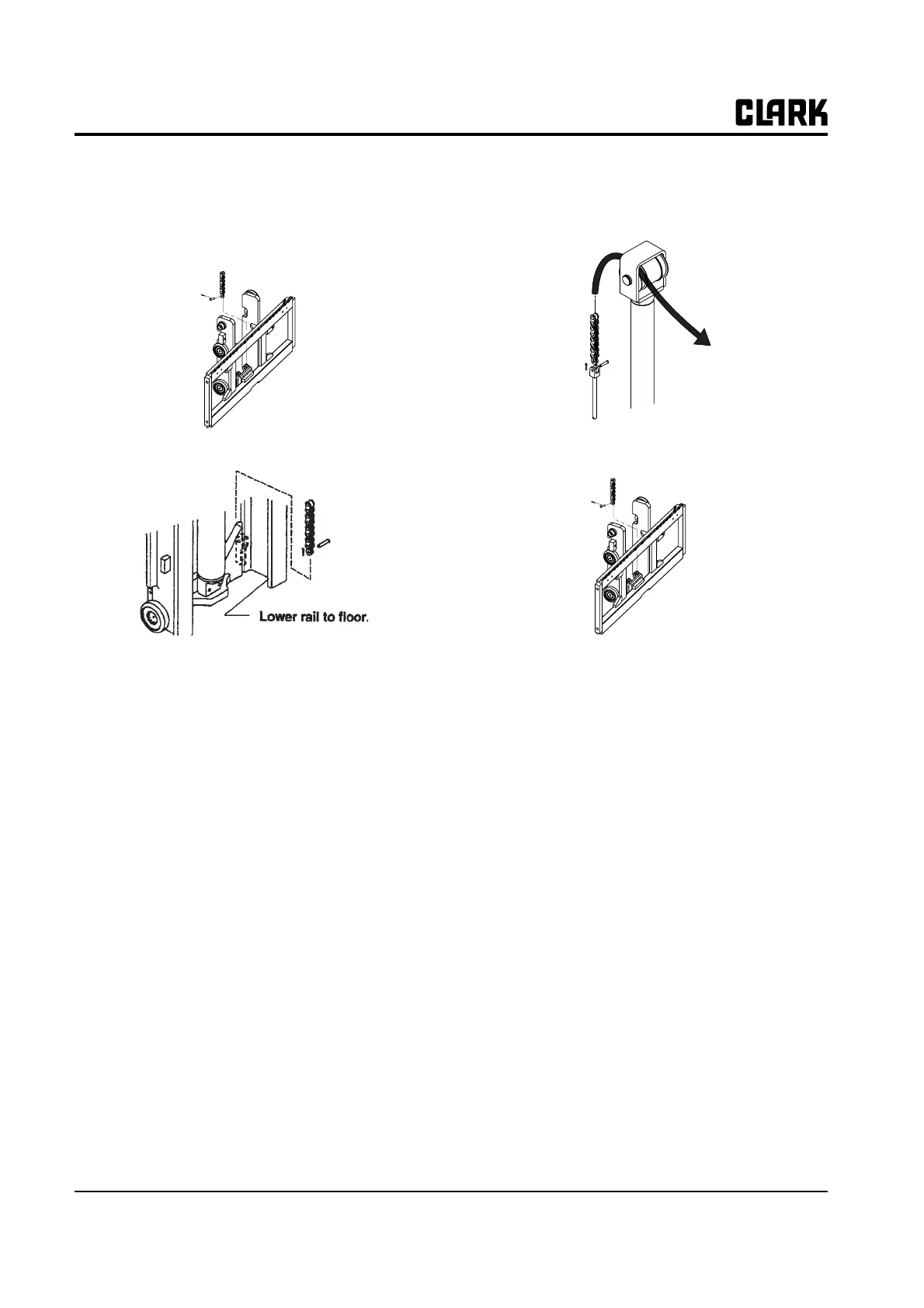
4. Remove the chain anchor pins from the carriage on
the standard upright or the inner rail on the TSU. On
the TSU, the inner rails must be lowered to the floor
to access the chain anchor pins.
Lift Chain Removal from Carriage (standard upright)
Triple-Stage Upright Lift Chain Removal from Inner Rail
N
TE
If a hose adapter assembly is used, the chain
sheaves must be loosened and removed to
prevent the hoses from stretching when the
inner rails of the TSU are lowered to access
the chain anchor pins.
5. Use the steps in reverse order to replace the lift chain
set.
Primary Cylinder/Carriage Chains (TSU
and Hi-Lo)
1. Tilt the upright forward, lower it, and completely col-
lapse the primary cylinder to create slack in the
chains. The carriage may also be lifted and blocked
in position and the primary cylinder completely col-
lapsed to create slack in the chains.
2. Remove the chain anchor pins from the back of the
primary cylinder. Pull the chains through the chain
sheave and lay over the carriage load backrest.
3. Remove the chain anchor pins from the back of the
carriage.
4. Use these steps in reverse to replace the primary cyl-
inder/carriage chain.
Perform the chain length adjustment and chain tension
check before returning the truck to service.
Other Chain Service Notes
• Use lengths of factory assembled chain. Do not
build lengths from individual components.
• Do not attempt to rework damaged chains by
replacing only the components obviously faulty.
The entire chain may be compromised and should
be discarded.
• Never electroplate assembled leaf chain or its com-
ponents. Plating will result in failure from hydro-
gen embrittlement. Plated chains are assembled
from modified, individually plated components.
• Welding should not be performed on any chain or
component. Welding spatter should never be
allowed to come in contact with chain or compo-
nents.
• Leaf chains are manufactured exclusively from
heat treated steels and therefore must not be
annealed. If heating a chain with a cutting torch is
absolutely necessary for removal, the chain should
not be reused.



 To Next Page