Group PS, Periodic Service
SM 765, Nov ’06 Planned Maintenance • PS-2-9
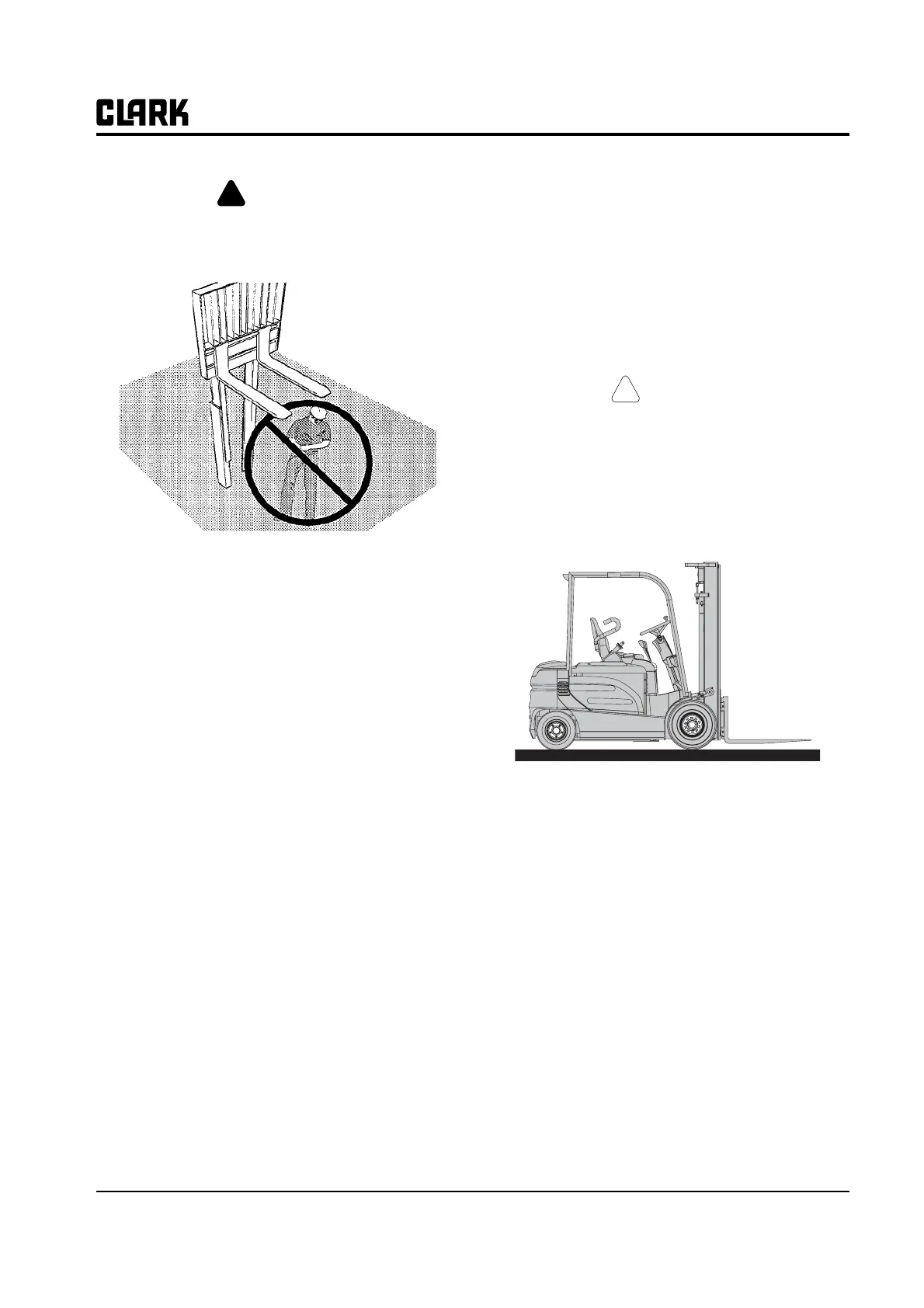
WARNING
!
FALLING FORKS. Do not walk or stand
under raised forks. The forks can fall and
cause injury or death.
Never Walk Under Raised Forks!
Check the upright rails, rollers, carriage, lift chains, and
cylinders as they move. Watch for binding or excessive
freeplay (looseness) between the carriage and the upright
rails and rollers. Listen for abnormal noises. If there is
excessive clearance between the rails and channels, the
upright roller needs adjustment. If the rails or carriage
bind or hesitate when lowering, the rollers are either dam-
aged or roller adjustment is incorrect.
Check the upright for excessive downdrift. Stop the fork
carriage in an intermediate position. Check that it holds its
position without moving down. If you observe downward
movement (drift) or have a report of a drift problem, the
lift cylinder seals may be worn. With forks elevated, turn
key switch off. Pull back on the lift lever. The forks should
not lower This tests the check valve.
Test the tilt function. Check for excessive tilt cylinder
drift. Stop the upright at a position near vertical. Check
that the upright holds its position without moving forward.
If you observe forward movement (drift) or have a report
of a tilt drift problem, the tilt cylinder seals may be worn.
Check fork height adjustment and carriage chain adjust-
ment. Tilt the upright to the vertical position and fully
lower the carriage. The forks should stop and be held
approximately 13 mm (0.50 in.) above the floor. If the
forks hit the floor, the carriage lift chains should be
adjusted. Also check the rail chains.
If truck is equipped with an attachment, briefly operate
the attachment to check the controls for correct function.
Test for correct tilt cylinder rod adjustment. Raise the car-
riage to an intermediate position. Tilt the upright fully for-
ward without a load on the forks. Check for upright
racking (twisting) as the tilt cylinders reach the end of
their stroke. Tilt the upright fully back. The upright should
not rack (twist) when the tilt cylinders reach the end of
their travel. If forward upright racking is found, adjust-
ment of the tilt cylinder rod ends (yokes or spacers) is
required. If backward racking is found, adding or remov-
ing shims is required. Refer to Group 32.
CAUTION
!
When you have completed the operational
tests, park and leave truck according to stan-
dard shutdown procedures.
Standard Shutdown Procedures:
• Come to a complete stop.
• Park only in authorized locations.
• Lower the forks fully, tilt upright forward until fork
tips touch floor.
• Allow travel control to return to neutral.
• Turn the key switch OFF.
• Apply the parking brake.
• Disconnect Battery
Make a record of all maintenance and operating problems
you find.



 To Next Page