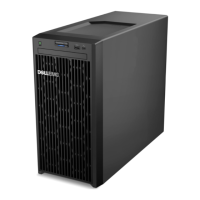
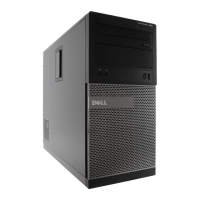
The Dell EMC PowerEdge T550 is a 5U tower server designed for robust performance and scalability, supporting two Intel Xeon Scalable processors and sixteen DDR4 DIMM slots. It offers flexible storage options with up to 24 universal U.2/SAS/SATA hot-swap drives, including a maximum of eight NVMe drives. The system is equipped with redundant AC power supply units for enhanced reliability.
Function Description
The PowerEdge T550 serves as a versatile server platform, capable of handling demanding workloads in various IT environments. Its primary functions include data processing, storage management, and supporting a wide range of applications. The server's design emphasizes ease of maintenance and configuration, making it suitable for both experienced administrators and those new to server management.
Important Technical Specifications
- Processors: Supports two Intel Xeon Scalable processors.
- Memory: Features sixteen DDR4 DIMM slots, supporting RDIMMs with capacities of 8 GB, 16 GB, 32 GB, and 64 GB. Memory speeds can reach up to 3200 MT/s, depending on the system profile, processor, and DIMM capabilities. The system supports Flexible Memory Configuration, allowing for various valid chipset architectural configurations. Mixing x4 and x8 DRAM based memory modules is supported, as is mixing memory modules of different speeds (they will operate at the slowest installed speed). However, mixing more than two memory module capacities is not supported, and unbalanced or odd memory configurations may lead to performance loss or system boot issues.
- Storage: Accommodates up to 24 universal U.2/SAS/SATA hot-swap drives, with a limit of eight NVMe drives. Drive backplanes are available for both 3.5-inch and 2.5-inch SAS/SATA/NVMe configurations.
- Power Supply: Equipped with two redundant AC power supply units (PSUs). The hot spare feature allows one PSU to enter a sleep state for efficiency, activating when the active PSU's load exceeds 50% or drops below 20% of its rated wattage. PSUs must be of the same type and maximum output power for redundant operation. AC PSUs support both 120V and 240V input voltages, except for Titanium PSUs which only support 240V.
- Expansion Slots: Includes multiple PCIe expansion card slots, with various riser configurations (C0, C0-1, C1, C1-1, C2) supporting different numbers and types of cards, including FPERC, HBA, NIC, PCIe SSD, and GPU cards (Nvidia T4, A10, A30, A40).
- Front Panel Ports: Features USB 2.0 and USB 3.0 ports for connecting USB devices. Optional BOSS S2 module slot and iDRAC Quick Sync 2 wireless indicator are also available.
- Rear Panel Ports: Includes VGA port, two USB ports (Type A), iDRAC dedicated port (RJ-45), and multiple NIC ports (RJ-45).
- System Management: Integrated Dell Remote Access Controller (iDRAC) for remote management, system alerts, and configuration. Supports iDRAC Direct for USB-based management.
- Physical Dimensions: 5U tower form factor.
Usage Features
- Initial Setup: The system setup involves unpacking, connecting peripherals, and powering on. iDRAC configuration is crucial for remote management, with options to set up IP addresses via iDRAC Settings utility, OpenManage Deployment Toolkit, iDRAC Direct, Lifecycle Controller, or the Server LCD panel.
- Operating System Installation: Supported operating systems can be installed using resources like iDRAC, Lifecycle Controller, OpenManage Deployment Toolkit, or Dell certified VMware ESXi. Dell recommends using Lifecycle Controller for OS installation to ensure all required drivers are installed.
- Firmware and Driver Updates: Firmware and drivers can be downloaded from the Dell support site, or via iDRAC virtual media, Dell Repository Manager (DRM), or Dell Server Update Utility (SUU).
- System Diagnostics: The system includes Status LED indicators, System Health and ID indicators, iDRAC Quick Sync 2 and iDRAC Direct LED indicators, and an LCD panel to display system information, status, and error messages. Dell Embedded System Diagnostics (ePSA) can be run from the Dell Lifecycle Controller or Boot Manager to test hardware components.
- Security: Features a Trusted Platform Module (TPM) for encryption key management. The TPM is cryptographically bound to the system board, and its removal breaks this binding. System and setup passwords can be managed via system board jumpers.
- Hot Spare Feature: For power supply units, the hot spare feature optimizes power consumption by allowing one redundant PSU to enter a sleep state when system load is low, improving efficiency.
Maintenance Features
- Component Installation/Removal: The manual provides detailed instructions for installing and removing various system components, including the front bezel, system feet, optional caster wheels, system cover, air shroud, cooling fans, cooling fan cage, fan board tray, front PERC module, drives, drive backplane, drive bays, optical drive, tape backup unit, front IO module, memory modules, BOSS S2 module, internal USB card, internal USB memory key, IDSDM module, MicroSD card, expansion cards, GPU card holder, GPU card, GPU riser, processor and heat sink module, OCP card, serial COM port, system battery, intrusion switch module, power supply unit, power interposer board, and system board.
- Safety Guidelines: Emphasizes safety precautions such as lifting the system with assistance, avoiding operation without the cover for extended periods, and performing repairs only by certified service technicians or as authorized by Dell. Antistatic mats and straps are recommended.
- Cooling System: Cooling fans are hot-swappable, but only one fan should be replaced at a time to maintain proper cooling. The system should not be operated without the air shroud to prevent overheating.
- Drive Management: Drive blanks must be installed in all empty drive slots to maintain proper cooling. Mixing drive blanks or drive carriers from previous generations of PowerEdge servers is not supported. Hot-swap drive installation requires operating system support.
- System Board Replacement: If replacing the system board, the iDRAC MAC address label must be transferred, and the Service Tag can be restored using the Easy Restore feature or manually updated via System Setup.
- Thermal Grease Application: When installing a processor and heat sink module, thermal grease must be applied in a thin spiral design on the heat sink.
- Documentation Resources: Comprehensive documentation, including the Installation and Service Manual, LCD diagnostics, and mechanical overview, is accessible via the Quick Resource Locator (QRL) on the information tag or Dell's support website.
- Automated Support: Dell EMC SupportAssist is an optional service that automates issue detection, case creation, and diagnostic data collection, providing proactive technical support.

 Need help?




 To Next Page
 General