EasyManua.ls Logo

Dell PowerEdge MX760c - User Manual

Dell PowerEdge MX760c
155 pages
Print Icon
To Next Page IconTo Next Page
Loading...
Dell PowerEdge MX760c
Installation and Service Manual
Regulatory Model: E04B
Regulatory Type: E04B004
February 2023
Rev. A01

Table of Contents

Question and Answer IconNeed help?

Do you have a question about the Dell PowerEdge MX760c and is the answer not in the manual?

Overview

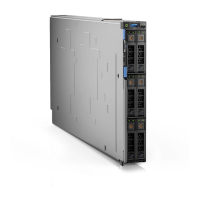
The Dell PowerEdge MX760c is a 2S single-width compute sled designed for installation in a Dell PowerEdge MX7000 enclosure. It serves as a server unit, providing advanced computing capabilities within a modular infrastructure.

Function Description

The MX760c functions as a high-performance server node, supporting a wide range of enterprise workloads. It integrates into the Dell MX7000 chassis, leveraging shared power, cooling, and networking resources. Key functions include:
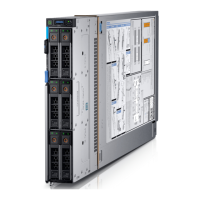
  • Processing: Utilizes up to two 4th Generation Intel Xeon Scalable processors, with up to 56 cores per system, for demanding computational tasks.
  • Memory Management: Supports up to 32 DDR5 DIMM slots, enabling substantial memory capacity for various applications.
  • Storage: Offers flexible storage configurations with support for 2.5-inch SAS/SATA/NVMe drives or E3.s NVMe SSDs.
  • System Management: Features integrated Dell Remote Access Controller (iDRAC) for remote management, monitoring, and diagnostics, enhancing system availability and administrator productivity.
  • Thermal Management: Incorporates advanced thermal management features, including liquid cooling options, to optimize performance and efficiency within the MX7000 enclosure.

Important Technical Specifications

  • Processors: Up to two 4th Generation Intel Xeon Scalable processors (up to 56 cores).
  • Memory: Up to 32 DDR5 DIMM slots.
    • DIMM Types: RDIMM (Single, Dual, Quad, Octa Rank).
    • DIMM Capacity: 16 GB to 256 GB per DIMM.
    • Memory Speed: 4000 MT/s, 4400 MT/s, or 4800 MT/s.
    • Maximum System Capacity (Dual Processors): Up to 8 TB (with Octa Rank 256 GB RDIMMs).
  • Drives:
    • 4 x 2.5-inch hot-swappable SAS/SATA/NVMe (HDD/SSD) drives.
    • 6 x 2.5-inch hot-swappable SAS/SATA/NVMe (HDD/SSD) drives.
    • 8 x E3.s hot-swappable NVMe (SSD) drives.
  • Storage Controllers:
    • Internal controllers: PERC H755 MX, PERC H965i MX, HBA350i MX.
    • Internal Boot: Boot Optimized Storage Subsystem (BOSS-N1) with HWRAID 2 x M.2 SSDs (480 GB or 960 GB).
    • Software RAID: S160.
  • PCIe Slots:
    • One x16 PCIe Gen4 slot for PERC (connected to processor 1).
    • One x16 PCIe Gen4 slot for Mezz A (connected to processor 1).
    • One x16 PCIe Gen5 slot for Mezz B (connected to processor 2).
    • One x16 PCIe Gen4 slot for Mini Mezz (connected to processor 1).
    • One x4 PCIe Gen4 slot for BOSS-N1 (connected to processor 1).
  • Ports and Connectors:
    • Front I/O module with iDRAC direct port (Micro-AB USB 2.0-compliant) and USB 3.0-compliant port.
    • Internal USB 3.0-compliant port (optional).
  • Video: Matrox G200 W3 graphics controller integrated with iDRAC (16 MB video frame buffer).
    • Supported resolutions up to 1920 x 1200 at 60 Hz with 8, 16, or 32 bits color depth.
  • Dimensions (Sled):
    • X (width): 257.0 mm (10 inches).
    • Y (height): 51.0 mm (2 inches).
    • Z (depth, handle closed): 622.35 mm (24.5 inches) for 4x2.5-inch/6x2.5-inch configurations; 631.77 mm (24.8 inches) for 8x E3.s configuration.
  • Weight (with all drives/SSDs):
    • 4 x 2.5-inch: 8.27 kg (18.23 pound).
    • 6 x 2.5-inch: 8.38 kg (18.47 pound).
    • 8 x E3.s: 8.59 kg (18.93 pound).
  • System Battery: CR 2032 3.0-V lithium coin cell system battery.
  • Environmental Specifications (Allowable continuous operations):
    • Temperature (<= 900 m altitude):
      • Category A2: 10–35°C (50–95°F).
      • Category A3: 5–40°C (41–104°F).
      • Category A4: 5–45°C (41–113°F).
    • Humidity (non-condensing): 8% RH to 80-90% RH depending on category.
    • Maximum Operational Altitude: 3,050 meters (10,006 feet).
    • Maximum Non-operational Altitude: 12,000 meters (39,370 feet).
    • Vibration (Operating): 0.26 Grms at 5 Hz to 350 Hz.
    • Shock (Operating): Six consecutively executed shock pulses of 6 G for up to 11 ms.

Usage Features

  • Hot-Swappable Components: Components with orange touch points are hot-swappable, allowing for replacement without powering down the entire enclosure. Non-hot-swappable components have blue touch points.
  • System Setup (BIOS/UEFI): Accessible via F2 during boot, allowing configuration of BIOS settings, iDRAC parameters, and device settings. Supports both BIOS and UEFI boot modes.
  • Boot Manager: Accessible via F11, provides options for normal boot, one-shot boot menu, launching System Setup, Lifecycle Controller, and System Utilities (diagnostics, BIOS update, file explorer, reboot).
  • PXE Boot: Supports Preboot Execution Environment for remote network booting and configuration.
  • Dell Lifecycle Controller (LC): Provides embedded system management for deployment, configuration, updates, maintenance, and diagnosis, independent of the operating system.
  • iDRAC Direct Port: Enables direct connection for iDRAC management, useful for initial setup or troubleshooting.
  • System Diagnostics (ePSA): Embedded Pre-boot System Assessment for testing hardware without additional equipment, accessible from Boot Manager or Lifecycle Controller.
  • System Information Label: Located on the front of the sled, provides Service Tag, Express Service Code, Manufacture date, and a Quick Resource Locator (QRL) for easy access to documentation and support.
  • Thermal Restriction Matrix: Provides detailed guidance on supported processor and storage configurations under various thermal conditions, including optimized sled conditions for air cooling and liquid cooling requirements.

Maintenance Features

  • Modular Design: Components like sleds, sled covers, air shrouds, drives, drive backplanes, drive cages, front I/O modules, memory modules, processors, heat sinks, liquid cooling assemblies, PERC cards, M.2 SSD modules, mezzanine cards, internal USB memory keys, system batteries, and system boards are designed for easy installation and removal.
  • Safety Guidelines: Emphasizes following safety instructions, using antistatic precautions (mat and strap), and ensuring proper cooling by populating all bays with components or blanks.
  • Firmware and Driver Updates: Dell recommends downloading and installing the latest BIOS, drivers, and system management firmware from the Dell support site or through iDRAC Lifecycle Controller, Dell Repository Manager (DRM), or Dell Server Update Utility (SUU).
  • Easy Restore: Feature to restore service tag, license, UEFI configuration, and system configuration data after replacing the system board.
  • Manual Service Tag Update: Allows manual entry of the Service Tag if Easy Restore fails.
  • Password Management: Options to create, change, or delete system and setup passwords, with a password jumper for disabling password features and clearing existing passwords.
  • System Event Log (SEL)/LifeCycle (LC) Log: Logs configuration validation errors and other system events for troubleshooting.
  • Drive Indicator Codes: LEDs on drive carriers provide visual status (activity, ready for removal, failed, rebuilding, online).
  • Quick Resource Locator (QRL): QR codes on the system provide quick access to how-to videos, reference materials, and direct links to Dell support for troubleshooting.
  • Secure Connect Gateway (SCG): Optional service for automated issue detection, case creation, diagnostic collection, and proactive support contact.

Dell PowerEdge MX760c Specifications

General IconGeneral
BrandDell
ModelPowerEdge MX760c
CategoryServer
LanguageEnglish

Related product manuals