VFD-L Series
DELTA ELECTRONICS, INC. ALL RIGHTS RESERVED
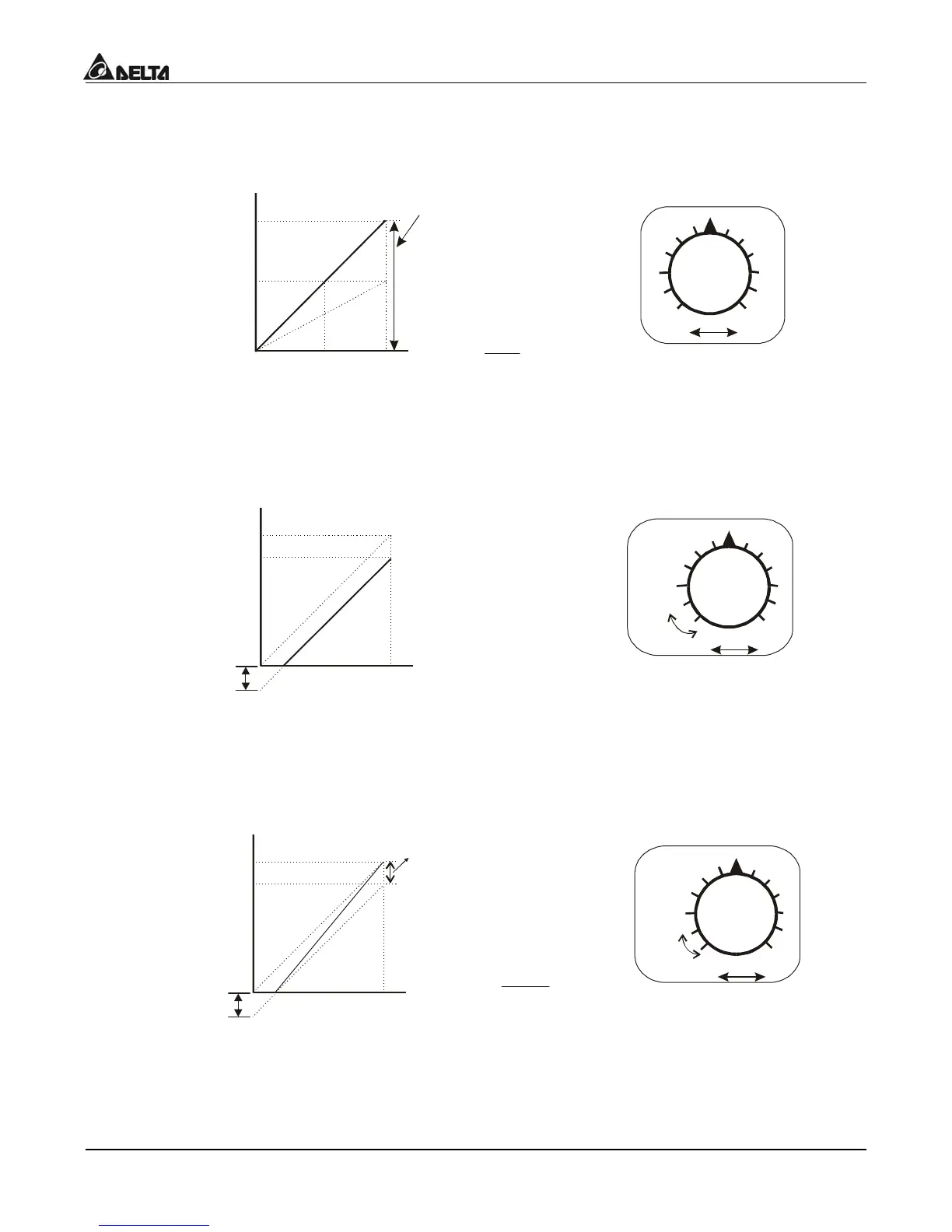
Example 4:
This example shows a potentiometer range of 0 to 5 Volts.
Pr.1-00=60Hz--Max. output Freq.
Pr.4-00=0Hz--Potentiometer bias freq.
Pr.4-01=0 -- bias polarity
Pr.4-02=200% -- pot. freq. gain
Pr.4-03=0 -- pot. REV motion enable
Example 5:
In this example a 1 volt negative bias is used. In a noise environment, it is advantageous to
use negative bias to provide a noise margin (1V in this example).
Pr.1-00=60Hz--Max. output Freq.
Pr.4-00=6Hz--Potentiometer bias freq.
Pr.4-01=1 -- bias polarity
Pr.4-02=100% -- pot. freq. gain
Pr.4-03=0 -- pot. Rev. motion enable
Example 6:
In this example, a negative bias is used to provide a noise margin. Also a potentiometer
frequency gain is used to allow the Maximum Output Frequency to be reached.
Pr.1-00=60Hz--Max. output Freq.
Pr.4-00=6Hz--Potentiometer bias freq.
Pr.4-01=1 -- bias polarity
Pr.4-02=110% -- pot. freq. gain
Pr.4-03=0 -- pot. Rev. motion enable


 To Next Page
 Loading...