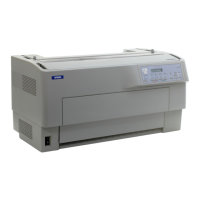
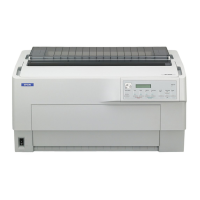
Epson DFX 9000 Revision B
Adjustment Software adjustment 238
5.3.2 APTC thickness detection adjustment
Summary
The rotation-center of the carriage shaft is offset at both ends to allow
the platen gap to be adjusted, and the eccentricity of the shaft is
approximately 1.0 mm. The precise amount of this offset varies
somewhat within allowable manufacturing tolerances, but this variation
increases as the platen gap increases: It becomes bigger with thicker
paper, compared to thinner paper, and affects the number of motor-steps
detected by the APTC sensor for a given paper thickness. This
adjustment is performed to compensate for the platen-gap variation of
each printer’s mechanism.
The table below shows the possible variation of the steps detected by the
APTC sensor.
Figure 5-20. APTC variance compensation adjustment
This adjustment is required after you remove or replace these parts:
PR MECHA ASSY
CARRIER UNIT
ROM BOARD (when the EEPROM Data Copy function fails)
Tools / materials: Adjustment Program
Paper: 1 sheet of 64 g/m
2
(17 lb)
10 sheets of 50 g/m
2
(13 lb)
APG Gauge Jig (P/N: 1422621)
APG PT Jig (P/N: 1422622)
C H E C K
P O I N T
Before performing this adjustment, make sure to perform
the TOF sensor sensitivity adjustment (p. 235).
Table 5-5. APTC sensor detected-steps variance
Paper Thickness
Motor-step range /
variance
1 Sheet, 64 g/m
2
(17 lb) 0.08 mm 14 - 15 steps / 1 step
10 Sheets, 50 g/m
2
(13.3 lb) 0.7 mm 119 - 127 steps / 8 steps


 To Next Page
 Loading...