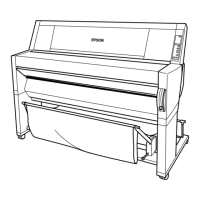
EPSON Stylus Pro 9000 Revision B
Operating Principles Description of Components 37
2.2 Description of Components
2.2.1 Carriage Mechanism
CR GUIDE RAIL
To print on paper as wide as B0 Wide, the printhead carriage must be more
stable and must travel further than the usual carriage. To make the printheads
more stable, EPSON added the CR Guide Rail to the SP 9000.
Every EPSON ink jet printer until now has used a carriage guide shaft to
stabilize the carriage during printing and horizontal movement. SP 9000 does
away with the carriage guide shaft and relies on the printer frame for its
stability.
The CR motor uses a DC motor to move the carriage, and the Linear Encoder
determines the lateral position of the carriage by counting the shaded areas of
the plastic Step Ruler (timing fence). See Figure 2-5 below. The Linear
Encoder reads the shaded stripes to determine the position of the carriage as
well as the carriage speed, and this data is sent to the software servo. To allow
for the extra distance the carriage must travel during printing, the rubber timing
belt has been changed to a belt made from steel.
The following sensors are used in combination with the CR Guide Rail
components:
HP Sensor
This optical sensor activates when the CR Guide Rail flag (flag) enters the
space between the light emitter and the light receiver. The flag is located
just above the home position, and the HP sensor sends an “On” signal
when the carriage is in the home position.
Linear Encoder
This sensor is located on the back of the carriage, lower than the HP
sensor. For every shaded section the Linear Encoder passes over, the LE
sends a pulse to the CR motor as a PTS (Print Timing Signal). The shaded
sections have a distance equal to 180 dpi, and the software controls use
this spacing for reference purposes.
Figure 2-5. Carriage Mechanism & CR Guide Rail
CR Guide Rail flag (projected
area)
Step Ruler
(plastic strip w/ shaded stripes)
Linear
Encoder
HP Sensor
Carriage
Carriage
HP signal
No HP signal


 To Next Page
 Loading...