57
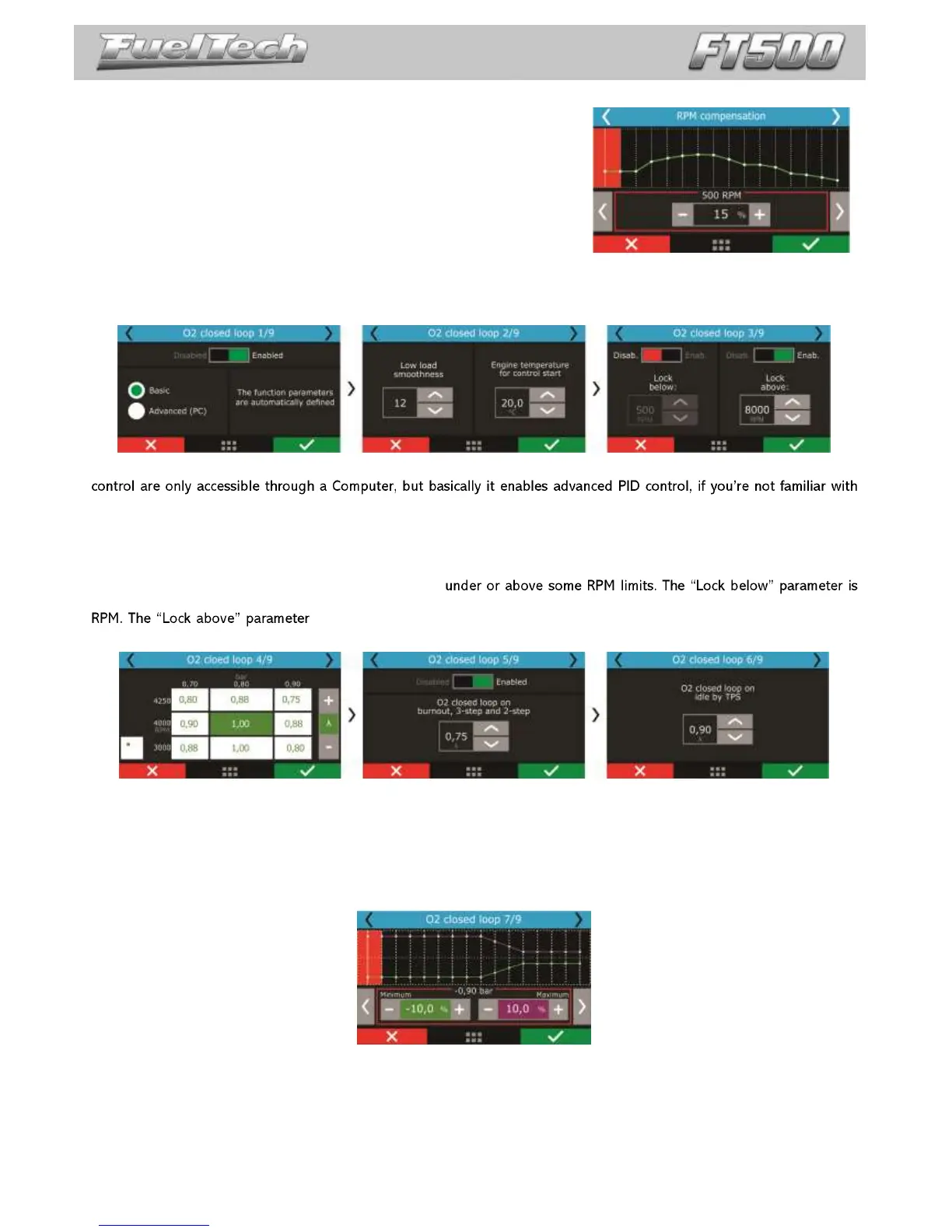
18.3 RPM compensation
This compensation is a percentage applied over the injection time
and is only available when the ECU is set up on the basic mode.
On the advanced mode, this RPM compensation is already included in
the 3D main fuel table.
It is very important to check data continuity, avoiding incoherent
values that may produce abrupt changes on the RPM graphic.
18.4 O2 Closed Loop
O2 closed loop reads O2 sensor and adds or removes fuel from the main fuel table in order to reach the O2
targets set up.
Basic mode enables basic control, usually performs very well on 99% of the cars. All the features of the advanced
these advanced programming, use Basic mode, it has very stable configurations that will surely suit your engine.
Low load smoothness is the speed control for low load situations like idle speed, where the O2 closed loop must
reduce the compensation for O2 variations.
Engine temperature for control start is a temperature limit below which the O2 closed loop stays disabled and
assumes the open loop fuel tables
It is also possible to block the O2 closed loop
used, i.e., on engines where the O2 sensor is installed too close to the end of the exhaust, reading free air below a certain
is a limit to disable the O2 closed loop and return to the open loop maps (Main fuel
table).
Next, is a 3D table of O2 closed loop targets versus RPM and MAP. It has up to 16x16 cells that can be edited
through the PC Software.
There is also an option to setup a different O2 target for burnout mode, 3-step and 2-step. This target is a fixed
value, no matter the RPM or MAP pressure.
The next screen (6/9) is only shown when the idle is TPS based. Set a target for idle condition (TPS=0%)
Control limits is a 16 points table, with fully configurable values, which defines the limits of action of the closed
loop control, thereby preventing the control of removing or add excess fuel as the user configuration.


 To Next Page