52
16.10 Gear detection
There are five different ways to perform the gear detection:
(1) By RPM drop (for drag race only does not require wheel speed sensor);
(2) By analog gear position sensor (only transmissions originally equipped with this sensor - does not
require wheel speed sensor);
(3) By interpolation of engine RPM versus wheel speed (wheel speed sensor is required);
(4) By pulses - an input, which will count each pulse received as an upshift (necessary to use an input
setup as Gear change detection does not require wheel speed sensor);
(5) By gear change output - internally counter that monitors the shifts performed by the Gear shift output
(Drag Race Features menu).
To view the currently
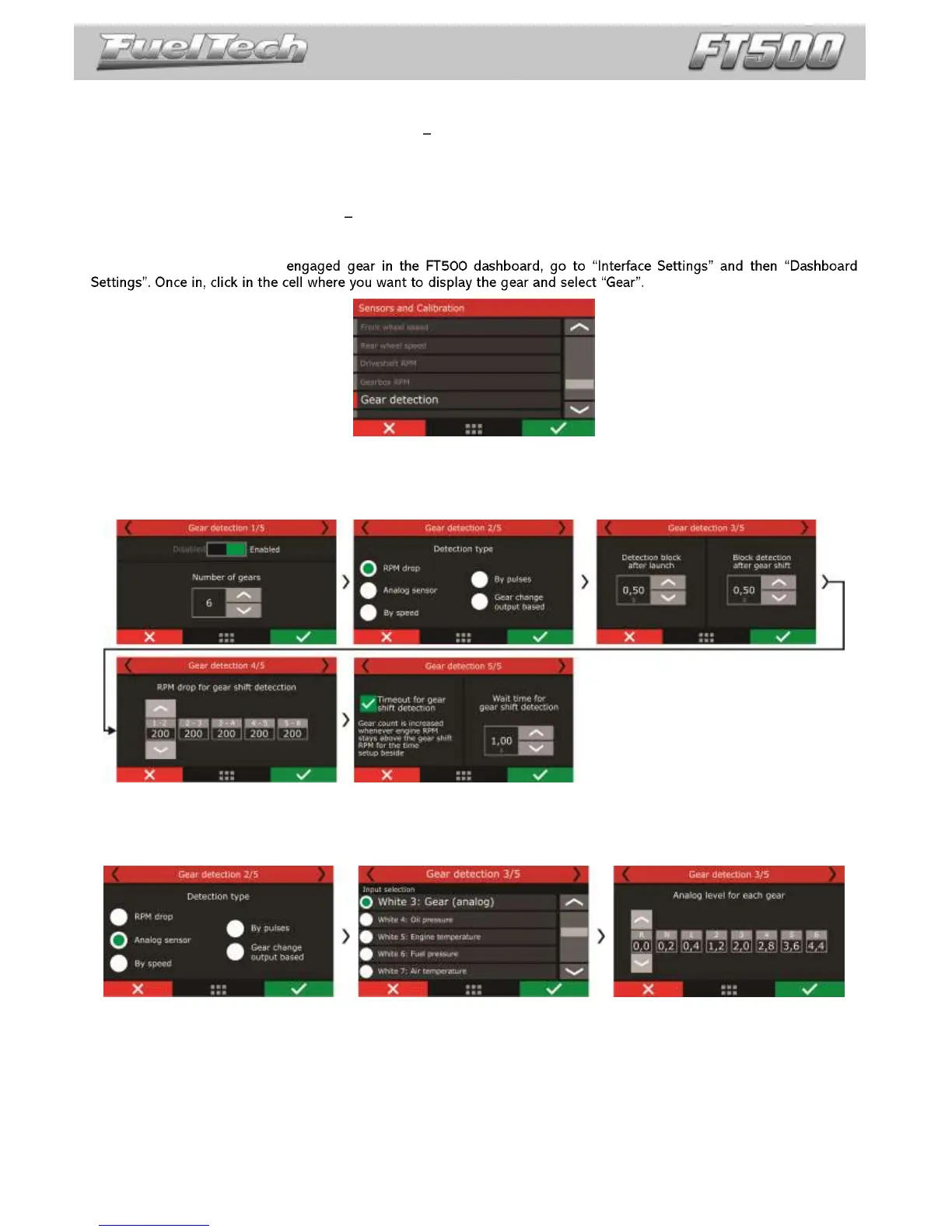
The first mode, by RPM drop, must be used only in drag race cars, since it can only detect upshifts and not
downshifts. The third screen is for safety configurations, used to prevent false gear detection due to traction loss. Default
values are good to most cases. The fourth screen is for the RPM drop programming to each gear. The fifth screen is to
enable and program the timeout for gear shift detection that is another safety feature to prevent false detection.
The second mode reads an analog gear position sensor, which is a potentiometer that indicates the engaged
gear in transmissions already equipped with this sensor. Select the input that will read the sensor signal and then
configure each gear voltage. To find the gear voltage, use a multimeter, in 20VDC scale, connected to the output of the
gear position sensor and engage a gear at a time.
The third mode crosses the wheel speed and RPM to calculate the engaged gear.
To configure, set the number of gears, gearbox ratio and differential ratio.
This detection mode will only show the engaged gear if the vehicle is moving and there is wheel speed reading.
When the clutch is pressed or the gear is disengaged (neutral) momentary misreading may occur.


 To Next Page