61
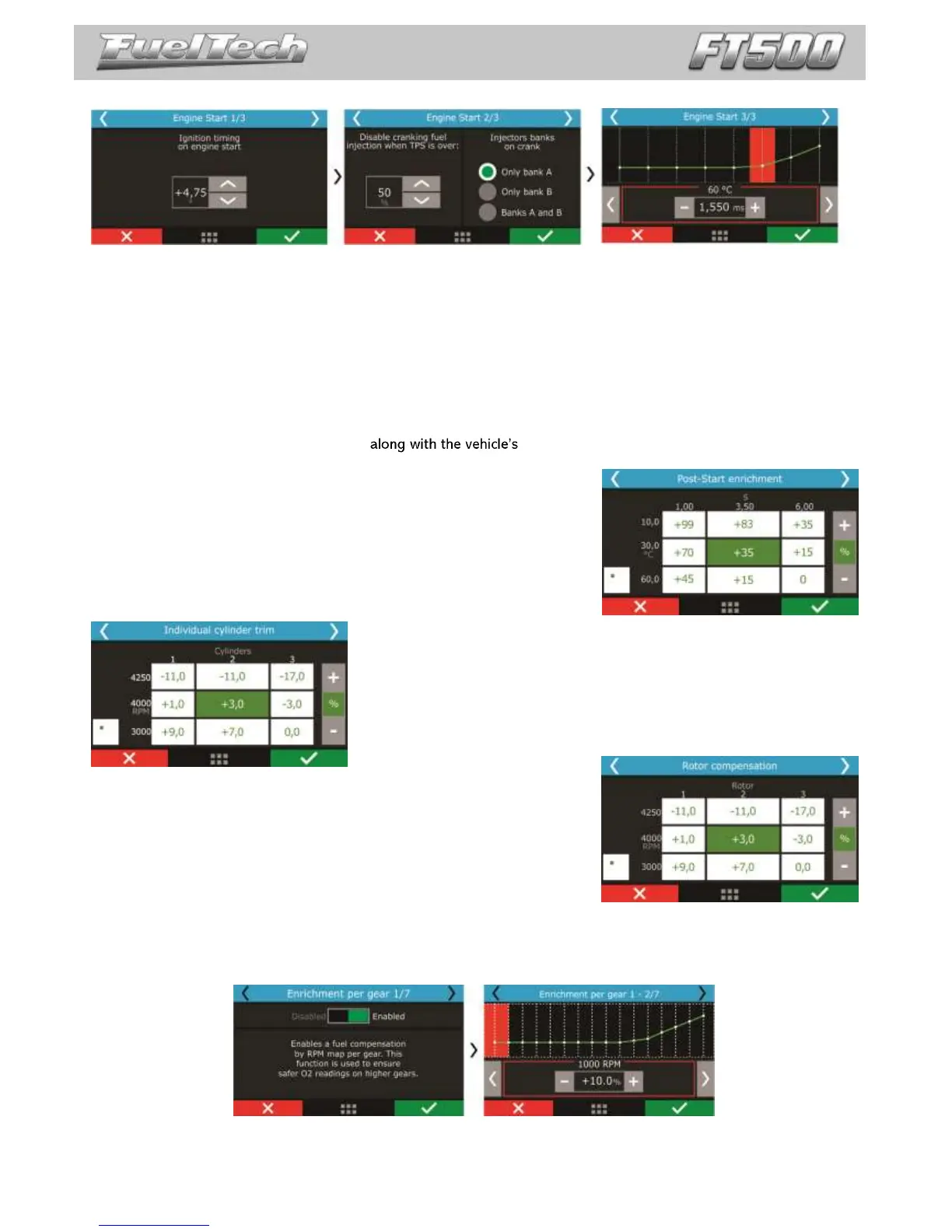
18.12 Engine start
This function is essential when starting the engine, as it needs a greater injection pulse to initiate its operation,
especially if the vehicle runs on ethanol or methanol. The amount of fuel necessary to start the engine also depends very
much on its temperature, as the colder it is, the more fuel is needed.
When cranking the engine at regular operation temperature, any excess of fuel can make it choke. By using 3
parameters in this function, it is possible to define perfectly the curve of the engine start injection based on engine
temperature.
Whenever the RPM drops below 400rpm, the ECU applies start injection pulses in addition to the idle speed
value. This excess of fuel prevents the engine from failing involuntarily, making it return to idle speed. Be careful not to
exaggerate on injection time, as it may cause the engine to stall/flood easily.
The engine must always be turned off through the injection system. Otherwise, if RPM drops below 600rpm and
injection is turned on, the system injects fuel that will not be burned and, therefore, will be accumulated on the cylinder.
For that reason, it is ideal to power the ECU ignition key/switch.
If the engine temperature sensor has not been installed, only the value from start injection with cold engine is
considered.
18.13 Post-start enrichment
This configuration is a table that relates engine temperature with time
in seconds. This parameter helps stabilizing engine RPM just after start,
improving the idle control especially under low temperature conditions.
18.14 Individual cylinder trim
Set a compensation to each injectors output on a table that relates
engine RPM with individual cylinder trim compensation. To use this
compensation as a cylinder trim, the injectors have to be wired with one
output per injector. This compensation usually brings expressive power gains
when correctly used, so, the use of one O2 sensor per cylinder is highly
recommended.
18.15 Rotor compensation
Available only when controlling rotary engines, this is an individual
rotor fuel trim. This compensation usually brings expressive power gains when
correctly used, so, the use of one O2 sensor per rotor is highly recommended.
18.16 Enrichment per gear
This option allows having a RPM based fuel compensation for each gear.
To enable this option, gear change detection must be enabled. It is possible to set up to 6 compensation tables
(6 gears).


 To Next Page