64
Cleaning
GBF-50 Fryer
5.01 Boil-Out Procedure, Cleaning the Cooking Vat - continued
Continued on Next Page
DO NOT allow a “rolling boil” ... It is not necessary to achieve cleaning action and overflow
could result, causing damage to the appliance and possible personal injury. Carefully
follow usage directions for the particular cleaner being used.
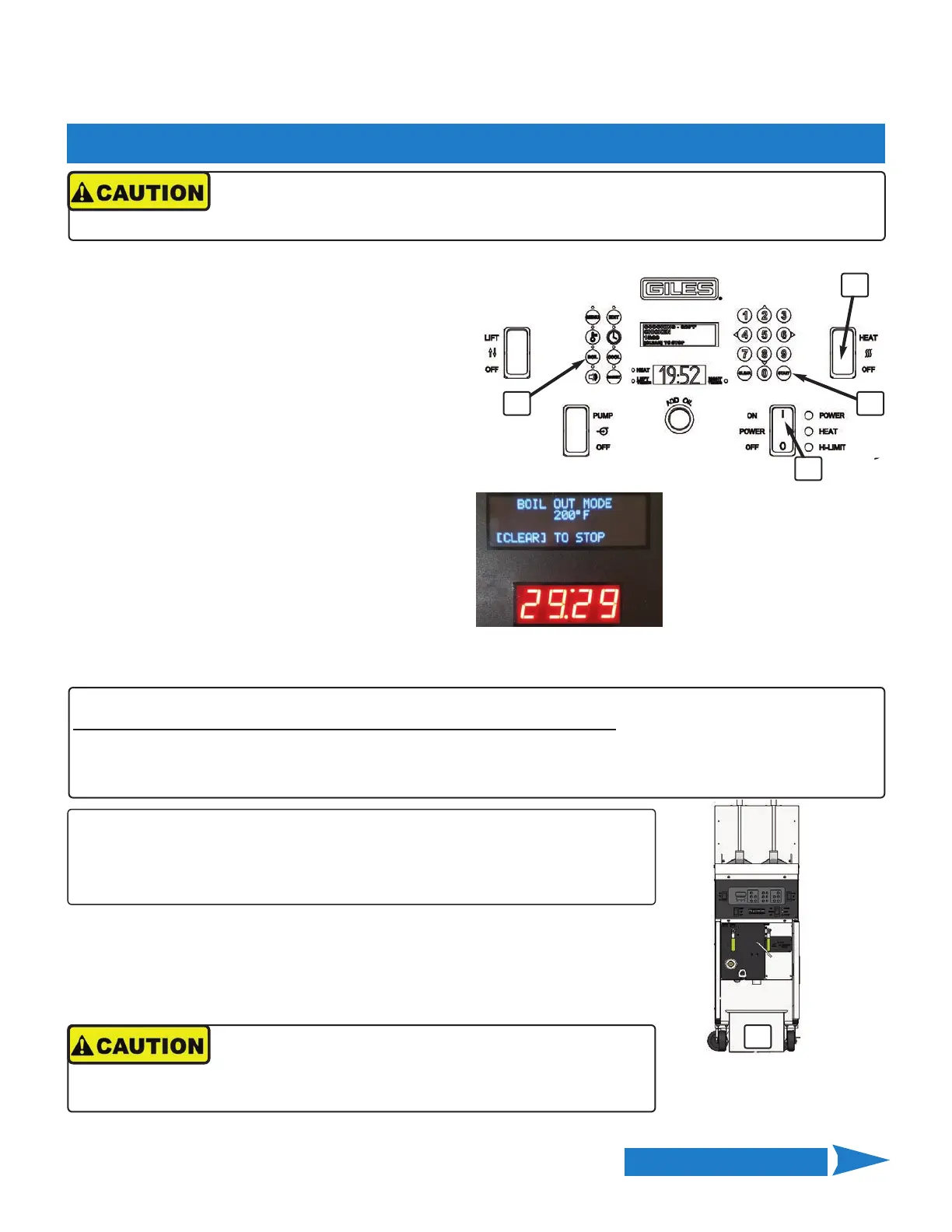
5. Place Power Switch ③ in [ON] position and Heat
Switch ④ in [HEAT] position.
6. After controller powers‐up and alarm sounds, press
[START] key ⑥ to enter PREHEAT mode ... control
panel amber HEAT light turns ON, cleaning solution
begins heating. Upper controller display reads
“PRESS [BOIL] ‐ GO TO BOIL‐OUT”. Press the [BOIL]
key ⑤ to place fryer into BOIL OUT mode. Temp
setting changes to 200°F (93°C) and timer begins
countdown from 30 mins. Allow the boil out cycle to
completely run.
Boil Out settings are factory‐preset, but can be
changed your preference in user settings, Section
4.01.8.
7. When boil out cycle time expires, controller issues
the “DONE COOKING” alarm.
8. Press the [ALARM] key ⑥ and place both Heat
Switch ④ and Power Switch ③ in [OFF] position.
9. Disconnect and remove Filter Pan from fryer.
3
4
5 6
To exit BOIL OUT MODE
before completion, press
[CLEAR] + [4]
NOTE:
As a safeguard, when the boil out cycle ends, the controller temperature setpoint
automatically changes to 50F. Before cooking activities can resume, a proper
cooking temperature setpoint must be entered in the controller.
IMPORTANT!!
DO NOT drain boil‐out solution into the filter pan or run through filter pump
! It is corrosive and can cause
damage to components. Equipment failures and/or malfunctions caused in this manner, will not typically be
covered by the factory warranty.
NOT THE FILTER PAN
7
10. Position a suitable heat resistant catch container ⑦ (not provided) beneath
the fryer drain. NOTE: Banked fryer systems have multiple drain tubes; be
certain container is positioned so that used boil‐out solution will properly
drain into it.
The catch container used must be heat resistant up to, at
least, 200°F (93°C) or higher. Plastic is generally not safe, as
it may soften and begin leaking ... a leak‐proof metal container should be used.
Failure to comply with this caution may result in personal injury.


 To Next Page