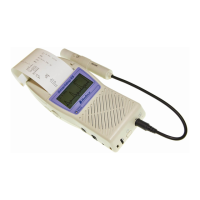
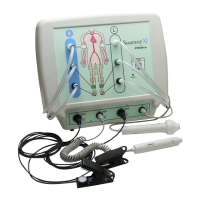
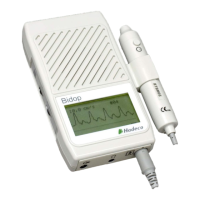
Smartdop
®
30EX Basic Operation
4. PPG TOE PRESSURES & TOE BRACHIAL INDEX (TBI)
Requires the optional PPG (Photoplethysmography) probe {PG-21}, supplied separately.
PPG (Photoplethysmography) toe pressure studies and related TBI’s (Toe Brachial Index) are
performed to assess the vascular condition of the foot by obtaining systolic pressures at the
toe. It employs the use of infrared energy rather than ultrasound. Toe pressures are useful in
cases of unsuspected vascular disease and in baseline diabetic foot assessment where falsely
high ankle pressures can occur due to calcication. Toe pressures are also useful in assessing
ulcer-healing potential in the diabetic foot.
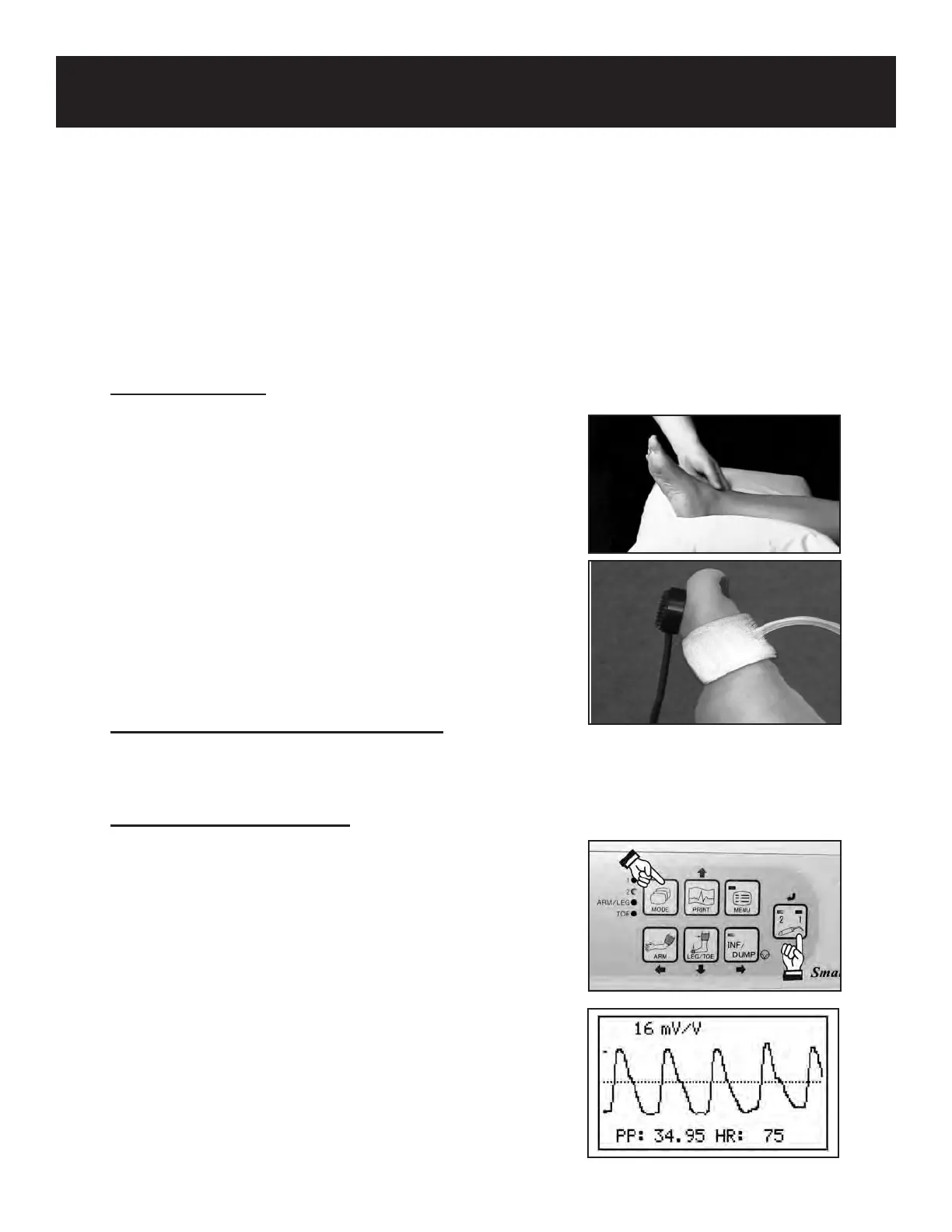
Prepare the Patient
1. Prepare the patient so that the toe is at the
same level as the heart. Make sure that the
room temperature is comfortable and that the
skin surface of the toe is warm. Cold constricts
supercial blood vessels and thus, may aect the
accuracy of PPG measurements.
2. Ax the PPG sensor with the clear side against
the skin surface using double-sided clear tape or a
PPG toe clip. Wrap a digit cu snugly around the
base of the patient’s toe.
3. Connect the Doppler probe to probe connector 1 on
the right side of the unit and the PPG probe to probe
connector 2 on the back. Turn the Doppler on.
Take a blood pressure reading at the arm
Follow the steps for taking a blood pressure reading at the arm as described in the instructions
for performing an Ankle Brachial Index.
Document the PPG waveform
1. Press the MODE button until the Mode 1 LED is lit.
2. Press the probe selection button to select probe 2
for the PPG probe.
3. The Smartdop
®
30EX automatically adjusts the gain
and the PPG waveform is shown on the LCD.
4. When the waveform becomes stable and rhyth-
mic, press the INF/DUMP button or probe button
(probe button function must be set to FREEZE or
FRZ&PRINT) to freeze the waveform. See 5-3-15
“OTHERS-PRB-KEY” for details.
5. If you would like to save the data in memory, see
5-3-8 “MEMORY - STORE” for details.
58


 To Next Page