EasyManua.ls Logo

Honda C65 - Battery Troubleshooting and Corrective Action

Honda C65
127 pages
Print Icon
To Next Page IconTo Next Page
To Previous Page IconTo Previous Page
Loading...
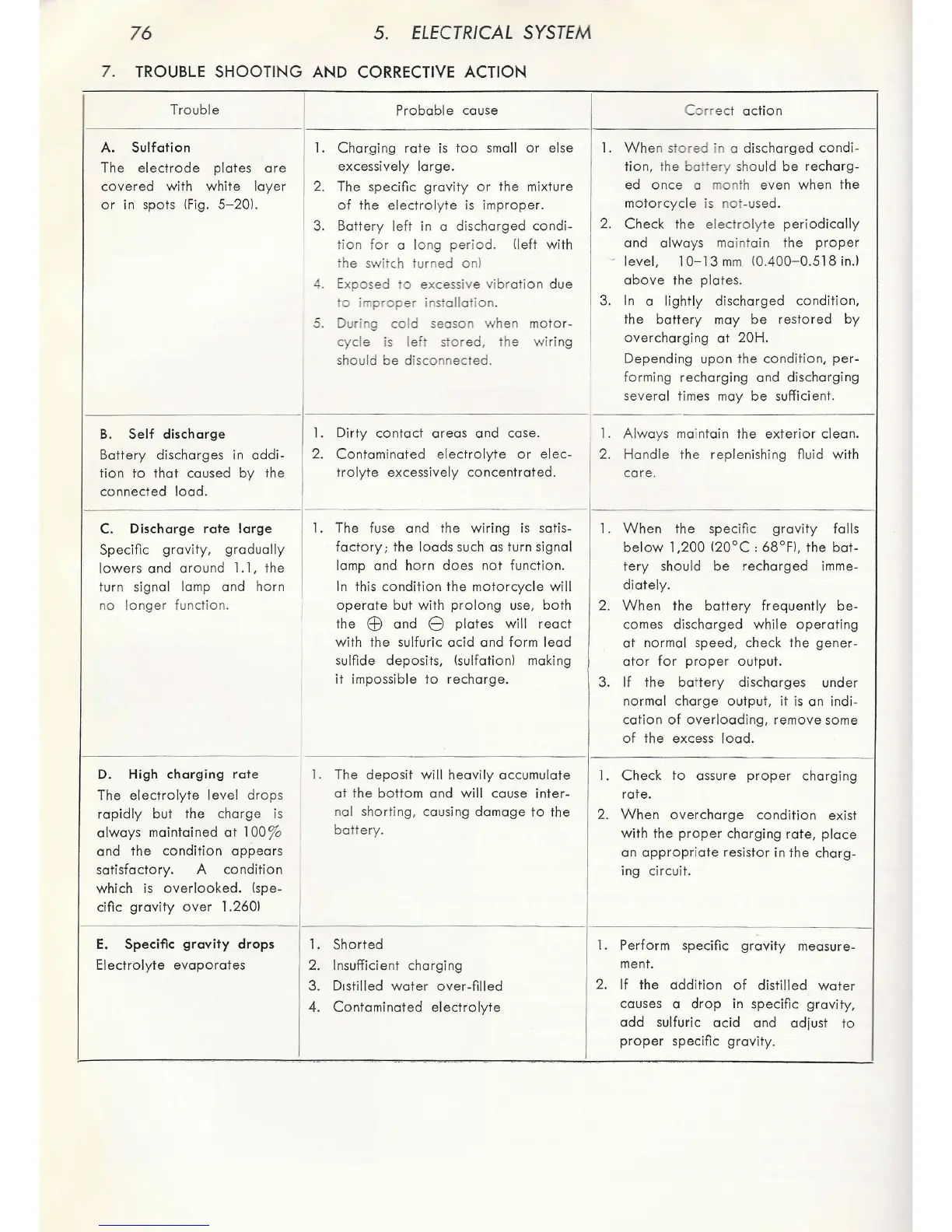
76
5.
ELECTRICAL
SYSTEM
7.
TROUBLE
SHOOTING
AND
CORRECTIVE
ACTION
Tro
ub
le
A.
Sulfation
The
elect
rod
e plates
are
covered
with
white
la
yer
or
in
spots !Fig.
5-20).
B.
Self
discharge
Battery
discharges
in
addi
-
tion
to
that
caused
by
the
connected
load.
C.
Discharge
rate
large
Specific
gravit
y,
gradually
lowers
and
ar
o und 1.1,
the
turn s
ignal
lamp and horn
no
long
er function.
D.
High
charging
rate
The
electrolyte
l
evel
dr
o ps
rapidl
y but the charge is
always
maintained
at
10
0 %
and
the
condition
appears
satisfactory.
A
condition
which
is
overlooked
. (spe-
cific
gravity
over
1.2601
E.
Specific
gravity
drops
Electrolyte
evaporates
Probable
cause
1.
Charging
ra
te
is
too
sm
all
or else
excessi
vely
la
rge.
2.
Th
e
specific
gravit
y or the mixture
of
the
elec
t
rolyte
is
improper
.
3.
Battery
l
eft
in
a d
ischarged
condi-
t
ion
f
or
a
long
pe
rio
d.
!left
with
the sw
it(h
turned
on
)
4. Exposed
to
excess
iv
e vi
br
at
i
on
due
to
im
pr
op
er
in
stalla
tion
.
5. Dur
in
g c
ol
d season
wh
en mot
or-
cy
cle
is le
fi
s
to
re
d,
the
wi
ring
should be di
sc
onn
ected.
1.
Dirty
contact
areas
and
case.
2.
Contaminated
el
ectrolyte
or
elec-
troly
te
excessively
concentra
ted.
1. The fuse
and
the
wiring
is satis-
fac
t
ory;
the
loads
such as turn signal
lamp
and
ho
rn
does
not
function.
In this
condi
t
ion
the
motor
c
ycle
will
operate
but w
ith
p
ro
l
ong
us
e,
both
the
EB
and
8
plates
wi
ll
react
wit
h
the
sulfuric
aci
d
and
form
lea
d
su
l
fide
deposits, lsulfati
onl
mak
in
g
it
impossible to
recharge
.
1. The
deposit
wil
l heavi
ly
accumulate
at the
bottom
and
wi
ll cause
inter-
nal sh
or
ting, causing
damage
to th e
ba
tt
ery.
1.
Shorted
2. Insufficient char
ging
3. Dtst
ill
ed
wate
r
ove
r-fill
ed
4.
Con
t
aminated
electrol
y
te
C
orr
ect
act
i
on
1.
Whe
n s
tor
ed
in
a dischar
ged
cond
i-
tion
, the
ba
tt
e
ry
should
be
rechar
g-
ed
o nce a month even
wh
en the
m
oto
rcycle is
not
-
us
ed.
2.
Check
the
elect
rol
yte
per
i
od
i
ca
lly
and
alw ays main
ta
in
the
proper
-
level,
10-13
mm (0
.400
- 0.518 in.l
above
the
plates.
3.
In a
lig
htly dischar
ge
d c
on
dition,
the
ba
t
ter
y may be rest
ored
by
overcharging
at
20H.
Depending
upon
the c
on
di
tio
n,
per
-
f
orm
ing
recharging
and discharging
se
v
era
l tim
es
may
be
sufficient.
1. Always maintain
the
exterio
r
clea
n.
2.
Ha
ndle the r eplenishing flu
id
with
care.
1. W hen the
speci
fic
grav
it
y falls
below
1,
200
1
20°C
: 68°FI,
the
ba
t-
tery should
be
r
echarged
i
mm
e-
di
ate
ly.
2.
When
the
ba
ttery fr
eque
ntly
be
-
comes disc
har
ged
wh
il
e
opera
ting
at
normal speed, check
the
ge
ne
r-
at
or
f
or
pr
oper
ou
tput.
3.
If the
ba
t
te
ry
discharges
un
der
normal char
ge
output, it
is
an
indi-
cat
ion
of
over
l
oading,
rem
ove
some
of
the
excess
load.
1.
Check
to assure
prope
r cha
rg
ing
rate
.
2. W hen
ove
rcharge
cond
it
io
n exi
st
with
the
pr
oper
charging
rate
,
place
an
appropr
iate resistor
in
the
charg-
ing circuit.
1.
Perform speci
fic
gravi
ty
meas
ur
e-
ment.
2.
If
the
add
it
ion
of distilled
wa
ter
causes a
dr
op in spe
cific
gravity,
add
sulfuric
ac
id
and adjust to
prope
r specific
gr
a
vi
ty.

Table of Contents

Related product manuals