
 Need help?
Do you have a question about the Johnson Controls LSWU035 and is the answer not in the manual?
Explains symbols used for warnings and important notes in the document.
Details how to remove mechanical restraints securing the supply fan during shipment.
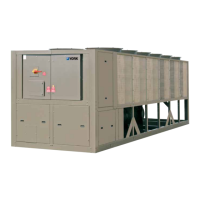
Provides dimensional data for the assembled top discharge LSWU units, 25-40 ton models.
Details requirements for field power wiring, including compliance with codes and proper conductor material.
Explains NEC requirements for locating and selecting the disconnect means for the unit.
Outlines formulas for calculating MCA and MOP based on NEC for proper electrical service sizing.
Describes standard and optional filters, their placement, and maintenance requirements.
Explains the purpose of crankcase heaters to prevent refrigerant migration and ensure proper compressor lubrication.
A comprehensive checklist of items to verify before starting the unit for installation and operation.
Covers oil level checks, analysis, and fan bearing lubrication procedures.
Step-by-step guide for replacing belts, emphasizing replacing them as a set.
Details when the supply fan turns ON/OFF in VAV mode and the conditions for supply fan lockout.
Explains how compressors are staged up/down to control Supply Air Temp, with interstage delay timers.
Describes the Copeland scroll compressor with digital unloading used in 25-60 ton units.
Details how the compressor unloads by allowing scrolls to separate, controlled by a duty cycle.
Describes the high pressure cutout device, its function, and reset mechanism.
Explains the external motor protector's role in monitoring compressor windings and its reset time.
Details how to reset compressor lockouts, especially for Low Press Sys faults.
Lists parameters required to enable economizer operation, including type and method.
Details the steps for the Morning Warm Up sequence, including temperature comparisons and setpoints.
Explains how Dew Point Reset changes Evaporator Leaving Air Temp based on underfloor air dew point.
Describes how Active Slab Control allows heat to turn ON during occupancy transitions if underfloor air temp is higher than slab temp.
Details the commissioning, monitoring, and troubleshooting functions of the User Interface.
Explains how to use data entry keys to input values for editable parameters.
Lists the available menu keys for accessing displays, programming parameters, and initiating commands.
Indicates high discharge temperature or shorted thermistor; includes restart delay and lockout conditions.
Indicates demand signal without compressor current, possibly due to overload or power loss; includes restart attempts.
Senses a locked rotor condition on four consecutive starts, leading to de-energization and lockout.
Indicates demand signal dropped below 0.5VDC, leading to compressor de-energization without lockout.
Complete unit shutdown requiring manual reset after fault correction.
Component shutdown requiring manual reset after fault correction.
Explains the function and installation of the duct pressure transducer for sensing static pressure.
 General
| Model | LSWU035 |
|---|---|
| Cooling Capacity | 35 tons |
| Refrigerant Type | R-410A |
| Compressor Type | Scroll |
| Category | Chiller |



 To Next Page
