Additional precautions for conditions of snow and ice
Considerable snow or ice may build up on the machine under low temperature conditions.
1.
There is danger of accidents caused by snow or ice falling off the machine.
Snow or ice falling from the towed machine can endanger following vehicles.
Problems with driving dynamics and damage to the machine could occur.
The maximum permissible axle load could be exceeded.
➤ Do not tow the machine if it is coated in snow or ice.
2. Remove any snow or ice before towing.
Observe / carry out the following before towing:
1. Make sure the towing hitch is compatible with the ball or eye coupling on the towed machine.
2. Check that the machine is shut down and secured against accidental restarting.
3. Detach all connecting lines and hoses.
4. Make sure there are no unsecured tools lying on or in the machine.
5. Close and lock the canopy.
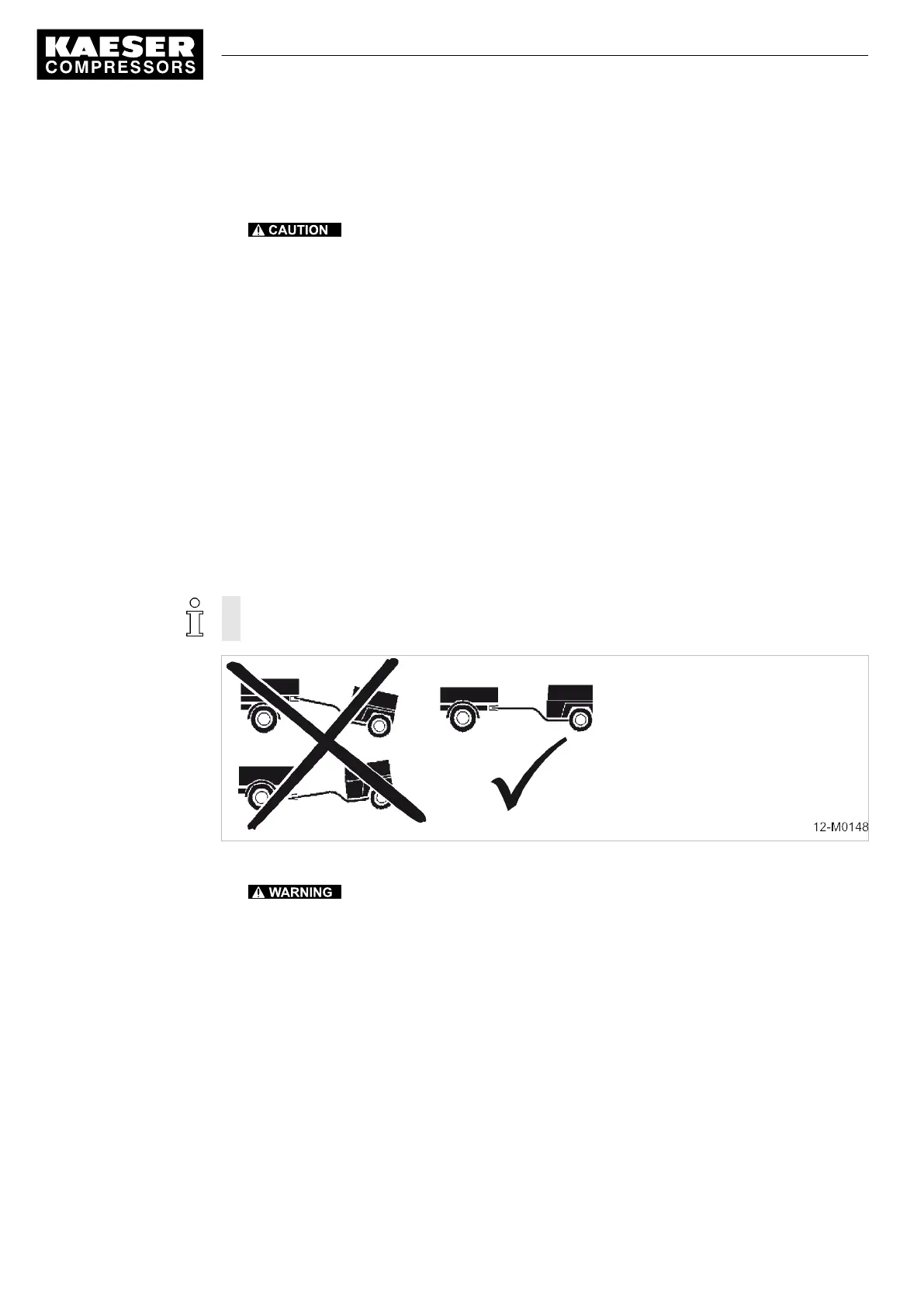
Adjust the towbar to suit the height of the towing vehicle hitch.
When the machine is coupled up, the towbar must be parallel with the ground.
See chapter 6.3 for the height adjustment.
Fig. 43 Towing alignment
1.
Unstable towing alignment.
Personal injury may result from towing.
Stability problems with the machine or towing vehicle.
Damage to the machine towbar or vehicle tow hitch.
➤ Do not couple up the machine at an angle to the towing vehicle.
➤ Ensure that the towbar is horizontal when coupled to the towing vehicle.
2. Adjust the towbar height to suit the height of the hitch on the towing vehicle.
Coupling-up
To couple up the compressor, lower the open coupling onto the ball hitch of the towing vehicle so
that it clicks into place. The coupling mechanism closes automatically. The coupling release lever
springs back to the horizontal position. The locking indicator shows green. If the locking indicator
does not show green, try pushing the release down to the horizontal.
12 Decommissioning, Storage and Transport
12.2 Transporting
168
SERVICE MANUAL Screw Compressor
M26
No.: 9_9446 01 USE


 To Next Page