Need help?
Do you have a question about the Kramer VS-211XS and is the answer not in the manual?
Initial setup, preparation, and tips for optimal device performance and cable usage.
Information on the disposal and recycling of Kramer Electronics products according to WEEE directive.
Highlights key features like Plug & Play, I-EDIDPro, HDMI signal support, and audio switching.
Details on Maestro's room control, remote device control, manual switching, audio de-embedding, and automation features.
Covers IP-based firmware upgrades, maintenance, and easy installation features.
Explains control options via DIP-switches, web pages, and serial commands.
Ideal for AV solutions in corporate/educational settings and small/medium meeting rooms.
Methods include front panel, Ethernet, touch panel, RS-232, and dry contact pins.
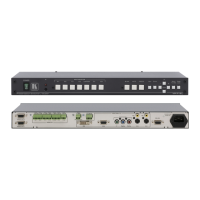
Detailed description and function of the front panel controls and indicators.
Guidance for rack mounting using adapters and surface mounting with feet or brackets.
Connecting HDMI sources, HDMI OUT, and audio outputs to the device.
Connecting remote control pins for input selection or Maestro triggers.
Pinout diagrams for connecting balanced and unbalanced stereo audio outputs.
Procedure for connecting the VS-411XS to a PC or controller using RS-232.
Details on manual, last-connected, and priority-based auto-switching modes.
Using front panel buttons and configuring DIP-switches for device operation.
Methods for finding the device's IP address via Ethernet, factory reset, router, or RS-232.
Procedure to reset the device and discover its IP address via the fallback IP address.
Methods to discover IP via router check or RS-232 commands.
Connecting to a network hub or switch using a straight-through cable.
Setting Ethernet parameters via the device's embedded web pages.
Manually selecting an input source via the web interface, overriding auto-switching.
How to adjust output volume and mute status using the web interface.
Accessing and modifying device settings like unit name, firmware version, and serial number.
Configuring remote contact closure pins for triggers.
Saving current settings to a file and loading saved configurations.
Steps to disable DHCP and configure static IP settings for the device.
Steps to re-enable DHCP for automatic IP address assignment.
Instructions for modifying the default TCP and UDP port numbers.
Steps to disable the web page security authentication.
Setting the color depth per input, either by following output or forcing 8-bit.
Selecting the audio source for de-embedded audio output, either forward or ARC.
Configuring HDCP support modes for inputs and outputs to manage HDCP protection.
Steps to enable or disable HDCP support for individual inputs.
Steps to configure the output HDCP support mode as Always On or Follow In.
Setting delays for auto-switching based on signal loss or cable unplugging.
Copying EDID data from an output or input to selected device inputs.
Reading EDID data from default source and copying to selected inputs.
Importing a custom EDID file and copying it to selected device inputs.
Configuring specific ports within Maestro to control room devices.
Choosing and configuring the panel model, including panel size and general properties.
Customizing panel background, grid, and buttons, including properties and appearance.
Adding new buttons and text fields to the Maestro control panel.
Default communication parameters and Maestro lists for control and automation.
Details default ports and actions for Maestro automation scenarios.
Explanation of Protocol 3000 command structure, parameters, and framing.
Detailed syntax, parameters, and examples for Protocol 3000 commands.
A list of error codes, their descriptions, and associated error numbers.
Details coverage, exclusions, duration, remedies, limitations of liability, and other conditions.
Default RS-232 and IP network settings, including fallback addresses and DHCP status.
Methods to perform a full factory reset via web pages or the reset button.
Lists default ports and their properties for Maestro control integration.
Details default actions and their commands for Maestro automation scenarios.
A list of error codes, their descriptions, and associated error numbers.
A list of error codes, their descriptions, and associated error numbers.
Details coverage, exclusions, duration, remedies, limitations of liability, and other conditions.


 To Next Page

 General