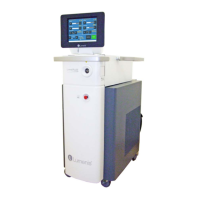
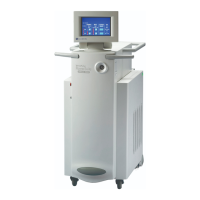
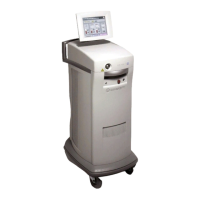
Selecta
PBL200051, Rev J
104 Professional Use Instructions
Photodisruptor Clinical Procedure and Parameters
Photodisruption—1064 nm Nd:YAG
The Selecta Nd:YAG 1064 nm treatment laser is intended for posterior
capsulotomy, posterior membranectomy, and other ophthalmic surgical
procedures such as iridotomy.
As in all surgery, there are risks involved and use of the laser may be
contraindicated for patients with certain pre-existing ocular pathologies.
Objective assessment of potential patients for these procedures must be done
in light of the risks.
General description of treatments
For optimal treatment, the objective is to use the minimum number of laser
shots to achieve the desired tissue effect or to obtain an adequate opening,
depending on the procedure. The initial energy should be set to the lowest
possible effective level. If the capsule is tough or scarred, higher energy levels
may be required, but the energy should be increased in small increments until
the optimum energy level is obtained. Once an opening has been established,
it is enlarged, as necessary, to the desired size.
Tissue effects
Unlike some commonly used ophthalmic lasers, such as argon, krypton or
ruby laser photocoagulators, which principally act on the chromophore of the
target tissue and which produce a primarily thermal effect, by contrast, the
Selecta 1064 nm wavelength acts principally on water in tissue and produces a
cutting or disrupting tissue effect. Therefore, the Selecta 1064 nm laser will
damage any tissue or structure on which the beam is focused. Care should be
taken to avoid inadvertently damaging nontarget tissue.
CAUTION - Care should be taken to focus the laser only on intended target
tissue. In addition, the surgeon should be aware of nontarget tissue that may be
beyond or near the target treatment area. Do not focus the laser on or near
iris blood vessels because the shock wave may produce bleeding and induce
astigmatism. The beam should never enter the eye at greater than 30° from the
visual axis.


 To Next Page