Version 1.9 Page 132 of 170
5.1.2 JUMP AND REACTION TEST
TCont. [s]: Contact times
TFlight [s]: Flight times
Height [cm or in]: Height of jumps calculated with the following formula
Power [W/kg]: Expressed power calculated with the following formula
g = gravity acceleration, T
f
= Flight Time, T
c
= Contact Time
Rhythm [p/sec]: Rhythm expressed in jumps (or steps) per second
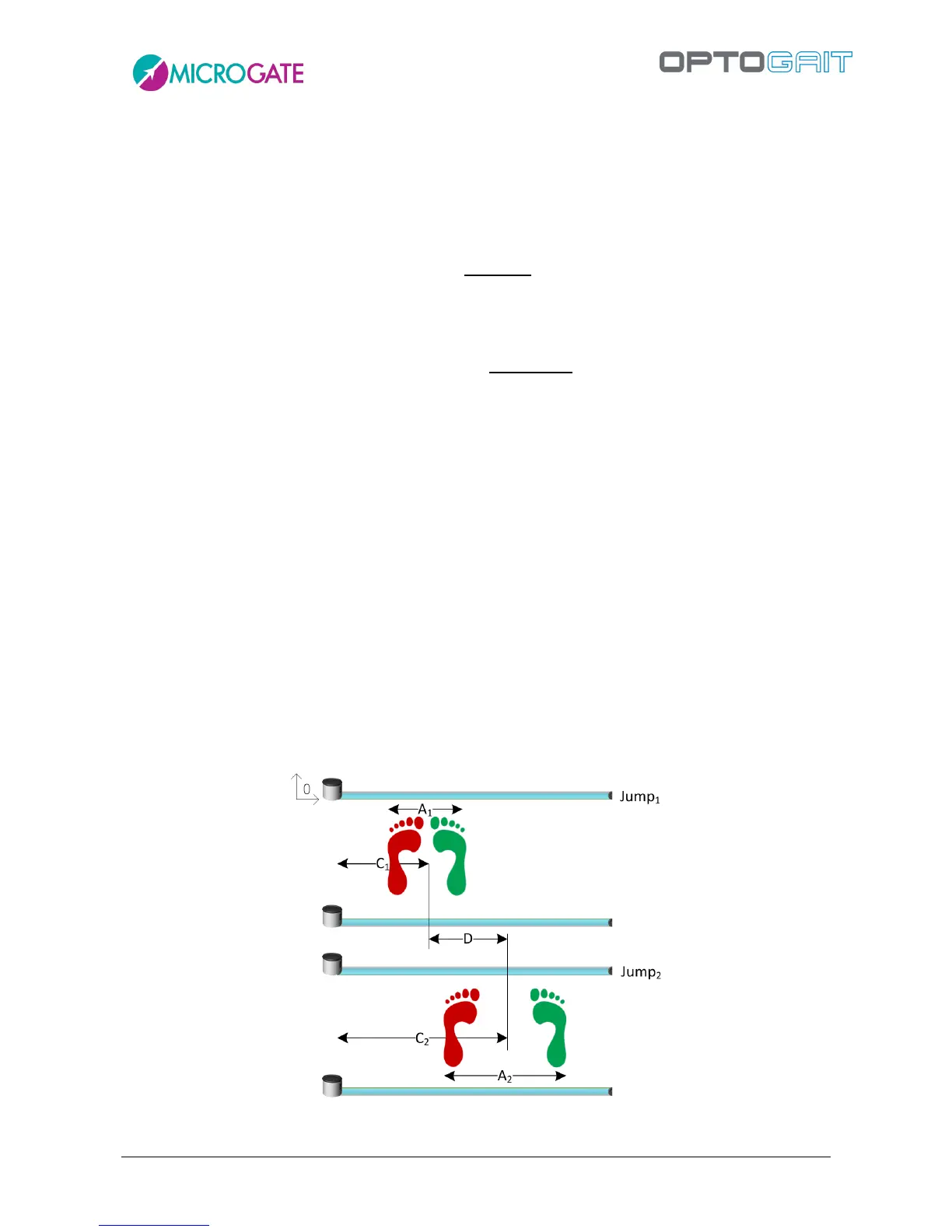
Jumping Point [cm]: This is the distance between the beginning of the bar (drum) and the
middle support point. In the case of jumps with both feet perpendicular to the bars, it will
show where the centre of gravity is.
Jumping Point Gap [cm]: Distance between the current centroid and the previous centroid,
i.e. how much the centroid is displaced with respect to the previous jump. A value = 0
indicates the perfect repeatability of a jump (useful mainly for one-leg jumps), negative
values indicate a displacement towards the drum (to the left for example), positive values
indicate displacements in the opposite direction (to the right in this figure); in jumps with
feet parallel to the bars indicate forward/back displacements.
User area [cm]: Difference in cm between the first and the last activated LED; indicates how
much the legs are apart.
Figure 108 –Jumping point (C), Jumping point Gap (D), and User Area (A)



 To Next Page